
Did you know that nearly 70% of people fail the Washington knowledge test on their first try? It’s a staggering number that can make even the most practiced drivers feel a surge of anxiety as they pull into the testing center. We understand that the pressure to perform is real; it's hard to stay calm when you’re trying to decode the difference between a minor two-point deduction and an automatic failure. Learning the common mistakes on wa driving test is the first step toward turning that nervous energy into genuine skill and confidence behind the wheel.
You deserve to feel empowered and ready, not confused by the digital scoring system or worried about "trick" questions on the written exam. We’re here to help you master the specific technical errors and high-stakes habits that often trip up Washington drivers. This guide provides a clear breakdown of the 2026 testing standards, from the strict ban on backup cameras to core maneuvers like backing around a corner. By the time you finish reading, you’ll know exactly how to protect your point total and head to your appointment with the quiet confidence of a seasoned professional.
Key Takeaways
- Learn how to navigate the 100-point scoring system, ensuring you understand the difference between minor technical deductions and critical errors.
- Uncover the specific figures and distances that trip up most students on the written exam, helping you avoid the most common mistakes on wa driving test knowledge sections.
- Master the high-point habits, such as consistent signaling and legal three-second stops, that keep your score safely above the passing threshold of 80.
- Identify the automatic failure triggers for 2026, including why even a minor speed increase in a school zone results in an immediate end to your test.
- Explore how a professional pre-test warm-up and skill assessment can help you shake off anxiety and prepare you for the specific road conditions in Seattle.
Understanding the Washington State Scoring System: Technical vs. Critical Errors
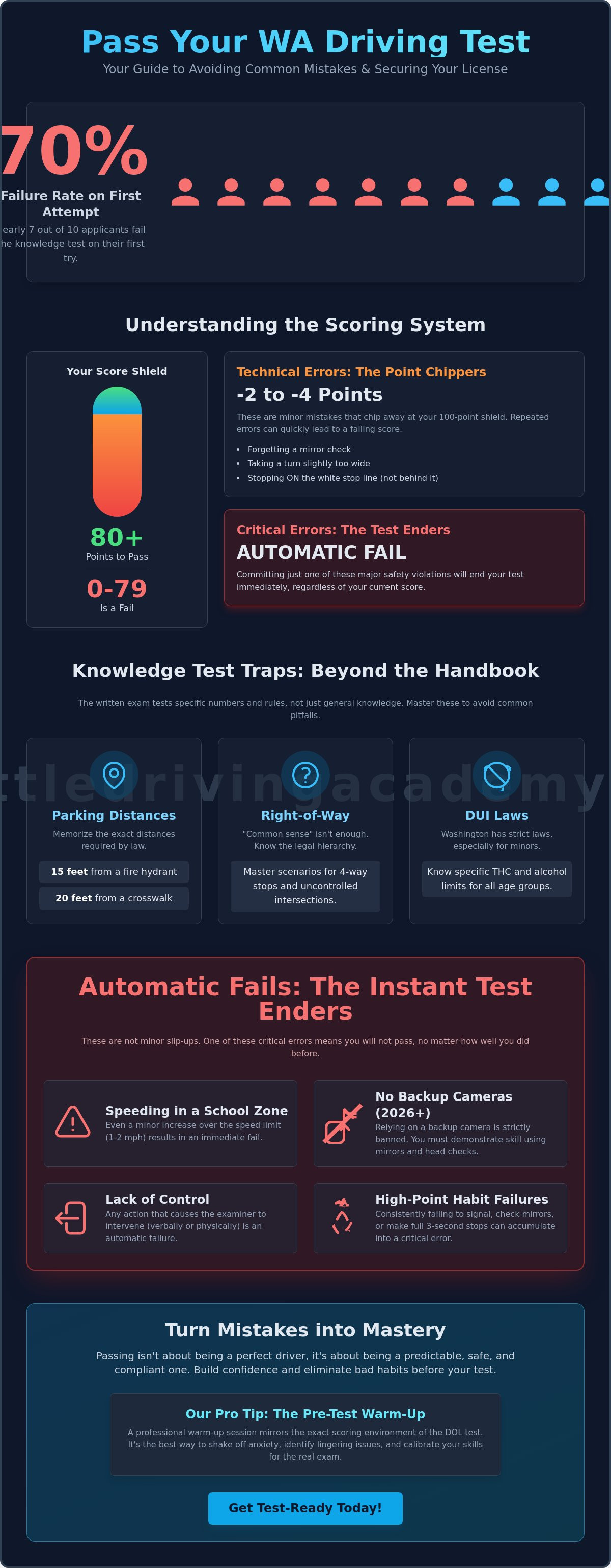
The Washington Department of Licensing (DOL) uses a specific, digital scoring system to evaluate your skills behind the wheel. It is a 100-point scale, and you must earn at least an 80 to walk away with your license. While that might sound like a generous margin, the points can disappear quickly if you aren't careful. Understanding the difference between a minor technical slip-up and a critical error is the best way to avoid common mistakes on wa driving test day. For a broader driving test overview, it's helpful to remember that most exams balance technical skill with safety awareness; however, Washington’s specific point system is uniquely structured to reward consistent, safe habits over "fancy" maneuvers.
Technical errors are minor deductions, usually costing you 2 to 4 points. These are the small things, like forgetting a mirror check or taking a turn slightly too wide. Critical errors, on the other hand, are automatic fails. If you commit one of these, the test ends immediately, regardless of how many points you had left. This explains why a "good" driver who is overly confident might fail on a single safety violation, while a more cautious, nervous driver might pass simply by staying within the technical rules. We want you to be the driver who combines both skill and compliance.
The Point Deduction Reality
Think of your 100 points as a shield that protects your passing score. Every small error chips away at it. For instance, stopping your front bumper on the white stop line instead of behind it is a common 2-point mistake. If you do this at every intersection, those points snowball. By the time you finish the course, those repeated minor errors can easily drop your score to a 79. Examiners look for consistency. They want to see that your safe habits are second nature, not just something you are trying to remember in the moment. It isn't about being a perfect driver, it's about being a predictable one.
The 80% Success Threshold
You don't have to be a professional racer to pass; you just need to be a compliant student of the road. The examiner isn't there to trick you or find reasons to fail you. They are objective observers tasked with ensuring you can operate a vehicle safely. We have seen many students overcome test anxiety by realizing the examiner is simply checking boxes on a digital tablet. To help you feel completely prepared, our pre-test warm up practice and driving skill test mirrors this exact scoring environment. It gives you a chance to identify any lingering bad habits and calibrate your internal safety clock before the real examiner hops in the car.
Common Pitfalls on the WA Knowledge Test: Beyond the Handbook
Many students view the written exam as a mere formality before the "real" challenge of the road. However, nearly 70% of test-takers fail the knowledge test on their first attempt. It's often a direct result of overconfidence. Skimming the Washington State Driver’s Handbook might feel productive, but it doesn't prepare you for the technical precision the DOL requires. Real mastery comes from active recall and understanding the common mistakes on wa driving test that catch people off guard. Instead of just reading, you need to challenge yourself to explain the rules in your own words. This shift in study habits transforms a stressful hurdle into a manageable step toward your license.
Tricky Topics That Trip Up Students
The DOL loves numbers. You won't just be asked about general safety; you'll be tested on specific distances and legal limits. Many commonly failed test questions revolve around parking distances, such as staying 15 feet away from fire hydrants or 20 feet from crosswalks. Another major pitfall involves Washington's strict DUI laws. Understanding the specific THC and alcohol limits for minors is crucial, as these laws are exceptionally strict. Right-of-way scenarios at four-way stops also frequently confuse students when they rely on "common sense" rather than the handbook’s specific hierarchy. These "number traps" are designed to ensure you truly know the law, not just the general vibe of driving.
Effective Prep with Practice Tests
Passive reading is the enemy of retention. To truly prepare, you need to simulate the testing environment. Taking a practice test helps you build the "test stamina" required to answer 40 questions with at least 80% accuracy. It reveals your weak spots before they cost you a fee at the licensing office. As of June 15, 2026, all testing locations have transitioned to electronic knowledge testing, so getting comfortable with a digital format is a smart move. Using a practice tool helps you avoid common mistakes on wa driving test day by familiarizing you with the DOL's specific phrasing. If you're feeling overwhelmed by the data, our Knowledge Test prep resources provide the supportive guidance you need to turn confusion into clarity. We treat our students like family, ensuring you have the tools to succeed on your very first try so you can move on to the fun part: driving.
High-Point Mistakes on the Road Test: Where Students Lose the Most Points
Transitioning from the written exam to the driver's seat brings a new level of excitement, but it also introduces the risk of high-point deductions. While a single minor error won't end your journey, certain habits can drain your score faster than you might realize. These are the common mistakes on wa driving test attempts that often surprise students because they feel like "normal" driving habits. In reality, the Washington DOL expects a level of technical precision that goes beyond just getting from point A to point B safely. It's about demonstrating that you respect the rules of the road every single time you move the steering wheel.
The 36-Point Turn Signal Trap
One of the most frequent ways students fail is by losing points incrementally for signaling errors. Some online guides mention that turn signals are "worth 36 points," but they often fail to explain that this isn't a one-time penalty. Instead, points are deducted for every single missed or late signal during lane changes, turns, and even when pulling away from a curb. If you forget to signal three or four times, you've already put your passing score of 80 in serious jeopardy. You must signal at least 100 feet before any maneuver. Even if the street looks empty, the examiner is watching for that habit. It's a mandatory test requirement that shows you are communicating with the world around you, not just reacting to it.
The 'Complete Stop' Definition
Stop signs are another area where points vanish quickly. A "California Roll" or a rolling stop is an instant deduction and, in some cases, can lead to an automatic failure if it's deemed a dangerous action. To satisfy the examiner, you need to come to a full, legal pause for at least three seconds. A great tip we share with our students is to wait until you feel that slight "jerk" or backward lean of the car as the momentum fully stops. You must also ensure you are stopped completely behind the white limit line. If you creep over that line before stopping, you're looking at a non-negotiable 2-point technicality. It might seem small, but these points are your safety net; don't let them slip away because of a lack of patience.
Beyond signals and stops, your observation skills are under a microscope. The SMOG technique is your best friend during lane changes:
- Signal: Give others plenty of warning.
- Mirrors: Check your rearview and side mirrors.
- Over-the-shoulder: Physically turn your head to check the blind spot.
- Go: Smoothly execute the change once it's safe.
Examiners are specifically looking for that physical head turn. Simply glancing at your mirrors isn't enough. Similarly, keep a close eye on your lane positioning. Drifting toward the center line or hugging the curb during a turn suggests a lack of vehicle control. By mastering these high-value habits, you transform from a nervous test-taker into a confident, capable driver ready for the road.
Automatic Fails: The Mistakes That End Your Test Instantly
While technical deductions are frustrating, automatic fails are the true heartbreakers of the road test. These mistakes end your session immediately, regardless of how well you performed during the rest of the exam. It can feel devastating to have your journey cut short; however, these rules exist to ensure that every driver on Washington roads is fundamentally safe. Understanding these "deal-breakers" is the ultimate way to avoid common mistakes on wa driving test day. By focusing on these critical areas, you transform your anxiety into a proactive plan for success.
The 'Dangerous Action' Umbrella
A "Dangerous Action" is a broad category examiners use when a driver's choice creates a hazard for themselves or others. It isn't just about avoiding a collision; it's about not forcing other people to react to your vehicle. For example, you must yield to any pedestrian who has even one foot in a crosswalk. If you merge into traffic so aggressively that another driver has to brake or swerve, the examiner will mark it as a failure. The most clear-cut sign that a test has gone off track is examiner intervention. If your instructor has to grab the steering wheel or use their dual-brake to maintain safety, the test concludes right then and there. We focus on building the defensive driving habits that ensure your examiner stays a silent observer rather than a participant.
Seattle Speed Traps and School Zones
In 2026, Washington maintains a strict zero-tolerance policy for school zones. Driving even 1 MPH over the 20 MPH limit in these areas results in an instant failure. Seattle is particularly dense with these zones, and our unique, hilly terrain makes speed control a genuine challenge. When you are descending a steep street, it is incredibly easy to let the car "creep" up past the limit without realizing it. You have to be proactive with your braking to stay compliant. Our Teen Complete Package students spend significant time practicing on these specific local routes, learning how to manage gravity on steep descents and identifying exactly where the school zone boundaries begin.
Traffic signals and parking maneuvers also carry high stakes. A common mistake on wa driving test attempts is trying to "beat" a yellow light. If the light turns red while any part of your vehicle is still in the intersection, it counts as disobeying a traffic signal. Similarly, while lightly bumping a curb during parallel parking is a point deduction, "jumping" the curb with a tire is an automatic fail. It's always better to take your time and be cautious than to rush and risk a critical error. By staying patient and mindful of these instant-fail triggers, you protect your hard work and move one step closer to your license.
Turning Mistakes into Mastery: Your Success Strategy
You have already learned about the technical pitfalls and the automatic fails that catch many drivers off guard. Now, it's time to bridge the gap between knowing the rules and executing them with total confidence. Success on the road isn't just about avoiding common mistakes on wa driving test day; it's about building muscle memory so that safe habits become second nature. We believe that every student has the potential to be a master of the road. With the right strategy and a bit of focused practice, that first-time pass is well within your reach.
The Power of Professional Feedback
While practicing with family is a wonderful way to log your required 50 hours, it often misses the technical nuances that examiners prioritize. Parents are excellent guides for general safety, but they might not notice the "point leaks" like improper lane positioning or slightly late signals. This is where an Individual Driving Lesson becomes your secret weapon. Think of it as a low-pressure mock test where a supportive mentor identifies exactly where you might be losing points. We focus intensely on the five core maneuvers that make up the bulk of the skills test: backing around a corner, parallel parking, hill parking, lane changes, and entering traffic. Mastering these specific skills ensures you aren't just driving; you're demonstrating the technical precision required by the state.
Final Test Day Readiness
Before you even turn the key at the testing center, your vehicle must pass a basic safety inspection. If your brake lights are out or your blinkers aren't crisp, your test could be canceled before it even starts. Create a simple checklist for your car: check the tires, ensure your mirrors are clean, and verify all lights are functional. On the morning of your exam, double-check that you have your instruction permit and current proof of insurance. Arriving with a positive, prepared mindset is just as important as having the right paperwork in hand.
Choosing to take your driver license driving test at an authorized driver license testing center like Seattle Driving Academy offers a level of comfort that a busy government office often lacks. We treat you with the care of a family member, providing a familiar environment that helps shake off those final nerves. If you're feeling a bit shaky, our pre-test warm up practice and driving skill test is designed to calibrate your senses. It's the perfect way to catch any common mistakes on wa driving test attempts before the official score counts. You have the skills and the knowledge; now, you just need to execute your strategy.
Schedule your road test or warm-up session with us today!
Step Into the Driver’s Seat with Confidence
The journey to your license doesn't have to be a guessing game where you're constantly worried about the common mistakes on wa driving test. By now, you understand that success comes down to more than just luck; it's about mastering the technical scoring system and avoiding those high-stakes automatic fails. Whether you're navigating a tricky school zone or perfecting your parallel park, you have the knowledge to protect your points and drive with precision. You've learned how to identify point leaks and why a professional perspective is the best way to polish your skills before the big day.
We are here to be your supportive partner every step of the way. As an Authorized WA DOL Testing Center, we offer specialized Adult Drivers Training 3 Hour Packages and a comprehensive Teen Complete Package with a structured curriculum designed for long-term safety. Our goal is to transform your test day from a high-stress milestone into an empowering victory. You've put in the work and studied the rules. Now, it's time to trust your training and unlock the freedom that comes with your new license. We can't wait to see you succeed on the road!
Book your Pre-Test Warm-Up and Road Test at Seattle Driving Academy
Frequently Asked Questions
How many points can I lose and still pass the WA driving test?
You must earn at least 80 out of 100 points to pass the Washington skills test. This means you can lose up to 20 points for minor technical errors before you fall below the passing threshold. However, keep in mind that certain critical mistakes result in an immediate failure regardless of your current score. It's best to focus on consistent habits like signaling and mirror checks to keep your point total high and your confidence steady.
Is hitting the curb an automatic fail on the Washington road test?
Bumping the curb is generally a point deduction, but jumping over the curb or striking it during specific maneuvers like backing around a corner is an automatic fail. This is one of the most common mistakes on wa driving test attempts. Examiners look for vehicle control and spatial awareness. If the car's momentum is stopped by the curb or a tire goes up onto the sidewalk, the test will end immediately for safety reasons.
What happens if I fail the Washington knowledge test the first time?
If you don't pass the knowledge test on your first try, you can retake it after paying the testing fee again. Don't feel discouraged, as nearly 70% of test-takers fail this portion initially. You'll need to wait at least one day before your next attempt. Use that time to revisit the Washington State Driver’s Handbook and focus on specific numbers like fines, distances, and legal limits that you might have missed.
Do I have to use my own car for the driving test in Seattle?
You are typically responsible for providing a safe, insured vehicle for your road test in Seattle. The car must pass a basic safety inspection, which includes working lights, turn signals, and tires with legal tread depth. If you don't have access to a vehicle that meets these standards, check with your chosen driver license testing center. Some locations provide a testing vehicle for an additional fee to ensure you're in a compliant and safe car.
What is a 'dangerous action' according to the WA DOL?
A dangerous action is any maneuver that forces another driver or pedestrian to take evasive action to avoid a collision. This includes merging too closely, failing to yield the right-of-way, or making an unsafe lane change. If the examiner has to intervene verbally or physically to prevent a hazard, it is classified as a dangerous action. These errors are automatic fails because they indicate a lack of safe driving judgment in real-world traffic.
How long do I have to wait to retake the test if I fail?
You typically have to wait one week before retaking the driving test if you fail your first attempt. This waiting period is designed to give you enough time to practice the skills that caused the initial failure. If you fail a second time, the wait is usually another week. For a third failure, the wait extends to three weeks. We recommend using this time for an individual driving lesson to identify and correct any lingering bad habits.
Are there trick questions on the Washington State Knowledge Test?
There aren't "trick" questions, but the exam is very specific about technical details that students often overlook. You will be tested on exact numbers, such as how many feet you must park from a fire hydrant or the legal alcohol limit for minors. These common mistakes on wa driving test written portions usually happen when students rely on general knowledge instead of the specific data and laws found in the official handbook.
Does the examiner talk to you during the driving test?
The examiner will only speak to you to provide directions, give safety instructions, or explain specific maneuvers you need to perform. They won't engage in small talk because they need to focus entirely on your driving performance and the safety of the road. While the silence can feel intimidating, try to view it as a sign of their professional focus. They are there to objectively observe your skills and ensure you are ready for the road.


