

What if staying calm in Seattle traffic starts before the car in front of you hits the brakes? If you’re learning how to handle seattle traffic for new drivers, it’s understandable to feel unsure about lane changes, quick turns, rain, and busy intersections. Seattle’s congestion is real: INRIX’s 2025 Global Traffic Scorecard ranked the city 10th worst in the United States for traffic.
The key is to anticipate, not react. With a little planning and practice, unfamiliar streets become easier to read, and you can make lane and intersection decisions with more confidence. You don’t have to master everything at once.
This guide covers practical ways to spot traffic changes early, choose lanes calmly, and account for pedestrians, buses, hills, and wet-road visibility. You’ll also learn how to approach busy intersections and build experience through guided local practice, one skill at a time.
Key Takeaways
- Learn how to handle seattle traffic for new drivers by watching for route changes and making decisions early instead of rushing at the last moment.
- In rain or reduced visibility, leave more space ahead and use gentle steering, braking, and acceleration.
- At intersections, lane changes, and merges, check signs and signals, scan for people, then choose a safe move.
- Build experience gradually, moving from familiar, quieter streets to more complex routes while focusing on one skill each drive.
- Individual driving lessons and pre-test warm-up practice can help you work on real traffic decisions with guidance.
Why Seattle Traffic Can Feel Challenging for New Drivers
A first drive through a busy Seattle corridor can require you to process signs, lane markings, nearby vehicles, and an upcoming turn all at once. That can feel demanding when the road network is unfamiliar. The goal isn’t to keep pace with the most assertive driver. It’s to make safe, lawful, predictable choices while giving yourself time to understand what’s ahead.
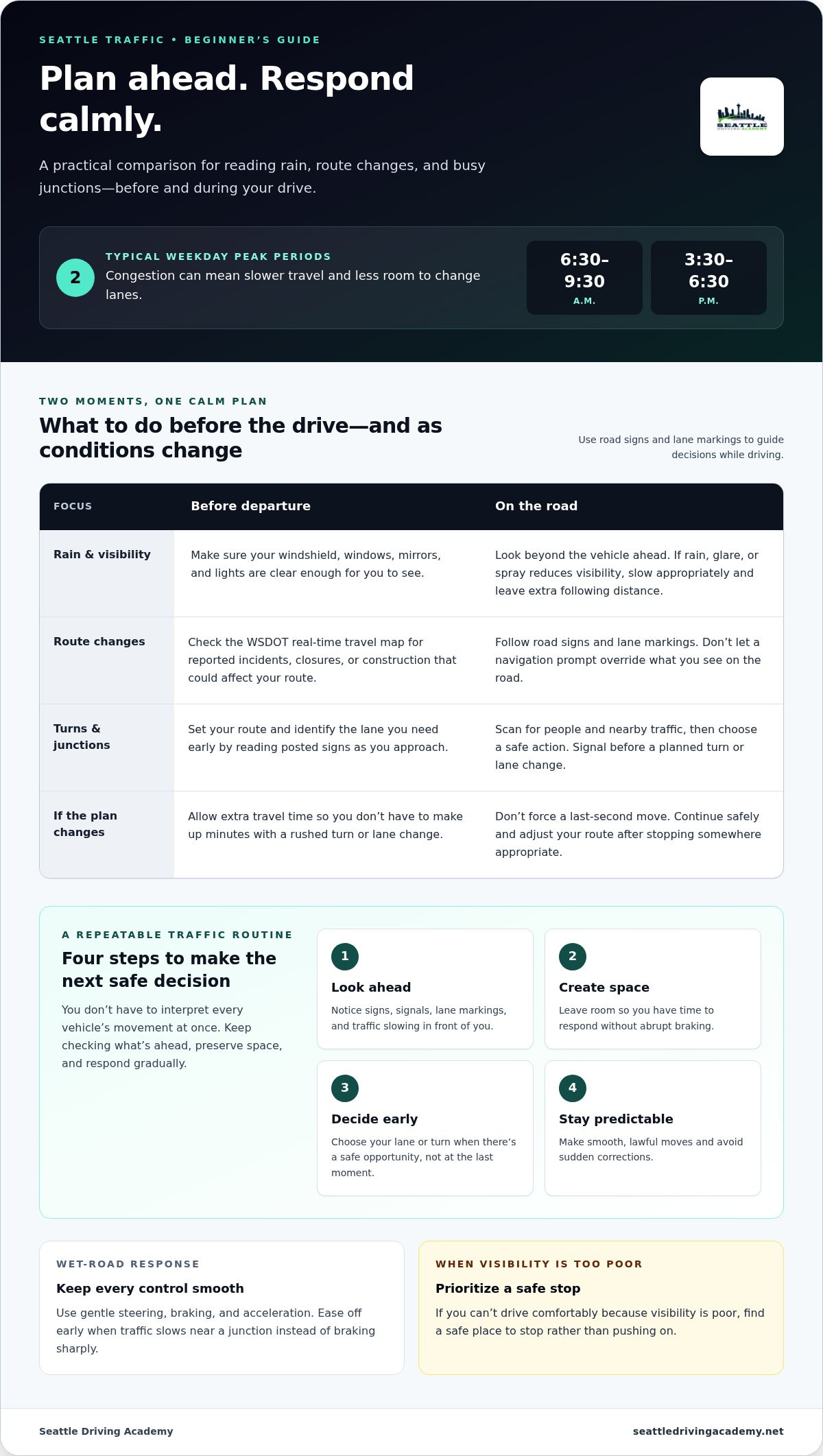
Traffic changes the rhythm of a route. Seattle’s typical weekday peak periods are 6:30 to 9:30 a.m. and 3:30 to 6:30 p.m., when congestion can mean slower travel and less room to change lanes. Construction, blocked lanes, and busy junctions can also alter a familiar trip. The general causes and effects of congestion are outlined in Understanding Traffic Congestion. On the road, keep your focus on the next steps: look ahead, create space, decide early, and avoid rushed moves.
What makes Seattle driving feel different?
Some Seattle streets require you to plan a turn or lane choice before you reach the junction. If you’re new to the area, reading signs, tracking traffic, and positioning the car can be a lot to manage at once. Downtown, buses and other transit vehicles, cyclists, and pedestrians add more movement to scan for, especially near stops and crossings.
Conditions vary with the time, route, construction, and local events. A street that feels straightforward on a quiet drive may be slower or busier during a commute or event. You don’t need to predict every delay; leave room in your plan for conditions to change.
A beginner’s mindset for busy roads
Allow extra travel time instead of trying to make up minutes with a sudden lane change or hurried turn. Focus on the next safe decision, not every brake light or delay in the distance. If you miss a turn, keep driving predictably and choose a safe place to stop before checking directions or selecting a new route.
Traffic confidence isn’t about driving faster or never hesitating. It grows as you recognize what’s happening, leave yourself options, and act calmly. Use this routine:
- Look ahead: Notice signs, signals, lane markings, and traffic slowing in front of you.
- Create space: Leave room so you have time to respond without abrupt braking.
- Decide early: Choose your lane or turn when you have a safe opportunity, not at the last moment.
- Stay predictable: Make smooth, lawful moves and avoid sudden corrections.
It’s fine to take a quieter route while you’re learning. Each calm decision helps prepare you for more complex Seattle streets.
How to Read Seattle Traffic, Rain, and Road Conditions
Rain affects visibility and can make it harder to judge the road. Spray from nearby vehicles may obscure lane markings, while wet pavement can make stopping distance harder to estimate. Adjust to the conditions instead of relying on your usual rhythm, and give yourself more time and space to respond. That’s a practical part of how to handle seattle traffic for new drivers.
Adjusting your driving when Seattle streets are wet
Before setting out, make sure your windshield, windows, mirrors, and lights are clear enough for you to see. While driving, look beyond the vehicle directly in front of you. If rain, glare, or spray makes it harder to see, slow appropriately for the conditions and leave extra following distance. The added space gives you time to brake gently instead of reacting at the last moment.
Keep steering, braking, and acceleration smooth. If traffic begins slowing near a junction, ease off early rather than braking sharply. When you need to change direction, make a gradual, controlled move only when there’s a safe opportunity. If visibility becomes too poor to drive comfortably, prioritize finding a safe place to stop rather than pushing on.
Reading route changes and traffic flow
Before departure, check current conditions using official traffic information such as the WSDOT real-time travel map. Look for reported incidents, closures, or construction that could affect your route. A map can help you plan, but road signs and lane markings guide your decisions while driving. Don’t let a navigation prompt override what you see on the road.
Once underway, scan in layers. Look ahead for signs, signals, and lane markings, then check nearby traffic and movement around crossings. If an unexpected closure or turn appears, don’t force a last-second lane change. Continue safely and adjust your route when you can do so without distraction.
- Before moving: Set your route and check for reported delays or closures.
- As you approach a junction: Read posted signs and identify the lane you need early.
- If the plan changes: Stay in a safe lane and reroute after you’ve stopped somewhere appropriate.
These habits make traffic information easier to act on. You don’t need to interpret every vehicle’s movement at once. Keep checking what’s ahead, preserve a comfortable gap, and respond gradually. For guided practice applying these decisions on Seattle roads, individual driving lessons can help.
How to Handle Seattle Intersections, Lane Changes, and Merges
Busy junctions ask you to notice several things at once. Use a repeatable sequence: observe signs and signals, scan for people and nearby vehicles, then choose a safe action. Give yourself time to take in the full scene before moving. That’s more useful than trying to copy another driver’s timing.
Predictability matters. Signaling before a planned turn or lane change gives others a clearer cue about what you intend to do. Pair the signal with adequate space and a deliberate move. A signal doesn’t make an unsafe opening safe. For Washington-specific right-of-way requirements, rely on current state guidance, especially at unfamiliar intersections.
Approaching busy intersections and crosswalks
As you approach, check the signal and posted signs, then scan crosswalks and nearby sidewalks for pedestrians and cyclists. Look for vehicles that may be turning or crossing your path. Give people time and space, and don’t enter an intersection if you can’t proceed safely. At an unfamiliar multi-way stop, slow down, read each sign, and follow the applicable right-of-way rules instead of guessing.
Changing lanes and joining faster-moving traffic
For a lane change, check your mirrors, look over your shoulder to check the blind spot, signal, and move only when there’s a safe opening. When merging, use the available space and match the flow of traffic when conditions permit, without forcing another driver to brake. If the opening closes, don’t swerve or rush into it. Continue safely and reassess.
Use this comparison to focus on the decision in front of you:
| Situation | What to watch | What to do |
|---|---|---|
| Intersection | Signals, signs, crosswalks, cyclists, and crossing or turning vehicles | Pause long enough to assess the scene, then proceed only when it’s safe and appropriate. |
| Lane change | Mirrors, blind spots, lane markings, and the gap beside you | Signal and move smoothly only when there’s enough space. |
| Merge | Traffic speed, available roadway, and the space ahead | Adjust smoothly when possible; if the opening disappears, stay controlled and reassess. |
The sequence is simple: observe, scan, signal if you plan to move, then act only when the space and conditions allow. If you’re approaching a turn lane and see a cyclist alongside you, wait for a safe opportunity rather than cutting across their path. If a merging lane feels crowded, stay composed instead of forcing your way in.
These small decisions are central to how to handle seattle traffic for new drivers. You don’t need to hurry to prove you belong on the road. A clear signal, a careful scan, and a predictable choice help others understand your intentions.
A Practical Seattle Driving Practice Plan for Beginners
Confidence grows through repeatable practice, not by tackling the busiest route on your first outing. Choose a route that leaves room to focus, then give each drive one goal, such as reading signs early or holding a steady lane position. Move on when those decisions feel consistent, keeping conditions and supervision appropriate for your experience.
Build skills gradually on Seattle roads
Start somewhere familiar and relatively quiet, where you can practise noticing signs, signals, and lane markings without managing too many demands at once. Then add complexity in small steps:
- Repeat a familiar route: Focus on scanning ahead and recognizing signs and signals before you reach them.
- Add simple turns: Practise choosing a lane early and making calm turns on streets you know.
- Try a busier arterial: Once basic choices feel steady, practise tracking traffic and preparing for a turn with more activity around you.
- Introduce a complex junction: Choose one you can approach with enough time to read signs and plan, rather than combining several new challenges at once.
Don’t make peak congestion the first test of a new skill. Practise in varied weather only when conditions and supervision make it appropriate. If a route feels too demanding, return to a familiar one and build from there.
Prepare for a drive before leaving
Set your destination and route before the car moves, and allow flexible travel time so you won’t feel pressured by a delay. Think through a safe alternative in case you miss a turn; continue safely and reroute once stopped. Keep your attention on the road rather than operating a phone. Preparation makes it easier to focus on the skill you chose to practise.
Afterward, review the drive. Name one thing that felt stronger and one specific skill to work on next time. You might feel more comfortable reading lane markings but want to practise calm turns again. Keep the next goal small and clear. This steady review helps you learn how to handle seattle traffic for new drivers without expecting perfection right away.
For guidance practising real Seattle traffic decisions, schedule an individual driving lesson.
When Seattle Driving Lessons Can Help You Build Traffic Confidence
Reading about traffic skills gives you a plan, but applying them at a busy intersection or during a lane change can feel different from practising in a quiet setting. An instructor can guide you through specific decisions, help you identify where you feel uncertain, and give you a chance to work on those skills in real driving situations. The goal is focused practice, not a promise of a particular result.
Seattle Driving Academy provides driver education for teens and adults, individual driving lessons, and pre-test warm-up practice. If you’re an adult returning to driving or starting out, this adult driving lessons guide offers more context about learning as an adult.
What focused driving practice can work on
A lesson can focus on the decisions that feel most demanding to you, such as scanning an intersection, judging a safe opening for a lane change, or choosing a lane before a turn. With guidance, you can talk through what you’re noticing and revisit a situation that felt rushed instead of trying to work on every skill at once.
Name a goal before practice begins. You might concentrate on checking mirrors and blind spots consistently, or on spotting signs early enough to position calmly. If you’re preparing for a driving test, pre-test warm-up practice gives you a chance to review your driving skills. For information about testing, see the Seattle driving test center guide.
Choose a supportive next step
Your priorities depend on your experience. A teen learning foundational skills, an adult beginner building experience, and a licensed driver who wants more practice may each need a different focus. Consider what would make everyday driving feel more manageable, then use that goal to guide instruction or practice.
- For a teen learner: Driver education can support structured learning as driving skills develop.
- For an adult beginner: Individual lessons can provide a focused setting to work on specific traffic decisions.
- For a test candidate: Pre-test warm-up practice can help you review skills before the driving skill test.
Be specific about what you want to practise, such as merging, reading signs, or navigating a familiar route that gets busier at certain times. That gives instruction a practical focus and makes it easier to reflect on what you learned. If you’re exploring how to handle seattle traffic for new drivers, Seattle Driving Academy’s teen and adult training, individual lessons, and pre-test warm-up practice offer ways to build experience, one decision at a time.
Make Your Next Drive a Step Forward
Confidence doesn’t arrive all at once. It grows each time you turn a traffic challenge into a chance to practise, reflect, and try again. Choose one skill to focus on for your next drive, then notice what feels more manageable. That steady approach can make how to handle seattle traffic for new drivers feel less like a test and more like a skill you’re building over time.
If you’d benefit from guidance, Seattle Driving Academy supports teen and adult learners with driver training, individual lessons, and pre-test warm-up practice. It’s also an authorized Washington Department of Licensing testing center. Choose the support that fits your goal, whether you’re practising everyday traffic decisions or preparing for a driving skill test.
Explore driving lessons and training at Seattle Driving Academy to take your next step. Build experience one calm, thoughtful drive at a time.
Frequently Asked Questions
How can a new driver stay calm in Seattle traffic?
Allow flexible travel time and focus on the next decision, not the whole trip. For anyone learning how to handle seattle traffic for new drivers, a familiar route can make early practice more manageable. If you miss a turn, keep driving safely and choose a new route after stopping in a safe place. Gradually add busier streets as your comfort grows; confidence develops through experience, not pressure.
Is Seattle traffic difficult for beginner drivers?
It depends on your experience, route, timing, and the conditions that day. A drive through Seattle may involve congestion, rain, transit vehicles, pedestrians, or a busy intersection, but these are situations you can learn to manage. Scan beyond the car ahead so you can notice a signal change or slowing traffic early. Build experience in stages instead of judging your ability by one challenging drive.
What should a new driver do if they miss a turn in Seattle?
Keep your current path and drive predictably rather than braking sharply or cutting across lanes. Set navigation before leaving so you’re less likely to feel pressured by a missed turn. Once stopped somewhere safe, review the route and choose a new one. Arriving later is preferable to making a rushed correction. If you’re unsure where to go, continue along a familiar road until you can safely pause and reassess.
How should new drivers prepare for driving in Seattle rain?
Before leaving, check route conditions and clear the windshield and windows so you can see well. Adjust your speed and following distance to match visibility and the road, since spray or glare can make it harder to judge what’s ahead. Use gradual steering and braking, and allow extra time for the trip. If visibility becomes difficult, don’t push on to keep your original schedule; prioritize finding a safe place to stop.
When is the best time for a new driver to practise Seattle traffic?
Start when the route and conditions feel manageable for your experience and supervision. Familiar streets during quieter periods can give you more room to focus before you try busier routes. There isn’t one ideal time for every learner, since traffic varies by area and day. Check current conditions before setting out, and introduce one new challenge at a time, such as a different intersection or a slightly busier stretch.
Can driving lessons help a new driver handle Seattle traffic?
Yes. Lessons can provide structured practice with observation, lane choices, intersections, and route planning, with an instructor’s guidance as you work through specific challenges. You might focus on judging a turn or preparing for a merge, then revisit the skill as needed. Seattle Driving Academy offers individual lessons and training for teen and adult learners. Instruction can support your practice, while confidence develops through continued experience behind the wheel.


