
Did you know that the difference between starting your driving journey at age 15 versus 15.5 can completely change your path to getting a license? It's a common point of confusion that leaves many families feeling stuck before they even turn the key. If you're feeling a bit anxious about tracking that 50-hour practice log or keeping up with the latest washington state teen driving laws, you aren't alone. Most parents tell us they feel like they're navigating a maze of restrictions and requirements that seem to change every year.
We're here to turn that stress into a clear, manageable roadmap for your family. This 2026 guide breaks down everything from permit rules and passenger limits to the newest safety course requirements taking effect this year. You'll learn exactly how to stay compliant, avoid license suspensions, and find a supportive Seattle training center that handles both your education and your official state testing in one convenient place. Let's get you ready for the road with total confidence and peace of mind.
Key Takeaways
- Discover why enrolling in driving school at age 15 provides a significant advantage over waiting until you're 15.5.
- Get a clear breakdown of the mandatory 30/6/1/50 training requirement and how to properly document your practice hours.
- Learn the specific passenger and nighttime rules that apply to intermediate licenses to keep your driving record clean.
- Understand the latest 2026 washington state teen driving laws so you can avoid the stress of warning letters or sudden suspensions.
- See how choosing a Teen Complete Package allows you to handle both training and exams at a certified driver license testing center.
Starting the Journey: Washington State Instruction Permit Rules
Getting behind the wheel for the first time is a massive milestone for any teenager. It represents a new level of freedom and responsibility. To keep everyone safe, Washington uses a Graduated Driver Licensing (GDL) program to help young drivers build their skills in stages. This structured system is the backbone of washington state teen driving laws, ensuring that students aren't thrown into complex traffic situations without the proper support and supervision.
The first step in this journey is obtaining an instruction permit. This isn't just a piece of plastic; it's a license to learn. Before you head to the Department of Licensing (DOL), you'll need to gather your documentation. You must provide proof of identity and social security number. Most importantly, parents must sign a Parental Authorization Affidavit. This document is a formal agreement where a guardian takes legal responsibility for the teen's driving actions during the permit phase. It's a foundational part of the mentorship between parent and child.
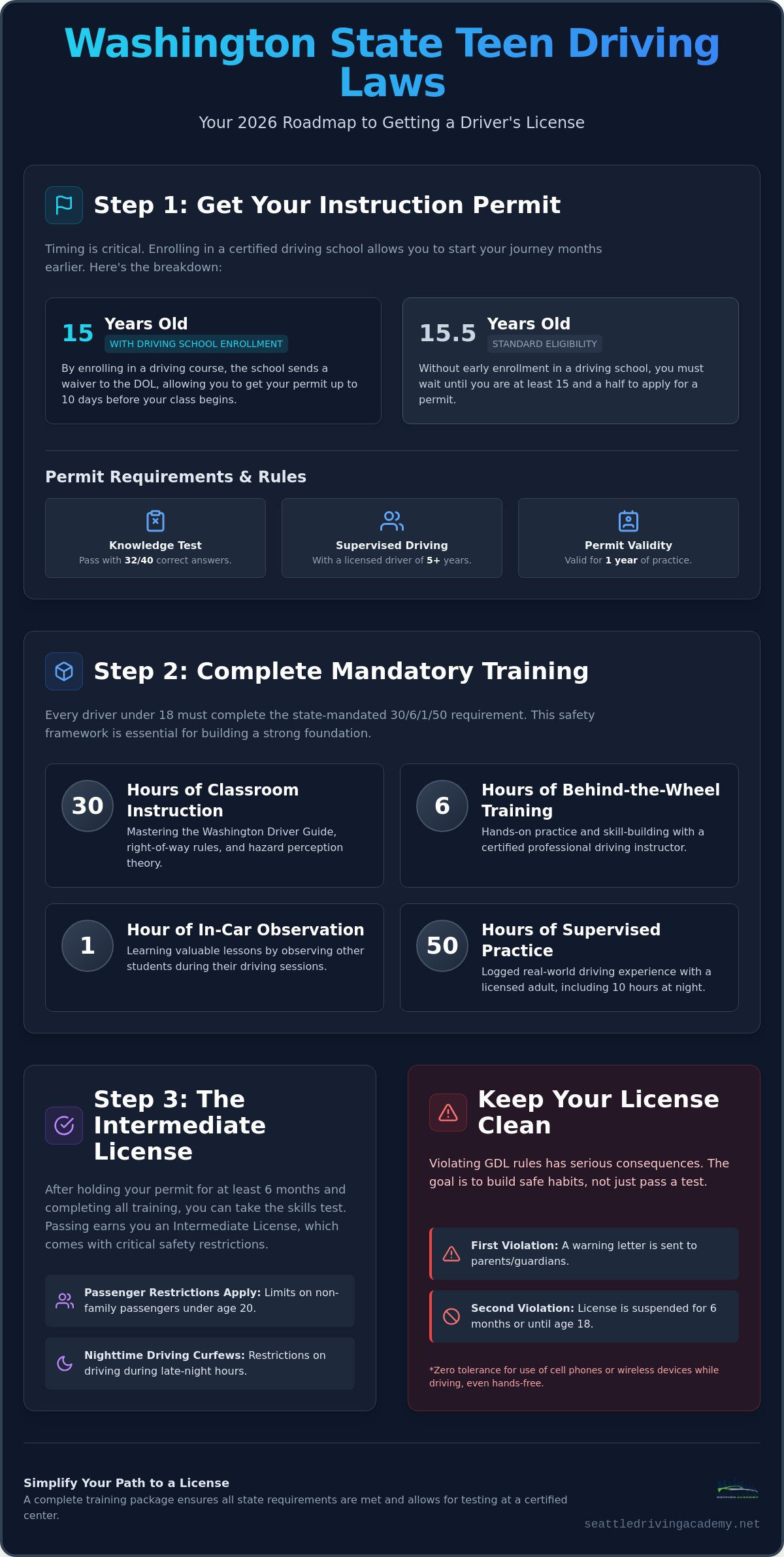
You'll also face your first big challenge: the Knowledge Test. This written exam consists of 40 multiple-choice questions pulled directly from the Washington Driver Guide. You need to answer at least 32 questions correctly to pass. It covers everything from right-of-way rules to the meaning of specific road signs. Passing this test proves you have the mental foundation required to start physical practice on the road.
Eligibility and the 15-Year-Old Rule
Timing is everything when it comes to the permit. Under standard washington state teen driving laws, a teenager must be 15.5 years old to apply for a permit on their own. However, there is a way to start earlier. By enrolling in a certified teen driving lessons Seattle program, students can apply for their permit at just 15 years old. When you register for a class, the school issues a digital waiver to the DOL. This waiver acts as a green light, allowing the state to issue the permit up to ten days before the class begins. Don't forget that a vision screening is also required at the licensing office to ensure you can safely spot hazards from a distance.
Supervised Driving: The Rules of the Road
Once you have that permit in hand, the real work begins. You are never allowed to drive alone. A supervising driver must occupy the front passenger seat at all times. This supervisor can't just be anyone; they must have at least five years of licensed driving experience. This ensures that the person guiding you has seen enough road scenarios to provide calm, expert advice. It's also vital to respect the zero-tolerance policy regarding electronics. Permit holders are strictly prohibited from using cell phones or any wireless devices while driving, even if they are hands-free. Your permit is valid for one year, giving you ample time to practice before moving to the next phase of the GDL program.
Mandatory Driver Training: The 30/6/1/50 Requirement
The roadmap to a license is built on a specific foundation known as the 30/6/1/50 requirement. This isn't just a set of numbers to check off; it's a proven safety framework designed to protect your teen during their most vulnerable stage of learning. According to the Washington State Department of Licensing, every driver under 18 must complete this rigorous training before they can even think about the skills test. It ensures that by the time they are solo, they've seen more than just a quiet cul-de-sac. Understanding washington state teen driving laws means realizing that every hour spent behind the wheel is an investment in their long-term safety.
The state-mandated breakdown includes:
- 30 Hours of Classroom Instruction: Theoretical knowledge covering the Washington Driver Guide.
- 6 Hours of Behind-the-Wheel Training: Hands-on practice with a certified professional.
- 1 Hour of In-Car Observation: Learning by watching peer performance.
- 50 Hours of Supervised Practice: Logged experience with a licensed adult.
Breaking Down the Professional Curriculum
Our Teen Complete Package is designed to handle the heavy lifting of these mandates. Students spend 30 hours in the classroom mastering the Washington Driver Guide, where they learn the nuances of right-of-way and hazard perception. This is paired with 6 hours of behind-the-wheel instruction. We don't just throw them onto I-5. We start slow. We build confidence. A unique part of washington state teen driving laws is the 1-hour observation requirement. This allows students to sit in the back while a peer drives. It's an eye-opening experience. It helps them spot mistakes and successful maneuvers from a different perspective, reinforcing defensive driving habits before they take the wheel themselves.
Mastering the 50-Hour Practice Log
While we handle the technical training, you play the vital role of the mentor for the 50-hour practice log. This log must include at least 40 hours of daytime driving and 10 hours at night. It sounds like a lot. It is. But it's where the real bonding happens. We suggest starting in empty parking lots and slowly graduating to busier Seattle arterials. Don't shy away from the rain. Most driving schools for teens near me recommend practicing in diverse weather to ensure your teen isn't surprised by a typical Northwest downpour. If you need help structuring these sessions, our Teen Complete Package provides a clear syllabus to follow at home.
The Intermediate License: Understanding Phase 2 Restrictions
Earning an intermediate license is a major milestone. It's the moment your teen finally gets to experience the road without you in the passenger seat. However, this new freedom is not absolute. Under washington state teen driving laws, the first year of driving is treated as a high-stakes apprenticeship. The state applies specific restrictions to minimize distractions and keep young drivers safe during their most vulnerable period. One of the most important rules involves the nighttime driving ban. Between the hours of 1 AM and 5 AM, intermediate license holders are not allowed to drive unless they are accompanied by a licensed driver who is at least 25 years old. There are very few exceptions, typically limited to agricultural purposes, so it's best to plan evening activities with these hours in mind.
The Washington State Attorney General's Office highlights that these laws are in place because the risk of a crash is highest during a teen's first year of solo driving. These rules aren't meant to be a burden; they are a safety net. Once your teen turns 18, these restrictions automatically lift, and the intermediate license becomes a standard, unrestricted license. This transition happens without a trip to the licensing office, provided your teen has maintained a clean driving record.
The First Six Months vs. The Second Six Months
The passenger rules are often the most difficult for teens to follow, but they are incredibly specific. For the first six months (the first 180 days) of holding an intermediate license, your teen cannot carry any passengers under age 20. The only exception is immediate family members. After those first six months are up, the rule relaxes slightly. For the remainder of the intermediate phase, they can carry up to three passengers under age 20 who are not family members. We suggest sitting down with your teen to explain that these legal boundaries are about focus. Having a car full of friends is the number one distraction for a new driver, and staying compliant is the best way to ensure they keep their driving privileges.
The 'No Cell Phone' Mandate
Washington takes a zero-tolerance approach to distracted driving for minors. While adults are allowed to use hands-free systems, intermediate license holders are strictly prohibited from using any wireless communication device while driving. This includes using a cell phone for calls, texting, or even adjusting a GPS or music app while the vehicle is in motion. If they need to change their route or pick a new playlist, they must pull over and park the car safely first. We always recommend that students set up their vehicle before they ever leave the driveway. Plug in the destination and start the music before shifting into drive. Developing these habits early makes it much easier to stay focused on the road ahead.
Penalties and Violations: Keeping Your License Clean
The first time a teen gets pulled over, the reality of the road usually sinks in pretty quickly. Under washington state teen driving laws, the Department of Licensing (DOL) doesn't just look the other way. For a first traffic violation, like a speeding ticket or a failure to yield, the state sends a formal warning letter to the parents. Think of this as a professional check-in designed to spark a conversation at home about safety and responsibility. It's a chance to correct course before the stakes get higher. This letter serves as a reminder that the intermediate license is a privilege that requires constant focus.
If a second violation occurs, the consequences become much more serious. Your teen will face a six-month license suspension or until they turn 18, whichever comes first. A third violation results in a total suspension until their 18th birthday. Washington also maintains a strict zero-tolerance policy for alcohol and THC. A Minor in Possession (MIP) charge or any trace of these substances while driving can lead to immediate legal action and long-term license loss. Even accidents where your teen isn't at fault can sometimes trigger a review of their intermediate status if they were violating any restrictions, like having too many friends in the car, at the time of the collision.
Traffic Violations and the DOL's Response
The goal of these penalties isn't just to punish. It's to ensure every young driver is truly ready for the road. If your teen faces a suspension, they must wait out the six-month period and keep a clean record during that time. Often, the state requires remedial training or retaking exams to prove mastery of the material. Finding the right seattle dol knowledge test locations is a vital step in getting back on track and preparing for the second chance. Remember, you need a full year of violation-free driving to graduate to an unrestricted license once you turn 18.
Safety Beyond the Law
It's also essential to understand the Implied Consent law. By signing for a license, you've already agreed to a breath or blood test if a police officer suspects you've been drinking. Refusing this test can lead to an automatic one-year suspension, regardless of whether you were actually impaired. Beyond the legal fees, a single ticket can restart the clock on your intermediate restrictions, delaying your full license for months. This also has a massive impact on family insurance premiums, which can skyrocket after just one incident. To avoid these hurdles and master the road safely, consider enrolling in our Teen Complete Package to build the defensive skills that keep tickets off your record. We treat every student like family, ensuring they have the tools to stay safe and keep their record spotless.
Mastering the Laws with Seattle Driving Academy
Knowing the theory behind washington state teen driving laws is a great start, but the real magic happens when you put that knowledge into practice on the streets of Seattle. Our city presents unique challenges that a standard textbook simply can't prepare you for. From the steep, wet hills of our historic neighborhoods to the high-pressure merges on I-5, we make sure our students are ready for the reality of Northwest driving. Our Teen Complete Package is designed to be the gold standard for local families, providing a seamless transition from that first classroom hour to the moment you receive your license.
We don't just teach you how to pass a test; we teach you how to thrive in our specific environment. Whether it's managing visibility during a typical Seattle downpour or understanding the right-of-way in a busy downtown intersection, our training is grounded in local expertise. We've helped thousands of students navigate these hurdles with confidence, turning what could be a high-stress experience into an empowering journey toward independence.
Why Seattle Families Choose SDA
We know that for many teens, the thought of driving in city traffic is more than a little intimidating. That's why our instructors adopt a mentor-style approach, focusing on patience and encouragement rather than just checking off boxes. We treat our students like family, ensuring they feel supported every step of the way. Because we serve as an official driver license testing center, your teen has the distinct advantage of testing in a familiar environment. This continuity builds massive confidence. Plus, we offer flexible scheduling to fit around the busy lives of high schoolers, making it easier than ever to complete your requirements without the stress of a backlogged DOL office.
Taking the Final Step: The Road Test
The road test is the final hurdle in the graduated licensing process. During the Washington State Skills Exam, examiners look for more than just technical ability; they want to see confident decision-making and a deep respect for safety. Common fail points often include things like rolling through stop signs or failing to check blind spots during a lane change. We spend significant time during our behind-the-wheel sessions polishing these specific skills so there are no surprises on test day. Booking your test at a private center like ours is typically much faster than waiting for a state-run appointment. We're here to help you cross that finish line with a smile, turning a high-pressure exam into a proud celebration of your new-found freedom.
Your Journey to Safe Driving Starts Here
You now have a clear roadmap for your teen's driving journey. From understanding the initial permit rules to mastering the specific passenger restrictions of the intermediate license, you're prepared to handle every step. Staying current with washington state teen driving laws doesn't just keep your teen legally compliant; it builds the foundation for a lifetime of safe habits on the road. Starting early at age 15 gives your student more time to build confidence under professional guidance before they ever face the pressure of solo driving.
We're here to be your partner through this entire process. As an official DOL testing center, we offer a supportive environment where students can learn and test in the same familiar place. Our patient, mentor-style instructors are dedicated to turning high-stress milestones into empowering successes. Enroll your teen in the Seattle Driving Academy Teen Complete Package today! We're excited to help your family achieve this rewarding goal with peace of mind. Let's get your teen ready for the road with the skills and confidence they deserve.
Frequently Asked Questions
What is the youngest age you can get a permit in Washington?
You can obtain an instruction permit as early as age 15 if you are enrolled in a state-approved driver training program. If you decide to apply without enrolling in a course, the minimum age requirement is 15.5 years old. Starting at 15 allows your teen to gain an extra six months of supervised practice, which is an excellent way to build confidence before they ever drive solo.
How many hours of driving practice do teens need in WA?
Washington requires teens to complete at least 50 hours of supervised driving practice with a licensed driver who has at least five years of experience. Within those 50 hours, at least 10 hours must be completed at night. This requirement is a major part of washington state teen driving laws and ensures that students have experienced a wide variety of road conditions and lighting scenarios before they graduate to a license.
Can a 16-year-old drive with friends in Washington State?
No, for the first six months of holding an intermediate license, a teen cannot have any passengers under age 20 unless they are immediate family members. After that initial six-month period, the restriction relaxes slightly, allowing them to carry up to three non-family passengers under age 20. These rules are strictly enforced to help new drivers stay focused on the road during their first year of independence.
What happens if a teen driver gets a speeding ticket in WA?
If a teen receives a traffic violation like a speeding ticket, the Department of Licensing will send a formal warning letter to their parents or guardians. A second violation results in a six-month license suspension, and a third violation will suspend the license until the driver turns 18. It's vital to keep a clean record, as any violation can restart the clock on their intermediate license restrictions.
Do I have to take a driving test at the DOL office?
You don't have to visit a state DOL office for your exams. You can complete both your knowledge test and your driving skills test at an authorized driver license testing center. Many families prefer this option because private centers often have more flexible scheduling and provide a more comfortable, familiar environment for students who are nervous about their final evaluation.
What are the night driving restrictions for WA intermediate licenses?
Intermediate license holders are not allowed to drive between 1 AM and 5 AM for the first year they have their license. The only exception is if they are accompanied by a licensed driver who is 25 years or older. This law is designed to keep inexperienced drivers off the road during the hours when visibility is lowest and the risk of serious accidents is statistically much higher.
Does Washington require a formal driver's education course?
Yes, all teens under age 18 must successfully complete a state-approved driver training program to get their license. This curriculum includes 30 hours of classroom instruction, 6 hours of behind-the-wheel training, and 1 hour of observation. Following these washington state teen driving laws ensures that every young person on our roads has received professional mentorship and has mastered the basics of defensive driving.
How long is the intermediate license period in Washington?
The intermediate license period lasts until the driver reaches their 18th birthday. At that point, the license automatically becomes a standard, unrestricted driver license, provided the teen has not committed any traffic violations in the previous 12 months. There is no need to pay for a new license or visit the DOL; the restrictions simply no longer apply once the driver is legally an adult.


