
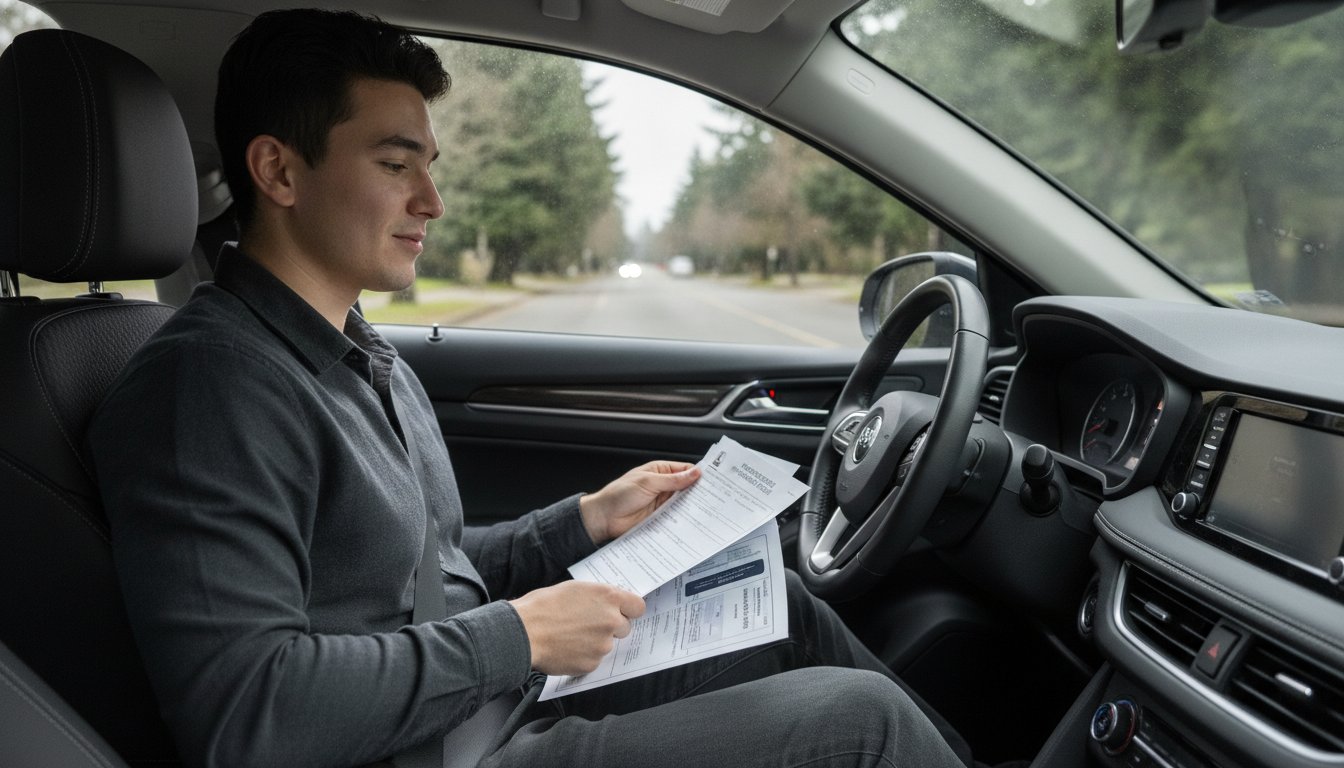
A successful Washington State driving test is often won or lost in the twenty minutes before you even start the engine. You've spent weeks practicing your parallel parking and scanning intersections, yet the most stressful moment often happens at the check-in desk rather than on the road. It's completely normal to feel a pit in your stomach at the thought of being sent home because of a simple paperwork oversight or a dim tail light. We understand that you've put in the work, and the last thing you want is a logistical technicality standing between you and your freedom. That's why knowing exactly what to bring for driving test wa is the most important step in your final preparations.
We're here to make sure your big day goes exactly as planned by providing the ultimate 2026 checklist for your exam. This guide covers everything from the specific insurance details required by the DOL to the mechanical safety standards your vehicle must meet to pass inspection. You'll learn about the latest 2026 requirements, including the mandatory safety course for drivers under 25 and the specific documents needed for your permit or license type. By the time you finish reading, you'll have the clarity and confidence to walk into that testing center ready to focus on your driving skills, not your paperwork.
Key Takeaways
- Secure your valid Washington State Learner’s Permit and current insurance documents to ensure a smooth check-in process without any surprises.
- Check your car for the "Zero-Defect" rule, where even a single dashboard warning light or a faulty turn signal can stop your test before it begins.
- Review our comprehensive 2026 guide on what to bring for driving test wa to verify that your vehicle and paperwork meet the latest state standards.
- Learn why a 30-minute practice session right before your exam is the highest return activity you can do to sharpen your maneuvers and settle your anxiety.
- Identify the unique requirements for your specific age group, including the mandatory safety courses now required for all applicants under the age of 25.
Essential Documents: The Washington State DOL Paperwork Packet
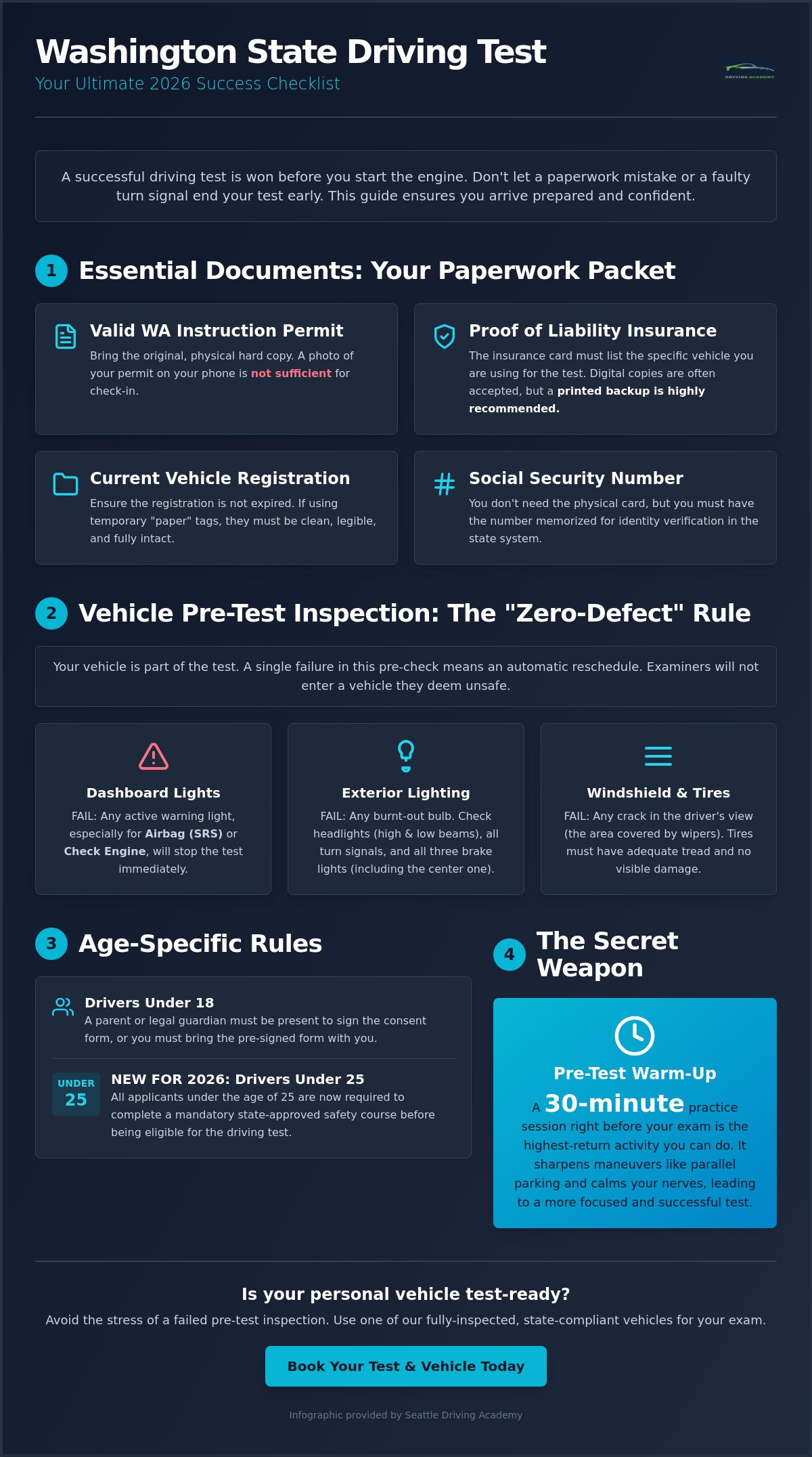
Walking into your appointment with the wrong paperwork is a heart-sinking experience that happens to more applicants than you might think. To ensure your day goes smoothly, you must treat your document packet as the foundation of your success. In Washington State, the requirements are strict, and unlike some other regions, the Department of Licensing (DOL) has very little flexibility when it comes to missing signatures or expired forms. Before you leave the house, double-check that you have your valid Washington State Instruction Permit, your vehicle's current registration, and proof of liability insurance. This is a critical part of the driving test preparation process that many students overlook until it's too late.
It's also important to clarify a common point of confusion. If you've been searching online for what to bring for driving test wa, make sure you aren't looking at requirements for Western Australia. We're focusing specifically on the Pacific Northwest, where our local DOL offices have their own unique set of digital and physical standards. Beyond your physical documents, you should also have your Social Security number memorized. While you don't need the actual blue card, the testing agent will need the number to verify your identity in the state system.
Identification and Permit Requirements
Your hard-copy Instruction Permit is your golden ticket. While we live in a digital world, a photo of your permit on your smartphone is usually not enough to check in for your exam. You need the actual permit in hand. If you've lost your permit recently, don't panic. You can log into your "License eXpress" account to verify your status, but it's much safer to visit a DOL office and get a replacement before your test date. For those under 18, remember that your parent or guardian must be present to provide a signature, or you must have a signed parental consent form ready to go.
Insurance and Registration Nuances
The vehicle you bring to the test center must be legally covered. Your insurance card must specifically list the vehicle you're driving, not just you as a driver. In 2026, most Washington examiners will accept a digital insurance card on your phone, but technology can fail. We always recommend having a printed backup in the glove box just in case your battery dies or the app won't load. Your registration must also be current. If you're using a car with temporary "paper" tags, ensure the registration document is clearly legible and hasn't expired. A blurry or water-damaged temporary permit can lead to an immediate reschedule, so keep those papers dry and protected.
Vehicle Readiness: Passing the Pre-Test Safety Inspection
Your vehicle is more than just a way to get to the appointment; it's your mobile testing environment. The Washington DOL follows a strict safety protocol, and if your car doesn't pass the pre-test inspection, you won't even get to put it in gear. This is a common point of failure that catches many people off guard when they consider what to bring for driving test wa. We want to ensure your car is as ready as you are, so you can focus entirely on your driving performance.
The state operates on what we call the "Zero-Defect" rule. This means your dashboard must be clear of critical warning lights. If your SRS or Airbag light is illuminated, the examiner will likely refuse to enter the vehicle. They need to know that the safety systems designed to protect them are fully functional. Similarly, your exterior lighting must be perfect. You'll be asked to demonstrate your high and low beams, both turn signals, and your brake lights. Check that center brake light in the rear window, as a burnt-out bulb there is a very frequent cause for an immediate reschedule.
Tires and visibility are the next priorities. Your tires must have a minimum tread depth and shows no visible damage to the sidewalls. While you are verifying what to bring for driving test wa, take a moment to inspect your windshield. A small rock chip might be fine, but any crack that enters the "driver view" area, which is the space covered by your windshield wipers, will trigger a fail. If you're worried your personal vehicle might not meet these high standards, you can always book a driver license testing center that provides a fully inspected, state-compliant vehicle for your exam.
Interior Controls and Safety Gear
Inside the car, every control must work exactly as intended. Your horn needs to be audible from at least 200 feet away, so give it a firm press before you leave your driveway. Seatbelts must click firmly into place and be free of any fraying or structural damage. Given our famous Seattle weather, your windshield wipers and defroster must be fully operational to ensure you have a clear view of the road at all times.
The Passenger Side Requirement
The examiner’s "office" for the next thirty minutes is your passenger seat. The passenger door must open easily from both the inside and the outside. If your handle is finicky, fix it before the test. The seat itself should be clean and free of trash or debris. Finally, the examiner must have clear access to the emergency brake. If your car has a center console, ensure it's clear so the examiner can reach the parking brake quickly if an emergency occurs during the maneuvers.
Teen vs. Adult Requirements: What Changes for You?
The rules of the road are the same for everyone, but the administrative hoops you have to jump through depend largely on your age. When you are looking up what to bring for driving test wa, it's vital to categorize yourself correctly. For teens under 18, the process is structured and requires significant documentation of your training history. For adults, the path is often faster but comes with its own set of pitfalls, specifically regarding technical skills that haven't been professionally evaluated. Knowing exactly what to bring for driving test wa based on your specific age bracket will save you from a wasted trip to the DOL.
If you are under 25, there is a new 2026 requirement you cannot ignore. As of May 1, 2026, all initial license applicants in this age bracket must complete an online course focused on work zone and first responder safety. This is a separate step from the driving test itself, but you'll need to have it finished before you can be licensed. For those under 18, the state still requires a specific set of milestones to be reached before your test date:
- Completion of a state-approved driver education course.
- Holding an instruction permit for at least six months.
- A minimum of 50 hours of supervised practice.
- At least 10 of those practice hours must be completed at night.
Your parent or guardian will need to certify these hours. Their presence at the testing center is usually the easiest way to handle the necessary signatures and ensure all teen-specific paperwork is in order.
The Teen Complete Package Path
Choosing the Teen Complete Package is the most streamlined way to handle these requirements. When you go through a professional school, your driver education records are sent electronically to the DOL. This eliminates the fear of losing a paper certificate on the way to your exam. It also ensures that you have met the state-mandated training hours in a controlled, expert environment. Having a mentor by your side during this process turns a complex legal requirement into a simple, manageable milestone.
Adult Learner Fast-Tracking
Adults who are 18 or older have the option to skip the formal driver education course, but this doesn't mean you should skip the preparation. Many adult learners develop "bad habits" when teaching themselves or learning from friends. These minor errors, like one-handed steering or failing to check blind spots properly, can lead to an immediate point deduction. Investing in an Adult Drivers Training 3 Hour Package allows a professional instructor to catch these issues before they become test-day disasters. Even if you don't have a WA instruction permit yet, you'll need to bring a valid photo ID to the DOL to establish your record and secure your permit before the skills test can proceed.
Day-of Logistics: Navigating the Seattle Test Center
The morning of your exam is finally here. You've checked your lights and gathered your permit, but the final hurdle is simply getting to the desk on time. In the busy Seattle corridor, logistics can be just as challenging as the driving itself. Knowing what to bring for driving test wa is only half the battle; you also need to know where to be and when to be there. Plan to arrive at your testing location at least 15 to 20 minutes before your scheduled slot. Most centers are very strict about their schedules. If you show up even five minutes late, you will likely be treated as a no-show, which means losing your fee and having to reschedule.
When you pull into the lot, keep an eye out for designated "Testing Only" parking spots. Many Seattle centers have these reserved to ensure examiners have a clear path for the start of the skills test. Before you even walk through the front door, have your documents in hand. Fumbling through a backpack or glove box at the counter creates unnecessary stress for you and the staff. We want you to feel calm and collected from the moment you step inside. Properly understanding what to bring for driving test wa ensures that your focus remains on the road rather than on missed details.
Your choice of clothing matters more than you might think. We recommend wearing comfortable shoes that give you a clear feel for the pedals. Avoid flip-flops, high heels, or heavy work boots. These can dull your "pedal feel" and make it harder to apply the precise pressure needed for smooth braking and acceleration. If you're ready to secure your spot, you can book your driver license driving test with our team to ensure a supportive experience.
Seattle Traffic and Timing
If you're testing at a central location, remember that I-5 and I-90 congestion can turn a ten-minute drive into a forty-minute ordeal. We suggest choosing an "off-peak" appointment time if possible. This helps you avoid the frantic energy of school zones and heavy commuter traffic. A great strategy is to perform a quick drive-around of the neighborhood near the driver license testing center on the morning of your test. This allows you to spot any new construction or tricky intersections before the clock is running.
Mental Preparation and Anxiety
It's natural to feel some nerves, but try to view your examiner as a supportive mentor. Their goal is to ensure you are safe, not to find reasons to fail you. If you feel your heart racing while waiting in the car, try a few deep, slow breaths to reset your focus. Remember that a single minor mistake doesn't always mean the end of the road. For example, lightly touching the curb during parallel parking is often just a point deduction rather than an automatic fail. Stay focused on the next maneuver and keep your eyes on the goal of mastery and freedom.
The Secret Weapon: Pre-Test Warm-Up Practice
Driving is a physical skill that relies heavily on muscle memory and recent repetition. Just as an athlete warms up before a big game, you shouldn't expect to perform your best if you haven't been behind the wheel for a few hours. We've found that a 30-minute practice session right before the exam is the highest return activity you can choose. It allows you to refresh your memory on technical maneuvers like parallel parking and the back-around corner turn in a low-pressure environment. As you verify what to bring for driving test wa, don't forget that your mental state is just as vital as your paperwork. When a professional instructor gives you a quick mock test first, you enter the actual exam with the momentum of success already on your side.
At Seattle Driving Academy, we believe in a student-centric approach that bridges the gap between learning and certification. We've integrated testing preparation directly into our curriculum to ensure no detail is left to chance. Our instructors know the common pitfalls of local routes and can provide that final bit of encouragement you need to stay calm. This proactive preparation anticipates the logistical hurdles you might face and solves them before you even arrive at the testing center lot.
Using an Academy Vehicle
One of the biggest stressors on test day is the fear of a vehicle inspection failure. If you use your own car, you're responsible for every bulb and sensor. However, choosing to use one of our school vehicles for your driver license driving test removes that burden entirely. Our fleet is meticulously maintained to pass the Washington "Zero-Defect" rule every single time. You won't have to worry about registration paperwork quirks or a sudden dashboard light appearing at the last second. It's a simple way to master the logistics and focus entirely on your driving skills.
Final Steps to Your License
Once you pass your test, the hard part is over, but there are a few administrative steps left to complete. The examiner will upload your scores to the DOL system immediately. You'll then need to pay the state licensing fee, which is currently $111 for a six-year license or $131 for an eight-year license. You'll receive a temporary paper license to use while you wait for your official plastic card to arrive in the mail. If you're ready to turn your anxiety into confidence, Schedule your pre-test warm-up and driving skill test today to ensure you're 100% ready for the road ahead.
Secure Your Success and Claim Your Freedom
Your journey to becoming a licensed driver is about more than just steering. It's about the careful preparation that happens before you ever turn the key. By organizing your permit and insurance early, you eliminate the stress of administrative errors. Checking your car for the "Zero-Defect" rule ensures that your vehicle is a partner in your success rather than a hurdle. Most importantly, remember that knowing exactly what to bring for driving test wa gives you the mental space to focus on the road ahead.
As an authorized DOL testing center, we've seen how a supportive mentor can transform a high-pressure exam into an empowering milestone. Our expert instructors have helped thousands of Seattle students achieve high first-time pass rates through patience and professional guidance. We're here to lead you through every step of this process with the care we'd give our own family members. We want you to feel empowered and ready to master every maneuver with total confidence.
Book Your Road Test and Warm-Up Session at Seattle Driving Academy to secure your spot and sharpen your skills. You've put in the hard work and the long practice hours. Now, take that final step with confidence and unlock the independence you deserve. We're ready to help you cross the finish line and start your new journey on the road.
Frequently Asked Questions
Can I take the driving test in my own car in Washington State?
Yes, you are welcome to use your personal vehicle as long as it meets all state safety requirements. It must have valid license plates, current registration, and proof of liability insurance that specifically lists the car. We always recommend doing a "dry run" check of your lights and signals at home to ensure your car is ready for the examiner's inspection.
What happens if my car fails the safety inspection before the test?
If your vehicle doesn't pass the initial safety check, the examiner won't be able to proceed with the test. You'll likely need to reschedule your appointment and may have to pay a retesting fee depending on the center's policy. This is why many students choose to use an academy vehicle to guarantee they won't be turned away for a mechanical issue like a dim center brake light.
Do I need an appointment for a driving test in WA in 2026?
Yes, you must have a scheduled appointment to take your skills test at any DOL office or third-party testing center. Walk-in testing is not available in 2026. Because slots fill up quickly in the Seattle area, we suggest booking your appointment at least two to three weeks in advance to get your preferred time and location.
Can I use my backup camera or self-parking features during the test?
You can use your backup camera as a secondary aid, but you must still perform physical head checks and use your mirrors. Relying solely on the screen is a common mistake that can lead to point deductions. Any automated self-parking features are strictly prohibited and must be turned off during the exam to prove you can master the car yourself.
What is the most common reason for failing the WA driving test before it starts?
The leading causes for a "no-test" result are missing documents and faulty equipment. Students often forget their physical permit or bring a vehicle with a burnt-out bulb. Reviewing the checklist for what to bring for driving test wa the night before is the best way to avoid these frustrating logistical setbacks and ensure you're ready to drive.
Is the knowledge test required before I can take the driving test?
Yes, you must successfully pass the 40-question written knowledge test before you are eligible for the skills exam. In Washington, you need to answer at least 32 questions correctly to achieve a passing score of 80%. Once your score is entered into the state system, you can move forward with scheduling your actual road test.
How much does the driving test cost in Seattle?
Testing fees vary because they are set by individual third-party testing locations rather than a flat state rate. In 2026, the skills test typically ranges between $55 and $60 when you provide your own vehicle. Keep in mind that this testing fee is separate from the licensing issuance fee you pay directly to the DOL after you pass.
Can I take my driving test in a different city than where I live?
You are free to take your driving test at any authorized testing center within Washington State regardless of your home address. Many residents choose a center based on appointment availability or familiarity with the local streets. As long as the center is state-certified, your results will be valid and uploaded to your DOL record immediately.


