

2026 Washington Driving Test: Parallel Parking Guide
Yes, parallel parking is part of Washington’s driving skills test, but knowing that doesn’t always make the manoeuvre feel less stressful. If you’re searching for the parallel parking requirements wa driving test, start by separating the official test rules from the parking technique you can practise at your own pace.
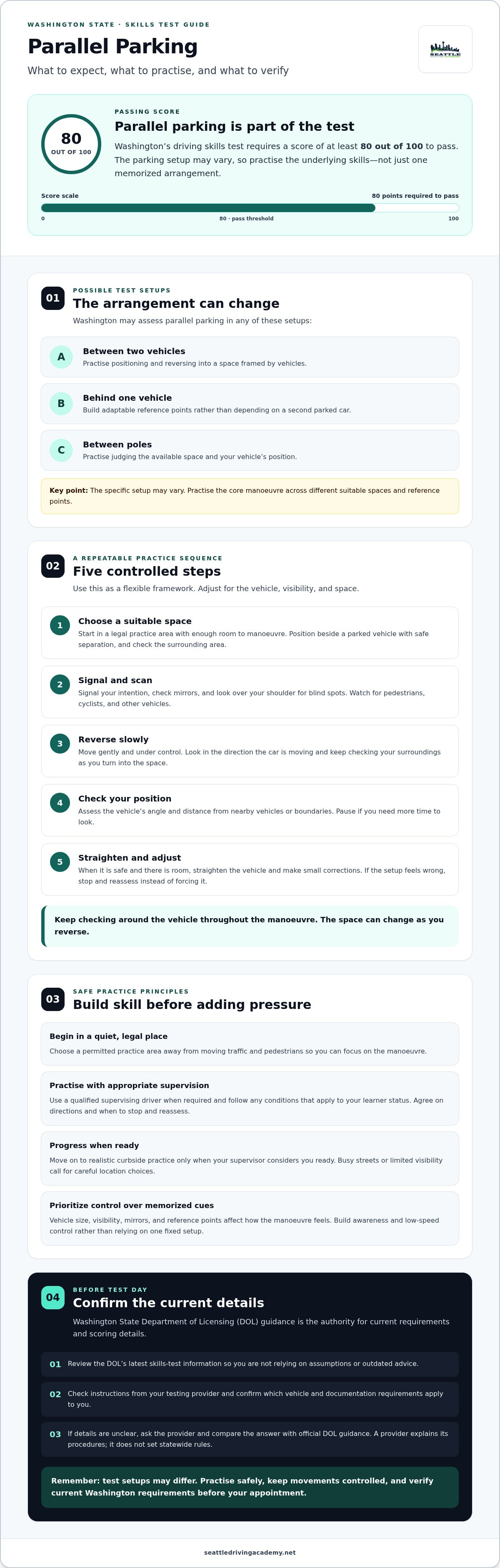
You may wonder whether you’ll park between cars, behind one car, or between poles, and whether a small mistake could affect your result. Washington may test the manoeuvre between two vehicles, behind one vehicle, or between poles. The test requires a score of at least 80 out of 100 to pass. The Washington State Department of Licensing (DOL) is the authority for current requirements and scoring details, so check its guidance before your appointment.
This guide explains what the test may assess, offers a repeatable practice sequence, and outlines what to confirm before test day. You can build confidence away from busy traffic first, then get feedback through individual driving lessons or pre-test warm-up practice if you want extra support. A calm, prepared approach can make the manoeuvre feel more manageable.
Key Takeaways
- Check Washington DOL guidance before test day so you’re working from current requirements, not assumptions.
- Practise in a safe, legal area with a supervising driver where required, focusing on slow, controlled movements.
- Use different suitable spaces and vehicle reference points to build adaptable skills instead of relying on one memorized setup.
- Review the parallel parking requirements wa driving test and confirm test logistics as part of your preparation checklist.
- If you’d like feedback, individual driving lessons or pre-test warm-up practice can help you prepare with greater confidence.
Are There Parallel Parking Requirements on the Washington Driving Test?
Yes. Parallel parking is a required manoeuvre on Washington’s driving skills test, according to Washington State Department of Licensing (DOL) guidance. The test requirement is separate from practice: practising helps you build the skill, but it doesn’t change which manoeuvres the state may assess. The DOL is the authority on test rules, so review its latest skills-test information before your appointment in case procedures have changed.
Does Washington require parallel parking during a skills test?
Yes. Washington may assess parallel parking in one of several setups: between two vehicles, behind a single vehicle, or between poles. The setup you encounter may vary, so practise the core skills rather than preparing for only one arrangement. For a general overview of how to parallel park, see Wikipedia. Use Washington DOL guidance, not an encyclopedic source or another state’s rules, to confirm what applies to your test.
That distinction matters when online advice seems inconsistent. Driving-test manoeuvres can differ between states, and information about another location doesn’t establish Washington’s requirements. For the parallel parking requirements wa driving test, look for current Washington-specific information and confirm the details with the DOL.
What should you verify before your Seattle driving test?
Before test day, review the DOL’s current skills-test information and check any instructions from the testing provider you booked with. Confirm which vehicle and documentation requirements apply to your circumstances instead of relying on an old checklist or someone else’s experience. If something is unclear, ask the provider directly and compare its answer with official DOL guidance.
A testing provider can explain its own procedures, but it doesn’t set Washington’s statewide rules. Seattle Driving Academy is an authorized testing center for DOL knowledge and skills tests; the DOL remains the authority on requirements. If you’re still choosing where to take your exam, a guide to choosing a driver license testing center can help you compare what to confirm before booking.
How to Parallel Park Smoothly: A Safe Practice Sequence
Steady parallel parking depends on awareness and low-speed control, not on memorizing one set of steering cues. Your vehicle’s size, mirror and window visibility, and reference points all affect how the manoeuvre feels. Use the steps below as a practice framework, then adjust what you observe to suit the car you’re driving.
What are the basic steps for parallel parking?
- Choose a suitable space. Start in a legal practice area with enough room to manoeuvre. Position beside a parked vehicle with enough separation to reverse safely, and make sure you can see the surrounding area.
- Signal and scan. Signal your intention, check your mirrors, and look over your shoulder to check blind spots. Before moving, watch for pedestrians, cyclists, and other vehicles.
- Reverse slowly. Move at a gentle, controlled speed. Look in the direction the car is moving and keep checking your surroundings as the vehicle turns into the space. Don’t depend on one mirror or reference cue.
- Check your position. As the car enters the space, assess its angle and distance from nearby vehicles or boundaries. Pause if you need more time to look.
- Straighten and adjust. When there’s room and it’s safe, straighten the vehicle and make small corrections. If the setup doesn’t feel right, stop and reassess instead of forcing the car into position.
Keep checking around the vehicle throughout the manoeuvre. A clear view at the start doesn’t guarantee the space will remain clear as you reverse.
How can Seattle learners practise safely?
Begin in a quiet, legal location away from moving traffic and pedestrians, such as a permitted practice area where you can focus without pressure. Practise with a qualified supervising driver when required, and follow any conditions that apply to your learner status. Before you start, agree on how the supervisor will give directions and when you’ll stop to reassess.
Once your supervisor considers you ready, progress to realistic curbside practice in an appropriate location. Seattle streets can be busy or have limited visibility, so don’t choose an unfamiliar or congested spot just to make practice feel more like test day. Don’t treat any particular street as an approved test route without confirmation.
Try the manoeuvre in different suitable spaces and notice how the car’s length, mirrors, and sightlines change your reference points. That flexibility is more useful than repeating one memorized setup. For state information on test manoeuvres and vehicle control, consult the Washington driving test requirements. If you’d benefit from guided feedback, individual driving lessons can help you practise with a clear focus before your skills test, including the parallel parking requirements wa driving test may assess.
What Do Examiners Look For During a Parking Manoeuvre?
During a parking manoeuvre, focus on driving safely and predictably. Washington’s Department of Licensing (DOL) identifies observation, vehicle control, signalling, and awareness as important parts of the skills test. These are useful habits to practise, but they aren’t a complete list of scoring rules. For current assessment details, check the DOL’s driving test guidance before test day.
In practice, stay alert to the space around you, control the car smoothly, and signal clearly when appropriate. If you need to pause, make sure it’s safe, look around again, and follow the examiner’s instructions. A deliberate adjustment is different from a sudden movement that creates a hazard.
Which parking errors should learners work on first?
Start with habits that affect safety and control. Rushing can make it harder to notice a person or vehicle entering the area. Skipping a mirror or blind-spot check can leave you unaware of what’s beside or behind the car. Unclear signalling and abrupt steering can also make your actions harder for others to predict.
Use practice to identify these habits without treating each one as an automatic test result. If your position doesn’t feel right, stop safely, reassess the space, and correct only when it’s clear to proceed. Washington’s scoring depends on the test’s stated criteria and what happens during the manoeuvre. Don’t assume a particular error earns a set score unless the DOL says so.
Does touching the curb mean you fail?
Washington’s current scoring guidance distinguishes between types of contact. Striking a curb during a manoeuvre results in an automatic failure. In a parallel-parking exercise between poles, hitting a pole is a four-point deduction rather than an automatic failure. These are specific outcomes, not a reason to guess how every light touch or near miss will be judged. Check the latest DOL scoring information for the wording that applies to your test.
A correction by itself isn’t listed in the guidance as an automatic failure. Stay composed, keep control of the vehicle, and listen to the examiner rather than rushing to recover. If you’re unsure about the current consequence of a particular action, verify it with the DOL. A testing provider can explain its procedures, but it doesn’t set statewide scoring rules. That’s the reliable way to understand the parallel parking requirements wa driving test without relying on rumours or advice from another state.
How to Practise Parallel Parking Before a Washington Skills Test
Focused practice can make the manoeuvre feel more manageable without turning it into a memorized script. Choose a safe, legal location, check posted parking signs, and practise with a qualified supervisor when required. Seattle’s busy streets and limited visibility can add pressure, but they aren’t official test conditions. Build the basics in a quieter setting before trying curbside practice in a more challenging area.
How should you build confidence without memorizing a script?
Keep practice sessions short and give each one a clear focus. For example, first work on checking the space and setting up beside a parked vehicle. In another session, focus on reversing slowly while staying aware of your surroundings. Then practise straightening and making a safe adjustment. Breaking the manoeuvre into parts helps you identify what needs work without rushing through every step at once.
Use consistent reference points in your vehicle, such as where a nearby car appears in a side window or mirror, but treat them as helpful cues rather than fixed rules. A different vehicle, space, or angle can change what you see. Keep your attention on your surroundings and speed before concentrating on steering.
After each attempt, ask a qualified instructor or supervisor for specific feedback: Was your setup safe? Did you keep checking around the car? Were your movements controlled? Specific feedback gives you something practical to work on next time. If you need to pause, stop safely, reassess, and continue only when the area is clear.
When can a pre-test warm-up help?
A warm-up can refresh familiar skills and help you settle into the car before a test. It isn’t a substitute for regular practice, and trying to cram unfamiliar techniques at the last minute may add pressure rather than build confidence. Use the time to review what you already know you want to work on, such as observation, setup, or controlled reversing.
Before your next session, check local signs and choose a space that lets you practise without interfering with traffic or pedestrians. As your confidence grows, your supervisor can help you decide whether it’s appropriate to try a more realistic curbside space. Practising in different suitable spaces helps you adapt your reference points instead of relying on one memorized arrangement.
If you’d like focused feedback before test day, schedule pre-test warm-up practice with Seattle Driving Academy. Use practice to strengthen your skills, and check Washington DOL guidance separately for current parallel parking requirements wa driving test details.
Get Ready for Your Seattle Driving Test with a Clear Plan
A simple plan can take some of the uncertainty out of test day. Washington’s Department of Licensing sets the official requirements. A driving school or testing provider can help you prepare and explain its own procedures, but it doesn’t decide the state rules. Use current DOL guidance for the parallel parking requirements wa driving test and other test instructions.
What should you do in the days before the test?
Keep your final preparation practical and focused. Before your appointment:
- Verify the rules. Recheck current Washington DOL skills-test instructions, including any manoeuvres or scoring details you want to confirm.
- Confirm logistics. Review your appointment details and contact your testing provider if you’re unsure about arrival instructions or what to bring.
- Practise safely. Refresh familiar skills in a suitable practice area, prioritizing observation, signalling, and calm vehicle control over last-minute cramming.
- Prepare your vehicle and documents. Follow current DOL and provider instructions for the vehicle and documentation required for your situation.
Give yourself time to review these details instead of relying on an old checklist or another learner’s experience. Requirements and procedures can change, so verify them close to your test date.
Where can Seattle learners get extra preparation?
If you’d like guidance before your appointment, Seattle Driving Academy offers individual driving lessons and pre-test warm-up practice. The academy is also an authorized testing center for Washington DOL knowledge and skills tests. Instruction and practice can help you identify areas to work on, but they can’t guarantee a passing result. Washington DOL remains the authority on statewide requirements.
Choose support that matches your needs: take a lesson for focused feedback, or book a warm-up to revisit familiar skills before the test. For details about Seattle Driving Academy’s testing and training options, visit Seattle Driving Academy services. With the rules checked, logistics confirmed, and practice handled safely, you can arrive with a clearer plan and a calmer mindset.
Take Your Next Step Toward Test-Day Confidence
Knowing the parallel parking requirements wa driving test is only part of feeling ready. Check the latest Washington State Department of Licensing guidance, which sets the official test rules, then practise in a safe, suitable area with a focus on observation and smooth vehicle control. A calm adjustment is better than rushing through a manoeuvre from memory.
Before test day, confirm your appointment details and follow current instructions for the vehicle and documents you’ll need. If you want extra feedback, Seattle Driving Academy offers individual driving lessons and pre-test warm-up practice. It’s also an authorized testing center for Washington DOL knowledge and driving skills tests. Preparation can help you feel more confident, but no lesson can guarantee a passing result.
Explore Seattle Driving Academy testing and lesson options to find support that fits your preparation needs. You’ve got a clear plan; take it one safe, steady step at a time.
Frequently Asked Questions
Does Washington require parallel parking on the driving test?
Yes. Parallel parking is a required manoeuvre on Washington’s driving skills test, according to current Washington State Department of Licensing (DOL) guidance. The test may use a setup between two vehicles, behind one vehicle, or between poles. For the parallel parking requirements wa driving test, use current DOL guidance as the source of state rules. Your testing provider can clarify its own procedures, but it doesn’t set statewide requirements.
How do you parallel park for a driving test?
Choose a suitable space, signal, and check your mirrors and blind spots before moving. Reverse slowly while staying aware of people, vehicles, and the space around your car. Straighten when appropriate, then make small corrections only if it’s safe. There’s no universal steering formula because vehicle dimensions and visibility vary. Practise in a safe, legal area with a qualified supervisor where required, and follow the examiner’s instructions during your test.
How far from the curb should your car be when parallel parking in Washington?
Don’t rely on a curb-distance number unless current Washington DOL guidance confirms it applies to your test. Curb-position expectations can depend on the official rule and test context, so verify the latest requirement before test day. As a practical skill, work toward a neat, controlled finish close to the curb without touching it or creating a hazard. Ask your instructor or testing provider if you need help locating the current rule.
Can you fail a Washington driving test for hitting the curb?
Washington’s current scoring guidance states that striking a curb during a manoeuvre results in an automatic failure. The consequence of other contact may depend on what happened and the official assessment criteria. In practice, avoid rushed corrections: pause safely if appropriate, look around again, and maintain control. If curb contact keeps happening during practice, ask a qualified instructor to identify the cause and help you work on that specific skill.
Can you practise parallel parking on Seattle streets?
Yes, but practise only where parking is legal and conditions are safe. Read signs, avoid blocking traffic or pedestrians, and start in a quieter suitable area before trying busier curbside spaces. Practise with a qualified supervisor where required, and stop if traffic or visibility makes the exercise unsafe. A street used for practice isn’t necessarily an approved test route, so don’t assume any Seattle street is part of the official exam.
Should you take a warm-up lesson before your Washington driving test?
A warm-up can help you revisit familiar skills and settle your nerves, but it can’t replace regular practice or guarantee a passing result. It may be useful if you want feedback on parking, observation, or vehicle control before test day. Seattle learners can ask a local instructor about available pre-test warm-up practice and individual lessons, then choose support that fits their needs. Keep the session focused on skills you’ve already practised.


