

Most drivers who fail their skills test in Washington don't actually lose their license because of a major crash or a missed stop sign. Instead, they get tripped up by small, technical habits that they didn't even realize were being graded. We've seen it often at our authorized testing center; knowing the common mistakes on driving test washington state is the single most important step to walking away with your license. It's perfectly natural to feel a bit of anxiety about those tricky Seattle roads or the mystery of what the examiner is writing on their clipboard. You want to know exactly where the line is between a minor point deduction and an automatic failure.
We're here to help you turn that uncertainty into total confidence. This 2026 guide promises to show you exactly how to master the technical errors that cause most drivers to fail, ensuring you're ready to ace the exam on your first try. We will break down the scoring system where you need at least an 80 out of 100 to pass, provide a clear checklist of mistakes to avoid, and explain the specific maneuvers like parallel parking and backing around a corner that often catch students off guard. You've got the skill, and now you'll have the strategy to succeed.
Key Takeaways
- Understand why even veteran drivers fail by distinguishing between general road safety and the specific technical standards required to pass the Washington state skills exam.
- Master the most common mistakes on driving test washington state like inadequate shoulder checks and signaling errors that often drain points from otherwise perfect scores.
- Learn the critical difference between simple point deductions and automatic failures so you can avoid immediate disqualification for mistakes like striking a curb or speeding.
- Navigate unique local challenges with ease by learning the UCLA acronym for hill parking and how to safely share the road with Seattle's many pedestrians and cyclists.
- Shake off your nerves and build muscle memory with a pre-test warm up practice session designed to prepare you for the exact maneuvers you'll face during the exam.
Why Even Experienced Drivers Fail the Washington Skills Exam
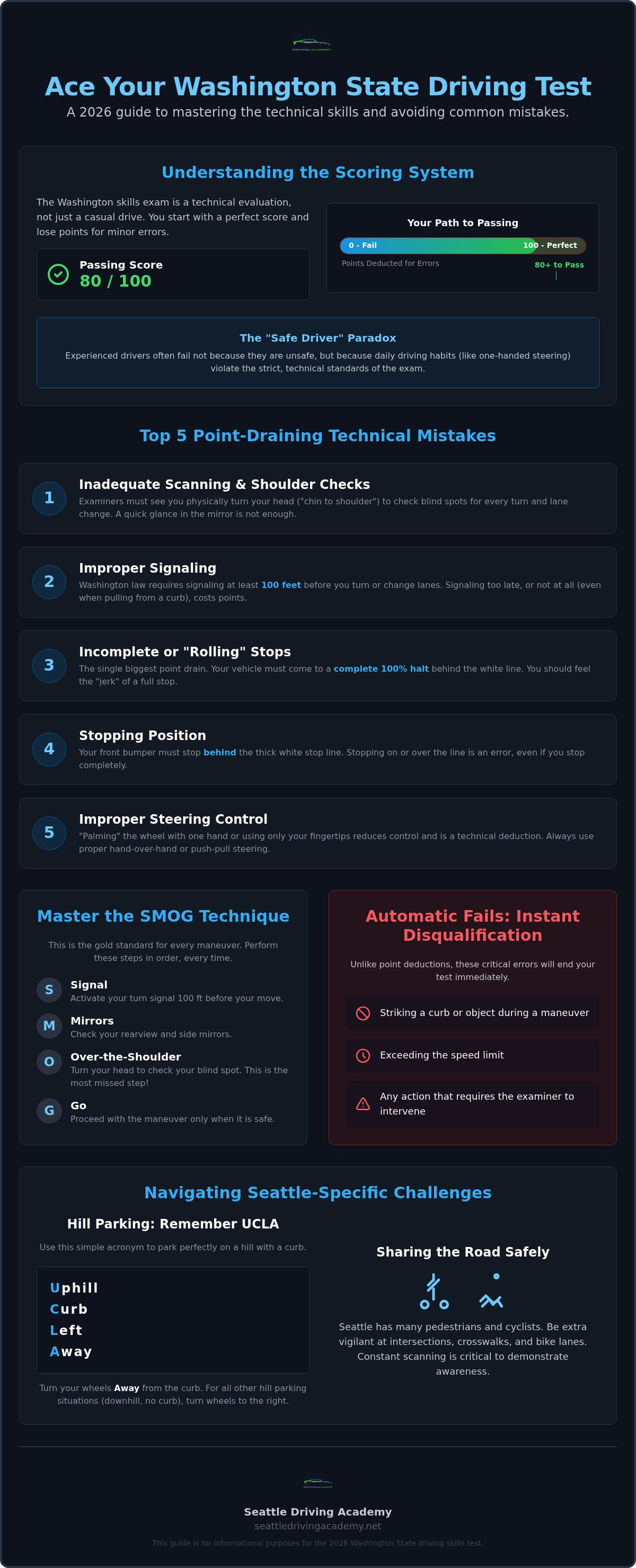
Many people think a driving test is just a quick check to see if you can handle a car without causing a scene. In Washington, it's actually a standardized technical evaluation. You start with a perfect 100 points, and every minor slip-up chips away at that total. To walk away with your license, you need to maintain a score of at least 80. This is where the common mistakes on driving test washington state start to add up, often surprising those who have been behind the wheel for years.
We often see a "Safe Driving" paradox. A driver might have decades of experience without a single ticket, yet they struggle on the skills exam. This happens because "safe" in daily traffic often involves following the flow of other cars, whereas the exam demands strict adherence to the Washington Driver Guide. Your muscle memory is your biggest asset on a commute, but it can be your worst enemy during a test. Those ingrained habits, like one-handed steering or checking mirrors too quickly, are exactly what an examiner is trained to penalize.
The Examiner’s Scorecard: How You Are Actually Rated
Every examiner at an authorized testing center uses a standardized rubric to keep things fair across the state. They aren't there to trick you or ask you to perform illegal maneuvers. Their goal is to ensure you can demonstrate specific skills under pressure. They look for compliance with the law, not how well you keep up with Seattle's aggressive traffic. If the guide says you must stop for several full seconds, then a two-second pause is a technical error, even if the road is completely clear.
The High Cost of Small Habits
Rolling stops are the single biggest point drain for adult learners. You might feel like you've stopped, but if the wheels are still moving, you're losing points. Another frequent issue is "palming" the steering wheel during turns. While it feels natural, it's a technical deduction because it reduces your total control. A technical error is defined as any deviation from the safety standards set by the Washington Administrative Code (WAC). These small deviations are the most common mistakes on driving test washington state that lead to a frustrating fail result. Understanding that the examiner is looking for precision, not just not crashing, is the key to success.
The Top 5 Technical Mistakes That Drain Your Score
Passing isn't about being a perfect driver; it's about being a precise one. Even the most confident students can find themselves losing points for things they do every day without thinking. These common mistakes on driving test washington state usually stem from being a bit too relaxed behind the wheel. To keep your score above that 80-point threshold, you need to focus on the technical details that examiners prioritize. Small habits like one-handed steering or drifting during a turn might feel natural, but they signal a lack of control to the person with the clipboard.
Inadequate scanning is the most frequent reason for point loss. It's not enough to just glance at your mirrors; you have to prove to the examiner that you are checking your blind spots. You must also use your blinker for every turn, lane change, and even when pulling away from a curb. Washington law requires you to activate your signal at least 100 feet before you move. Stopping on or over the white line is another common trap. Your front bumper must stay behind that line to avoid a violation. Finally, ensure you are making complete stops. You should feel the slight "jerk" of the car coming to a complete 100% halt before you proceed.
Mastering the SMOG Technique
The gold standard for any maneuver is the SMOG technique: Signal, Mirrors, Over-the-shoulder, and Go. The "Over-the-shoulder" part is where most students stumble. A true shoulder check means turning your head so your chin nearly touches your shoulder. We recommend making these head movements slightly exaggerated. If the examiner doesn't see your head move, they can't give you credit for the check. If you want to refine these habits, our pre-test warm up practice is designed to help you master these exact movements under professional guidance.
The "Two-Stop" Rule for Stop Signs
Visibility is often blocked by trees or parked cars at Seattle intersections. The law requires you to stop behind the limit line first. Once you've made that legal stop, you can creep forward for a better view. This second look is safe and encouraged. It's much better than the "California Roll" which results in immediate point deductions. Taking that extra second to ensure the path is clear shows the examiner you prioritize safety over speed. This simple two-step process can be the difference between a passing grade and a frustrating retake.
Automatic Failures vs. Point Deductions: Knowing the Difference
One of the biggest sources of anxiety for our students is the fear that a single small error will end their test immediately. It is helpful to remember that the Washington skills exam is designed to see if you are a safe, predictable driver, not a robot. While there are several common mistakes on driving test washington state that will cost you points, most of them won't result in an immediate fail. You have a 20 point buffer to work with, and your examiner actually wants to see you succeed. They prioritize safety over absolute precision parking every single time.
The scoring system splits errors into two categories: "Accumulated Errors" and "Dangerous Actions." Accumulated errors are technical slips, like forgetting a shoulder check or taking a turn a bit too wide. These take small bites out of your 100 point starting score. Dangerous actions, however, are automatic failures. These include things like speeding, disobeying a traffic signal, or striking a curb. If your actions force another driver to slam on their brakes or swerve to avoid you, the test will end right there. Knowing which mistakes are "expensive" helps you prioritize your focus during the drive.
Immediate Disqualification (Dangerous Actions)
A "Dangerous Action" is anything that creates an immediate safety risk. The most common reason for an automatic fail is examiner intervention. If your examiner has to grab the steering wheel or step on the dual brake to prevent a hazard, the test cannot continue. Striking the curb is another big one. While a light brush during parallel parking might just cost you 4 points, jumping the curb or hitting it hard with your tire is a disqualification. You must also be extremely vigilant about pedestrians. In Washington, you must yield to any pedestrian as soon as they show intent to cross, even if they haven't reached your lane yet.
The Math of Passing: Managing Your 20-Point Buffer
You don't need a perfect score to pass; you just need an 80. This means you can afford to "sacrifice" a few points on maneuvers that make you nervous. If you're struggling to get perfectly close to the curb during your backing around a corner maneuver, it's often better to stay a bit further away and take a small point deduction rather than risking a curb strike. Some errors are more costly than others. For example, missing a signal is usually a 5 point deduction because it impacts other drivers, while a wide turn might only be 2 points. When you are Choosing the Right Driver License Testing Center, look for a place that feels supportive, as a calm environment makes it much easier to manage your points and stay focused on the road ahead.
Navigating Seattle-Specific Road Challenges in 2026
Seattle's geography creates a unique set of hurdles that aren't always found in other parts of the state. From steep inclines to a dense network of transit lanes, you have to stay alert to avoid the common mistakes on driving test washington state that are specific to our city's layout. One of the most frequent traps for students is the bus-only lane. These restricted lanes are clearly marked with paint and signs, and accidentally driving in them during your test is a quick way to lose points. You also need to adjust your driving for our famous weather. If it's raining during your exam, you should increase your following distance beyond the standard three seconds. This shows the examiner you understand how to maintain safety when the roads are slick and visibility is reduced.
The Seattle Hill Start and Parking
Parking on our steep hills is a mandatory part of the skills exam, and it's where many people get confused about wheel direction. To keep it simple, use the UCLA acronym: Uphill, Curb, Left, Always. This means if you're parking uphill next to a curb, you turn your wheels to the left. In every other scenario, whether you're facing downhill or there's no curb at all, you turn them to the right. Seattle examiners often use quiet neighborhood hills for this maneuver, so practicing your hill starts is essential. You need to be able to move from a stop on an incline without rolling backward. While rare for modern tests, if you're driving a manual, using the emergency brake to assist your start is a smart move that examiners appreciate. For more context on handling these unique grades, Navigating Seattle Roads: Safety Tips for New Drivers offers great additional advice.
Sharing the Road with Seattle Cyclists
Our city has a high density of vulnerable road users, and the law is very protective of them. A common error is the "Right Hook," where a driver turns right across a bike lane without checking for cyclists first. You must always look over your shoulder and check your mirrors before crossing into a bike lane to make a turn. Additionally, you need to remember the 3-foot passing rule. If you're passing a cyclist, you have to give them plenty of space. Failing to yield to a cyclist or pedestrian is a dangerous action that leads to an immediate fail. To make sure you're ready for these high-density areas, you can book a driver license driving test at our authorized center, where we help you navigate these local challenges with total confidence.
The Ultimate Fail-Safe: Pre-Test Warm Ups at Seattle Driving Academy
The morning of your driving test can feel like a whirlwind of nerves and "what-ifs." Even if you've spent weeks studying the handbook, the pressure of the moment often leads to those small, technical slips we've discussed. At Seattle Driving Academy, we've developed a solution to eliminate those "cold feet" errors. Our pre-test warm up practice is designed to be your ultimate fail-safe. By getting behind the wheel right before your official exam, you can shake off the jitters and lock in your focus on avoiding the common mistakes on driving test washington state that trip up so many others.
One of the biggest advantages of this session is the vehicle itself. You'll have the opportunity to practice in the exact same car you'll use for the skills test. This means there are no surprises with the brake sensitivity or the steering feel when the examiner sits down beside you. Our instructors act as your expert guide, quickly identifying any 2026 technical flaws in your habits before they cost you points on the scorecard. By catching these common mistakes on driving test washington state during your warm-up, you ensure a much smoother experience during the actual evaluation.
Why Professional Prep Beats Solo Practice
While practicing with friends or parents is helpful for building basic comfort, they often overlook the "test-ready" standards that examiners demand. Your dad might be a great driver, but he likely doesn't know the specific WAC safety standards for shoulder checks or stop-line positioning. Our instructors provide a mock test environment that simulates the real pressure of the exam. This helps you build the mental resilience needed to stay calm under observation. For those who feel they need more than a quick refresher, our Adult Drivers Training 3 Hour Package offers a deeper dive into mastery.
Booking Your Skills Test with Confidence
Choosing where to take your exam is just as important as how you prepare. Testing at an authorized center like ours offers a level of convenience and personal attention you won't find at a busy DOL hub. You can schedule your Department of Licensing Test Package directly with us, allowing you to test in a familiar environment with people who are invested in your success. We are here to support you through every step of this journey. Once you pass, you'll unlock a new world of freedom and opportunity that comes with being a licensed Washington driver. Let's get you on the road with confidence.
Unlock Your Freedom on Washington Roads
The journey to earning your license doesn't have to be a stressful ordeal. By focusing on technical precision, such as mastering the SMOG technique and understanding the "two-stop" rule at Seattle intersections, you're already ahead of the curve. Remember that examiners are looking for safe, predictable habits rather than absolute perfection. Avoiding the common mistakes on driving test washington state is much easier when you have a clear strategy for managing your points and navigating local challenges like hilly terrain and busy bike lanes.
We're here to be your supportive partner every mile of the way. As an authorized DOL testing center with patient, expert instructors and a convenient Seattle location, we provide the professional guidance you need to succeed. Don't leave your results to chance on test day. Book Your Washington State Skills Test & Pre-Test Warm Up Today and experience the difference that expert preparation makes. You've put in the work, and now it's time to claim the freedom and independence that comes with your new driver's license. We can't wait to see you on the road!
Frequently Asked Questions
What is the most common reason people fail the driving test in Washington?
Inadequate scanning and missing shoulder checks are the top reasons for point loss. Many applicants fail because they don't make their head movements obvious enough for the examiner to see. Another frequent issue involves technical habits like rolling stops or improper lane positioning. Understanding these common mistakes on driving test washington state allows you to focus your practice on the specific areas that examiners prioritize during the evaluation.
How many mistakes can I make on the WA driving test and still pass?
You start with a perfect 100 points and must achieve a score of at least 80 to pass. This gives you a 20 point buffer to manage technical errors. Different mistakes carry different weights; for example, a missed signal might cost more than a wide turn. As long as you avoid "Dangerous Actions" that result in an automatic fail, you can make several minor errors and still walk away with your license.
Is parallel parking required on the Washington State driving test in 2026?
Yes, parallel parking remains a core requirement of the skills exam in 2026. Examiners also look for mastery in backing around a corner and parking on hills using the correct wheel direction. While these maneuvers can be intimidating, they are simply technical skills that you can master with practice. We often recommend a pre-test warm up to help you refine these specific movements right before your official test begins.
Can I use my own car for the driving test at Seattle Driving Academy?
You are welcome to use your own vehicle, provided it is in safe working condition with functional turn signals, brake lights, and a parking brake. It must also have valid insurance and registration. If you prefer, you can use one of our academy vehicles for the test. Many students find this helpful because it ensures the car meets all state requirements and is the same one they used during their practice sessions.
What happens if I fail my driving test in Washington State?
If you don't pass on your first attempt, don't be discouraged; many successful drivers need more than one try. You can schedule a retake at our authorized testing center after a short waiting period. Use the feedback from your examiner to focus on the specific areas where you lost points. We offer individual driving lessons to help you polish those skills so you can return for your next attempt with total confidence.
Do I need to bring my own insurance and registration to the test?
Yes, if you choose to use your own car, you must provide valid proof of insurance and current registration. The vehicle must also be in good mechanical shape to pass a quick safety inspection before the drive. If you don't have access to a vehicle that meets these standards, we provide well-maintained cars for our students to use during their official skills exam to ensure everything goes smoothly.
Is the driving test harder in Seattle than in other WA cities?
The test itself follows the same standardized rubric used across the entire state to ensure fairness. However, Seattle presents unique environmental challenges like steep hills, high pedestrian density, and complex bike lanes. While the grading is the same, the "real-world" application of your skills requires extra alertness. Our instructors are experts at helping you navigate these specific local hurdles so you feel prepared regardless of the route's complexity.
Can I take the driving test in rain or snow?
Driving tests in Washington proceed in the rain, as we expect our drivers to be competent in all typical weather conditions. You should adjust your following distance and speed to account for wet roads. If there is extreme snow or ice that makes the roads unsafe, we will work with you to reschedule your appointment. Learning to handle these conditions is a vital part of becoming a safe and capable driver in the Pacific Northwest.


