

Did you know that a single missed turn signal can cost you more points than a messy parallel park? While most drivers lose sleep over backing into a tight spot; the reality of the Washington state driving test is that 36 points are tied directly to your signaling, while parallel parking only accounts for four. It's easy to feel overwhelmed by the pressure, especially when you're worried about the common mistakes on washington driving test examiners are trained to spot. We know how much you want that license, and we understand the fear of having to pay for a re-test because of one confusing Seattle intersection.
You don't have to face this milestone alone. We've helped countless students transform anxiety into mastery by focusing on what matters to the Department of Licensing. In this guide, we'll show you how to maintain your score above the required 80 points and avoid automatic failures that catch people off guard. You'll get a clear, 2026 checklist that explains how the scoring works, which traffic laws are the trickiest, and how to stay calm so you can pass on your very first try.
Key Takeaways
- Learn how the Washington scoring system works and why maintaining an 80-point threshold is the key to your success.
- Identify high-point technicalities, such as constant scanning and proper signaling, to help you avoid the most common mistakes on washington driving test.
- Familiarize yourself with the "Big Four" automatic failures so you can steer clear of instant disqualifications like curb strikes or dangerous maneuvers.
- Gain confidence in local conditions by mastering hill parking and wet-weather driving techniques specific to the Seattle area.
- Find out how a professional pre-test warm-up can help you polish your skills and walk into your exam feeling completely prepared.
Decoding the Washington State Driving Test Scoring System
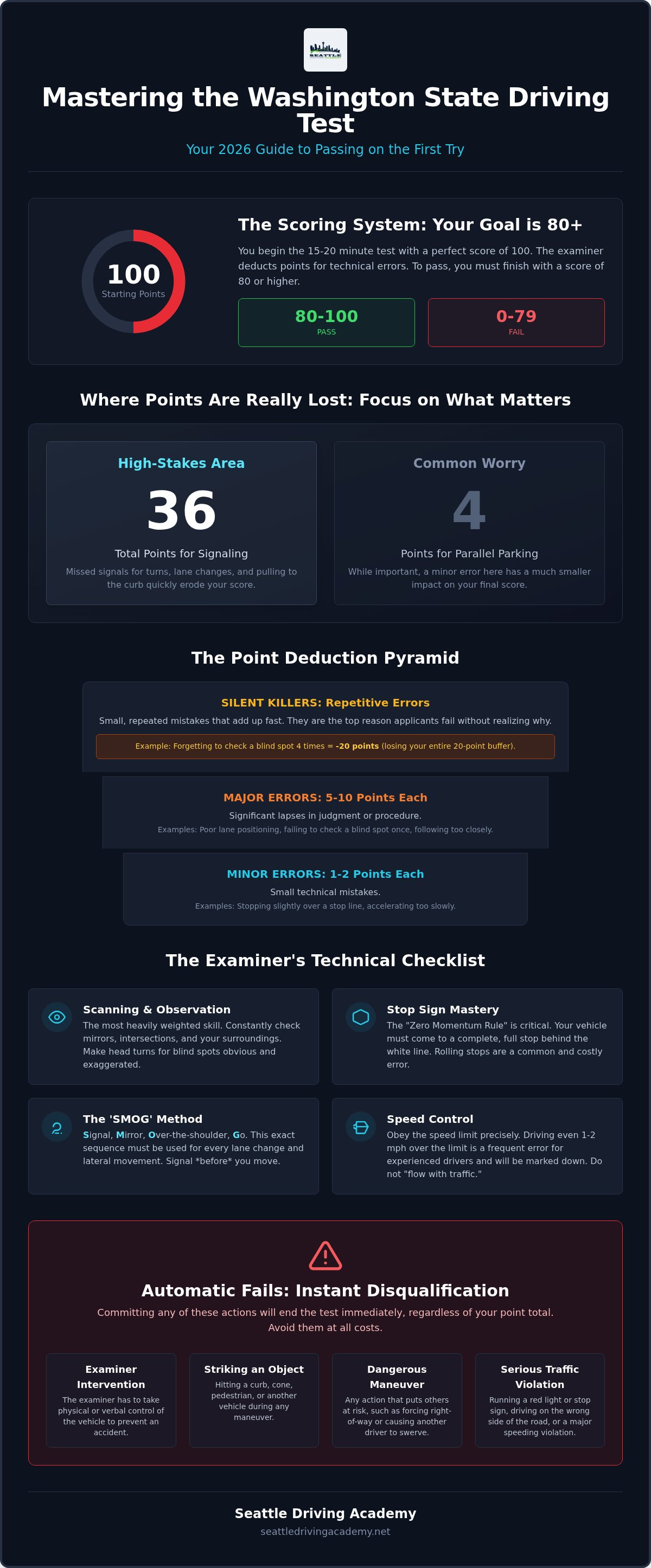
Many people walk into their skills exam thinking they just need to prove they are a "good driver." However, the Washington State road test is less about your natural intuition and more about your ability to follow a rigid set of technical rules for a focused 15 to 20 minute window. It's a high-stakes performance where you start with a perfect score of 100. Your goal is to keep that number at 80 or higher by the time you put the car back in park. While the U.S. driver's license system provides a general framework for road safety, Washington's specific scoring model is designed to catch technical lapses that often go unnoticed in daily life.
Examiners are trained to be completely objective. They aren't looking for a "vibe" or judging you based on personal opinion; they're simply recording observed errors on a standardized score sheet. This is why understanding the common mistakes on washington driving test scoring sheets is your best defense against a failing grade. You need to distinguish between technical errors, which chip away at your score, and "Automatic Fails," which end the test immediately regardless of how well you've driven up to that point.
The Point Deduction Pyramid
Think of your score as a bucket of water with small holes. Minor errors are 1 or 2 point deductions. These might include stopping slightly over a white stop line or accelerating a bit too slowly after a light turns green. Major errors are more serious, typically costing 5 to 10 points. These include failing to check a blind spot during a lane change or poor lane positioning. The real danger lies in what we call "Silent Killers." These are the small, repetitive mistakes that add up to a failing 79 faster than you might expect. For example, if you forget to check your blind spot four times, you've already lost 20 points and exhausted your margin for error.
Why Experienced Drivers Often Fail
If you're an adult learner or someone moving from another state, you might find the technicalities surprisingly strict. Veteran drivers often fail because they've developed "slippery habits" over the years. Rolling stops are a massive issue; if the car doesn't come to a complete, neck-snapping halt, it's a technical error. Even speeding by a mere 1 or 2 mph is one of the most frequent veteran errors during the exam. The test measures your total compliance with the law, not your ability to flow with the speed of surrounding traffic. Mastering these common mistakes on washington driving test criteria is the only way to ensure you walk away with your license on the first try.
The Technical Checklist: High-Point Errors to Guard Against
While many applicants fixate on the difficulty of parallel parking, the examiner is actually watching your eyes. Scanning and observation are the most heavily weighted behaviors throughout the entire test. You must demonstrate that you're constantly aware of your surroundings, not just staring straight ahead. This includes checking intersections before entering them and glancing at your mirrors every few seconds. If you don't show active awareness, the points will start to disappear before you even leave the first neighborhood.
Turn signals are another high-stakes area that often surprises students. According to the Washington Driver Guide, you must signal for every turn, lane change, and maneuver. This includes the small movements, like pulling over to the curb or exiting a parking spot. In fact, signaling correctly is worth a total of 36 points on the test. If you skip a few signals, you'll quickly find yourself below the passing score. It's a simple habit to master, but it's one of the most frequent ways people lose their margin for error.
Mastering the 'SMOG' Technique
The sequence for any lateral movement must be "SMOG": Signal, Mirror, Over-the-shoulder, Go. A frequent error is signaling after you've already started turning the wheel. You need to give other drivers time to react. We often recommend the "Exaggerated Head Turn" to our students. If you just move your eyes, the examiner might not see it. Make your blind spot checks obvious so there's no doubt you're being safe. If you're feeling unsure about your form, a quick pre-test warm up practice can help you iron out these technicalities before the examiner gets in the car.
Stop Signs and Intersection Management
One of the most frequent common mistakes on washington driving test attempts is the rolling stop. To pass, you must prove you have zero momentum. This means a full stop behind the stop line. Stopping on, instead of behind, a stop line results in a 2-point deduction. You also need to manage your space cushion. When stopping behind another vehicle at a red light, you should be able to see their rear tires touching the pavement. This buffer is constantly evaluated. Finally, be decisive at 4-way stops. Hesitating too long when it's your turn can result in points for impeding traffic, while going out of turn is a failure to yield. Mastering these technical habits ensures you stay on the right side of the scoring sheet.
The 'Big Four' Automatic Failures on the Washington Road Test
While the point-deduction system gives you some room for minor errors, there are certain behaviors that end the evaluation instantly. These "Automatic Failures" are non-negotiable because they represent a direct risk to public safety. We know how much effort you've put into your practice, so understanding these is vital; they are often the most heartbreaking common mistakes on washington driving test attempts because the test stops right then and there. We want you to feel empowered, not intimidated, by these rules, so let's break down exactly what to avoid.
A collision or accident is the most obvious auto-fail. However, it doesn't have to be a multi-car crash to count. Even a "love tap" on a curb during parallel parking or backing around a corner can trigger an immediate failure. If the wheel strikes the curb with enough force to jar the vehicle, or if you actually drive up onto the sidewalk, the examiner is required to stop the test. It's always better to take an extra second to adjust your position than to rush and strike an object.
Speeding is another common pitfall that catches many confident drivers off guard. In Washington, exceeding the posted limit by more than 5 mph is an automatic disqualification. This rule is especially strict in construction zones where workers are protected by law. Finally, a total failure to stop at a red light or stop sign will result in an immediate trip back to the testing center. Even if the intersection is completely empty, your wheels must stop moving entirely to satisfy the legal requirement.
What Counts as a 'Dangerous Action'?
A "dangerous action" is a broad category that essentially means the examiner had to step in, either verbally or physically, to prevent trouble. This includes anything that forces another driver or a pedestrian to take evasive action. If a pedestrian has to pause their walk or change their pace because you entered a crosswalk too early, that is an automatic fail. Similarly, driving on the wrong side of the road or failing to yield to an approaching emergency vehicle are rare but definitive ways to end your test early. We recommend keeping a wide berth around all other road users to ensure your safety and your success.
The School Zone Trap
Examiners frequently choose routes that pass through school zones to test your situational awareness. You must be hyper-aware of flashing yellow lights or signs that say "When Children Are Present." In Washington, the "When Children Are Present" rule specifically means that the speed limit applies if children are on the sidewalk, waiting at a crosswalk, or walking anywhere within the school zone boundaries. Speeding in these zones is often treated as a more severe dangerous action than standard speeding, so keep your eyes peeled for those 20 mph signs. It's a simple check that proves you are a protective and responsible driver.
The Seattle Factor: Local Challenges and Road Conditions
Seattle is a beautiful place to drive, but its unique geography and urban density create specific hurdles that you won't find in a rural testing environment. While the scoring criteria are standardized across the state, the environment in which you're tested can lead to unique common mistakes on washington driving test attempts. Whether you're dealing with a sudden downpour or a steep incline in Queen Anne, your ability to adapt to these local conditions is exactly what the examiner is looking for. They want to see that you aren't just a "fair weather" driver, but a capable pilot who can handle the complexities of the Pacific Northwest.
One of the most significant local factors is the "Rain Factor." In Washington, driving tests are rarely canceled for rain. This means you must be prepared to demonstrate proper use of your windshield wipers and defrost settings before you even leave the parking lot. If your windows fog up and you don't know how to clear them quickly, it's a safety issue that can lead to an immediate deduction. Additionally, Seattle is a high-cycling city. Crossing a bike lane without performing a dedicated shoulder check is a major error. You must treat the bike lane as its own lane of travel; failing to do so is one of the most frequent technical errors we see in urban testing centers.
Hill Starts and Parking
Seattle's hills require a specific maneuver called the "Hill Park," which is a dedicated 5-point check on your score sheet. If you're parking uphill with a curb, remember the phrase "Up, Up, and Away." You should turn your wheels away from the curb so the back of the tire would hit the curb if the car rolled. If you're parking downhill or on a street with no curb, you must turn your wheels toward the edge of the road. Using your parking brake is not just a good habit; it's a required part of the maneuver. Failing to set the brake during a hill park is an easy way to lose points. You can find more detailed tips on navigating Seattle's hilly terrain to ensure you're ready for the climb.
Navigating Shared Roadways
The "Green Box" and specialized bike lane intersections in Seattle can be confusing for even the most experienced drivers. When you see these markings, you must be extra vigilant about yielding to cyclists. Furthermore, you must remember the unmarked crosswalk rule. In Washington, every intersection is legally a crosswalk, whether there are painted lines or not. If a pedestrian is waiting at a corner in West Seattle or Capitol Hill, you must yield. Failing to yield to a pedestrian is a dangerous action that will end your test instantly. If you want to practice these specific urban challenges with a mentor who knows the city, we invite you to visit our authorized driver license testing center for a pre-test session.
How to Ensure Success: The Seattle Driving Academy Advantage
Navigating the technicalities of the road is only half the battle. The other half is managing the nerves that naturally come when an examiner sits down next to you with a clipboard. At Seattle Driving Academy, we believe that your success depends on feeling prepared, supported, and confident. As an authorized driver license testing center, we provide a familiar and professional environment where you can showcase your skills without the clinical coldness of a government office. We treat every student like a member of our own family; we ensure that you aren't just another number on a schedule, but a driver we are proud to see on the road.
Our team acts as your expert guide, anticipating the hurdles you might face and offering solutions before you even have to ask. We understand that the fear of failing and having to pay for a re-test is a significant pain point for many. By projecting a sense of patience and dedication, we work to transform this high-stress milestone into a manageable and empowering journey. You've already learned the rules of the road; now, let us help you master the specific art of the Washington state driving exam.
The Pre-Test Warm-Up: Your Secret Weapon
The Pre-test warm up practice and driving skill test is our way of helping you catch those "slippery" habits before they can cost you your license. This 30-minute session happens right before your exam, giving you a chance to polish your parallel parking and backing around a corner in the exact vehicle you'll use for the test. It's the best way to get immediate feedback on your scanning and signaling from a professional instructor. This focused practice effectively neutralizes the common mistakes on washington driving test scoring that often trip up even the most talented students. It calms your nerves by letting you review the expectations right before the examiner steps into the car.
Comprehensive Packages for Every Stage
Our packages are designed to meet you exactly where you are in your journey. The Teen Complete Package provides a comprehensive foundation, covering everything from the initial knowledge test to the final skills evaluation. For older students, our Adult Drivers Training 3 Hour Package is a focused session that polishes your existing skills. This is especially helpful for those who learned to drive in other states or countries where the rules might differ slightly. We help you understand exactly what the examiner is looking for, ensuring you don't fall victim to the common mistakes on washington driving test scoring that catch veterans off guard. Our goal is to unlock your potential and help you achieve the freedom that comes with a license. Schedule your driving test with us today to experience a supportive, professional testing environment.
Take the Wheel with Confidence
You now have the roadmap to navigate the technicalities of the Washington State road test. By mastering the scoring system and staying vigilant against the common mistakes on washington driving test examiners are trained to spot, you've already built a strong foundation for your success. Remember that passing is about more than just steering; it's about demonstrating consistent awareness and following the law to the letter, especially when navigating Seattle's tricky hills and busy intersections.
At Seattle Driving Academy, we're more than just an authorized WA Department of Licensing Testing Center. We're your partners in this journey. Our supportive, patient instructors are dedicated to helping you join our community of students who enjoy a high first-time pass rate. Whether you need a final polish or you're ready to prove your skills, we're here to guide you every step of the way. Book Your Pre-Test Warm-Up and Skills Exam Today and let's get you on the road. You've done the work, and now it's time to claim the freedom of your license. We can't wait to see you behind the wheel!
Frequently Asked Questions
What is the most common reason people fail the driving test in Washington?
The most frequent reasons for failure are dangerous actions and failing to yield the right of way. These errors often happen at intersections or when pedestrians are nearby. It isn't just about your technical skill; it's about making safe, predictable decisions that don't force other road users to take evasive action to avoid you. Staying calm and observant is your best defense against these high-stakes errors.
Can I fail the test if I can't parallel park perfectly?
No, you won't fail the entire test just because your parallel parking isn't perfect. This specific maneuver is only worth 4 points on your score sheet. While you should certainly practice, a minor error in positioning won't cause a failure as long as you don't strike the curb or commit an automatic disqualification. Focus on your signaling and scanning during the process to keep those points.
What happens if it starts raining during my Washington driving test?
Your test will almost certainly proceed as scheduled since Washington examiners rarely cancel for rain. You'll need to show the examiner that you can manage the conditions by using your windshield wipers and defrost settings correctly. Keeping your visibility clear and adjusting your following distance are key parts of demonstrating that you're a safe, prepared driver who can handle our local weather.
Is the Washington State driving test hard compared to other states?
The Washington test is known for being technically rigorous because it uses a very objective point-deduction system. You start with 100 points and must maintain at least 80 to pass the skills exam. While it's challenging, staying focused on the technical requirements helps you avoid the common mistakes on washington driving test attempts that often trip up those who rely solely on their "feel" for the road.
How many points can I lose and still pass the WA skills test?
You can lose up to 20 points and still walk away with your license. Since the passing score is 80 out of 100, you have a small buffer for minor technical errors like stopping slightly over a line. However, keep in mind that any single "Automatic Failure" ends the test immediately. This happens regardless of how many points you still have left in your bucket.
What items do I need to bring to my driving test appointment?
You must bring your photo ID or learner's permit and a vehicle that is legally licensed and registered. Your car needs to have valid proof of insurance, and all equipment must be in working order. This includes your brake lights, turn signals, and seatbelts. If your vehicle doesn't meet these safety standards, the examiner won't be able to start the test with you.
Can I use my own car for the driving test at Seattle Driving Academy?
Yes, you're welcome to use your own vehicle as long as it meets all Washington State safety and insurance requirements. Many students find that using a familiar car helps them feel more comfortable and avoid common mistakes on washington driving test maneuvers like parallel parking. If you don't have a vehicle available, we can often provide one for your exam through our testing packages.
Does hitting the curb during a maneuver result in an automatic failure?
Hitting the curb is considered an automatic failure if it's a hard strike or if the wheel goes over the curb. A very light touch might only result in a point deduction, but any action that jars the vehicle or poses a hazard will end the test instantly. It's always safer to stop, check your surroundings, and adjust your position rather than risking a hard strike.


