

What if parallel parking depended less on memorizing an exact steering sequence and more on noticing your car’s position? If you’re searching for how to parallel park for driving test seattle, it’s understandable to worry about judging the curb, nearby vehicles, and when to turn. A repeatable process can make the maneuver more manageable, even when the space or setup changes.
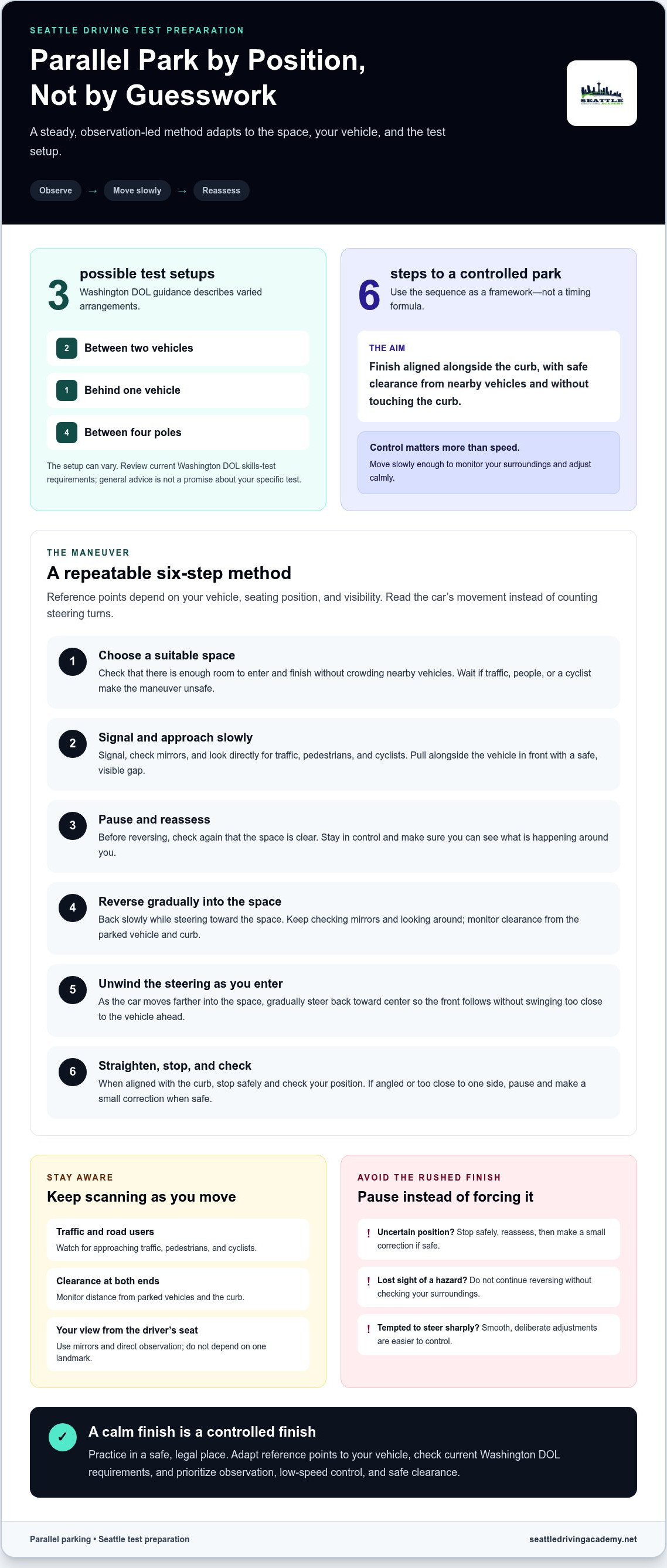
This guide covers a step-by-step approach, adaptable reference points, and safe ways to correct your position instead of rushing. Washington’s DOL skills test may use two vehicles, one vehicle, or four poles for the parallel-parking maneuver, so practising observation and control matters more than memorizing one setup.
You’ll also find common test-day mistakes to avoid and practical ways to prepare for Seattle driving conditions. Focused practice, including an individual lesson or pre-test warm-up, can help you build steadier habits before test day.
Key Takeaways
- Understand what parallel parking involves and why checking current Washington skills-test guidance can help you prepare.
- Use a steady sequence for how to parallel park for driving test seattle, from signaling and checking your surroundings to reversing and aligning.
- Recognize how rushing, late observation, or oversteering can affect your position, and learn when to pause and correct calmly.
- Build a practice routine that progresses from wider spaces to more realistic curbside parking as your control improves.
- Use an individual driving lesson or pre-test warm-up to work on vehicle-specific reference points and strengthen your confidence.
Why parallel parking matters for a Seattle driving test, and what to verify
Parking between vehicles can feel stressful when a driving test is approaching, especially if it’s hard to judge the curb or the space behind you. Parallel parking means positioning your vehicle beside the curb in a space between parked vehicles. It’s useful for everyday Seattle driving, whether or not a particular test route includes a street-parking situation. For a general overview of what parallel parking is, you can also review common steps and variations.
Keep practice techniques separate from test requirements. A technique can help you build control, but it doesn’t establish exactly what an examiner will ask you to do. To prepare for how to parallel park for driving test seattle, practise parking safely and review current Washington State Department of Licensing (DOL) skills-test requirements.
What does a successful parallel park look like?
A good park starts with a controlled approach and awareness of traffic, people, and nearby vehicles. As you reverse, move slowly enough to monitor clearance and adjust your steering. Finish aligned alongside the curb without crowding the vehicle ahead or behind. The goal is controlled placement, not a fast maneuver.
Reference points vary with vehicle size, seating position, and what you can see through the windows and mirrors. Rather than memorizing a steering count, practise noticing how the car responds at low speed. Pause when needed, reassess your position, and make a small correction when it’s safe.
Is parallel parking part of every Seattle driving test?
Don’t assume every examiner, testing site, or skills test uses the same parking setup. Washington DOL guidance describes parallel-parking assessments using two vehicles, behind one vehicle, or between four poles. The setup can vary, so general advice isn’t a promise about your specific test. Review the latest DOL skills-test requirements as you prepare.
For more about testing-center considerations, read the Seattle driving test center guide. Whatever setup you encounter, the fundamentals remain useful: observe carefully, move at a controlled speed, and leave safe clearance. Individual driving lessons and pre-test warm-up practice can help you build a steady routine and get comfortable with the vehicle you practise in.
How to parallel park: a repeatable step-by-step method
Practise only in a safe, legal place where you have room to stop and can watch for other road users. The steps below offer a dependable framework, not a fixed timing formula. Your vehicle’s size, visibility, and the space available affect when to steer, so move slowly and respond to what you can see.
- Choose a suitable space. Check that there’s enough room to enter and finish without crowding nearby vehicles. Don’t begin if traffic, people, or a cyclist make the maneuver unsafe.
- Signal and approach slowly. Signal your intention, check your mirrors, and look directly for traffic, pedestrians, and cyclists. Pull alongside the vehicle in front of the space, leaving a safe, visible gap. The right reference points depend on your vehicle’s dimensions and your view from the driver’s seat.
- Pause and reassess. Before reversing, make sure the space is still clear and check your surroundings again. Keep the car under control and make sure you can see what’s happening around you.
- Reverse gradually into the space. Begin backing slowly while steering toward the space. Keep checking your mirrors and looking around, rather than focusing on one reference point. Monitor the distance from the parked vehicle and curb as the rear of your car enters the space.
- Unwind the steering as you enter. As the car’s angle changes and it moves farther into the space, gradually steer back toward center so the front follows without swinging too close to the vehicle ahead. Use the car’s movement and your view to guide the timing instead of counting wheel turns.
- Straighten and secure the car. Once your vehicle is aligned with the curb, stop safely and check your position. If you’re angled or too close to one side, pause, reassess your clearance, and make a small correction when it’s safe. Don’t rush to finish in one motion.
Set up beside the vehicle in front
A useful setup gives you room to reverse while keeping the surrounding area visible. Before moving, scan for approaching traffic, pedestrians, and cyclists using mirrors and direct observation. Don’t rely on one windshield or mirror landmark: a reference point that works in one car may not suit another vehicle or a driver seated at a different height.
Reverse, straighten, and finish near the curb
As the vehicle enters the space, adjust the steering smoothly and keep checking clearance at both ends. Small, deliberate corrections are easier to control than sharp turns made in a hurry. Finish straight and close enough to the curb to be properly parked, without touching it or encroaching on nearby vehicles. Individual driving lessons can help you practise these steps and identify reference points that work in your vehicle. Learn about individual driving lessons.
Seattle parallel-parking mistakes, and how to correct them calmly
Rushing often makes a parking maneuver harder, not faster. Turning before checking the space, continuing to reverse after losing sight of a hazard, or steering sharply when uncertain can leave the car angled or too close to the curb. Seattle curbside parking calls for attention to visibility, parked vehicles, and busy streets. Give yourself time to observe, and practise where you can focus without pressure from moving traffic.
A useful habit for how to parallel park for driving test seattle is to treat each movement as a decision: check your surroundings, move slowly, and pause if you’re unsure. Don’t continue just because you’ve already started. A safe stop gives you a moment to reassess.
How do you avoid hitting the curb or another vehicle?
Keep your speed low and check mirrors and blind spots throughout the maneuver. Look around directly too, since mirrors can’t show everything. If you lose sight of a nearby car, cyclist, pedestrian, or curb edge, stop safely rather than guessing. Start practising in a spacious, low-pressure area, then work toward tighter spaces as your control and awareness improve.
What if the car ends up too far from the curb or crooked?
First, bring the car to a secure stop. Take a breath and check the space around you before deciding whether to adjust. If there’s room and it’s safe, use a small, deliberate movement to improve your alignment, then stop and reassess. Avoid abrupt steering or repeated movement when you can’t see the clearance clearly. Safe control matters more than forcing a perfect result in one motion.
Corrections are part of learning. During practice, consider what led to the position: perhaps you began turning too late, unwound the steering too soon, or relied on a reference point that doesn’t suit your view from the driver’s seat. Change one part of your approach at a time, then observe how the car responds. This makes it easier to build a method you can repeat.
An individual driving lesson or pre-test warm-up can help you practise calm observation and controlled adjustments. Explore Seattle driving practice and work on your parking routine with guidance.
How to practise parallel parking before your Washington skills test
Good practice is more than repeating the same turn. Build a routine that helps you notice what’s around the car, control your speed, and judge your position. Practise only in a safe, legal location and with appropriate supervision. Begin with a wide, low-pressure space, then make the setup more realistic as your control improves.
A simple practice routine for new drivers
Use this checklist for each attempt. Keep the steps consistent and focus on one adjustment at a time:
- Observe: Check mirrors and blind spots, and look directly for traffic, pedestrians, and cyclists.
- Set up: Signal and approach slowly, choosing a space with enough room to practise safely.
- Reverse: Move at a controlled pace while monitoring the car’s clearance and surroundings.
- Align: Gradually adjust your steering as the vehicle enters the space, aiming to finish straight beside the curb.
- Stop safely: Secure the vehicle, review its position, and decide whether a correction is safe.
Repeat the observation and setup sequence until it feels deliberate rather than rushed. Then change one condition, such as the space width or your starting position. You can also practise in different visibility and curbside conditions, but only when you can maintain a clear view and safe control. After each attempt, choose one specific adjustment for the next round, such as slowing down earlier or checking a blind spot before reversing. Avoid changing several parts of your approach at once, since that makes it harder to tell what helped.
What should you review before test day?
Parking practice builds vehicle control, but it isn’t a substitute for the official test rubric. Review current Washington State Department of Licensing skills-test requirements and any instructions provided with your appointment. Requirements and test setups can change, so use current official information rather than assuming a practice exercise exactly matches your assessment.
Prepare broadly, too. The skills test involves more than one parking maneuver, so continue practising observation, signaling, speed control, and other vehicle-handling skills. If you’re an adult learner who wants support beyond parking, the adult driving lessons guide offers a starting point for broader coaching.
For focused support, learn about individual driving lessons to practise vehicle control and build steady habits before test day.
Build test-day confidence with Seattle driving practice
Confidence comes from knowing what to check and having a process to return to when you feel nervous. Parallel parking may feel awkward at first, but calm observation, low-speed control, and thoughtful corrections become more familiar with practice. You don’t need every attempt to be perfect. Focus on learning how your vehicle responds and making each movement safely.
When can an instructor help with parallel parking?
An instructor can observe how you approach the space, check your surroundings, steer, and respond when your position needs adjusting. That feedback can help you notice habits that are difficult to catch from the driver’s seat, such as turning too early or relying on a reference point that doesn’t fit your view.
Vehicles differ in size and visibility, so a reference point that works in one car may not transfer neatly to another. Individual driving lessons give you a chance to practise with guidance tailored to what you can see and how the car moves. The aim is to strengthen your judgment and control, not promise a particular test result.
Make a practical next step before your test
Choose preparation that matches what you need most. If you want to work on a specific parking habit, an individual lesson can provide focused coaching. If your test is approaching and you’d benefit from a final review, pre-test warm-up practice gives you an opportunity to settle in, revisit vehicle-control skills, and approach the assessment with a familiar routine.
Before your appointment, review current Washington State Department of Licensing instructions and keep practising broader driving skills, not just parking. On test day, take a moment to settle, observe carefully, and use the deliberate process you’ve practised. Each safe, controlled attempt helps build habits you can use beyond the test.
Seattle Driving Academy offers individual lessons and pre-test warm-up practice to help you prepare. Explore driving test preparation with Seattle Driving Academy.
Take your next step toward confident driving
Learning how to parallel park for driving test seattle is easier when you focus on a repeatable process instead of memorizing one steering pattern. Signal, observe, move slowly, and pause to reassess whenever you’re unsure. Practising in a safe space and gradually working toward more realistic conditions can help you build control and confidence.
Review current Washington DOL test guidance, since practice advice and official test requirements aren’t the same. A driving lesson can help you find reference points that suit your vehicle and strengthen habits that matter beyond parking. Seattle Driving Academy offers individual driving lessons, pre-test warm-up practice, and official Department of Licensing knowledge and skills testing.
Choose preparation that fits your needs and take it one step at a time. Prepare for your driving test with Seattle Driving Academy. With steady practice and calm observation, you can arrive feeling more prepared for the road ahead.
Frequently Asked Questions
How do you parallel park for a driving test in Seattle?
Signal, check your surroundings, approach slowly, and reverse into the space with controlled steering. Use mirrors and direct observation throughout, then straighten the car and stop securely near the curb. Reference points differ by vehicle, so practise the sequence in the car you’ll use. For how to parallel park for driving test seattle, remember that a repeatable process is more useful than memorizing a fixed steering count. Check current Washington DOL guidance for test instructions.
Is parallel parking required on the Washington driving test?
Don’t assume parallel parking is required on every Washington driving test or at every testing location. Test procedures may vary, so review current Washington State Department of Licensing information and any instructions provided for your appointment. Even if a particular test doesn’t assess the maneuver, parallel parking is useful for everyday driving in Seattle, where curbside spaces are part of city driving. Separate general practice advice from the official requirements for your test.
How far should your car be from the curb when parallel parked?
Aim to finish close and reasonably parallel to the curb without touching it, but don’t rely on an unverified distance as a universal test rule. Your view is affected by the vehicle’s width, the curb’s shape, and your seating position. Check your alignment using mirrors and direct observation. During a test, follow the examiner’s instructions and current official guidance rather than assuming one curb-distance measurement applies to every setup.
What is the easiest way to parallel park without hitting the curb?
Move slowly, set up with enough room, and keep checking your mirrors and surroundings as you reverse. Use reference points suited to your vehicle instead of copying another driver’s exact steering count. If you’re unsure about your position or clearance, stop safely and look again before correcting. Practise first in a spacious, safe location, then gradually try tighter spaces as your control improves. Steady observation helps you avoid guessing.
Can you fail a Washington driving test for hitting the curb?
The result depends on current Washington DOL scoring criteria and the circumstances of the maneuver. Don’t assume curb contact automatically means either a pass or a failure without checking official guidance. In practice, focus on controlling speed, watching your clearance, and stopping safely if you need to reassess. A calm correction may be safer than continuing with poor visibility, but follow the examiner’s instructions during your test.
How can I practise parallel parking before my Seattle driving test?
Start in a safe, legal, low-pressure area with a wider space, and practise signaling, observation, reversing, steering, alignment, and stopping as one routine. As your control improves, work toward more realistic spaces and curbside conditions, changing one factor at a time. Review current Washington test information too, since practice isn’t the same as the official rubric. An individual lesson or pre-test warm-up can provide coached feedback.
Should I use a reference point to parallel park during my driving test?
Yes, a reference point can help you judge when to steer or straighten, but it should support your observation, not replace it. The right landmark depends on the vehicle, your seat position, and what you can see. Practise identifying useful reference points in the car you’ll drive while continuing to check mirrors and surroundings. Learn to adapt the method to the space instead of memorizing another driver’s exact timing.


