

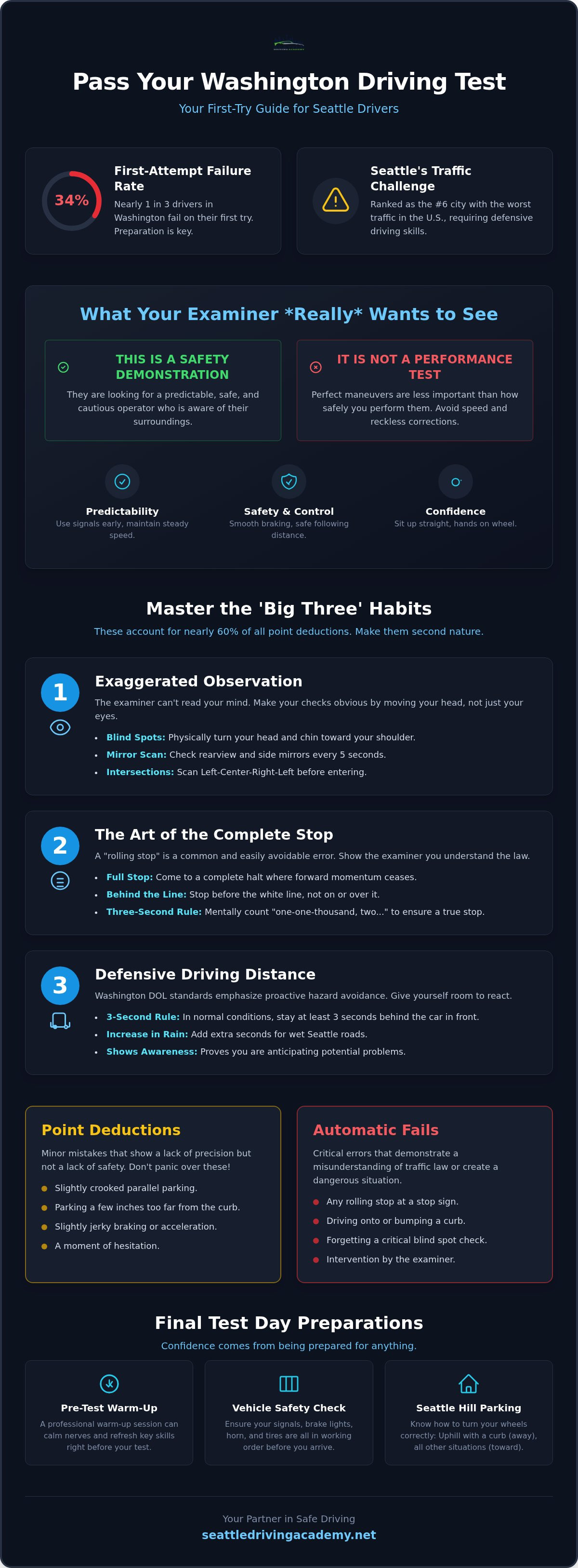
Did you know that nearly 34% of drivers in Washington fail their road test on the first attempt? That is a staggering statistic, especially when you consider that Seattle is officially ranked as having the 6th worst traffic in the United States. It's completely natural to feel a knot in your stomach when you think about navigating steep hills or busy intersections with an examiner watching your every move. You probably worry that a single silly mistake, like a rolling stop or a slightly bumped curb, will lead to an automatic failure. We understand those nerves because we see them every day, and we know how much that first taste of freedom means to you.
This guide offers the exact tips to pass the driving skill test by focusing on the specific safety habits and technical maneuvers that Washington State examiners prioritize. We're here to help you transform that test-day anxiety into quiet confidence so you can secure your license on the very first try. We will walk you through everything from mastering parallel parking to demonstrating the "invisible" observation skills that prove you're a safe, capable driver ready for the unique challenges of the Seattle roads.
Key Takeaways
- Understand that your examiner isn't looking for a race car driver; they want a predictable, safe operator who treats the exam as a safety demonstration.
- Discover the top tips to pass the driving skill test by mastering "invisible" habits like the three-second stop and exaggerated mirror checks.
- Learn the difference between a simple point deduction and an automatic fail so you don't panic if your parallel parking isn't perfect.
- Get the 2026 vehicle safety checklist and learn how to handle Seattle’s unique hill parking requirements with total confidence.
- Find out why a professional pre-test warm-up at an authorized center can be your secret weapon for calming nerves before the big moment.
Understanding the Examiner's Mindset: What They Really Want
When you step into the car for your road exam, it's easy to feel like you are being judged on your ability to drive like a seasoned professional. However, the reality is much more encouraging. In Washington State, the driving test is essentially a safety demonstration rather than a technical exhibition of high-level mastery. Your examiner isn't looking for a driver who can zip through traffic with surgical precision; they are looking for someone who is predictable, cautious, and deeply aware of their surroundings. One of the most effective tips to pass the driving skill test is to shift your focus from "performing" to simply being the most responsible version of yourself behind the wheel.
Examiners value predictability above almost everything else. If they can anticipate exactly what you are going to do next, they feel safe. This means using your signals early, maintaining a steady pace, and following the rules of the road without hesitation. Your confidence also plays a massive role here. When you sit up straight, keep both hands on the wheel, and check your mirrors with purpose, you signal to the examiner that you are ready for the responsibility of a license. This sense of readiness helps build immediate trust, which can make the entire process feel less like an interrogation and more like a partnership.
The Difference Between Skill and Safety
It is a common myth that you need to be a "perfect" driver to pass. We often see students panic because their parallel park ended up a few inches too far from the curb or slightly crooked. While accuracy matters, examiners care much more about how you got there. A slow, safe, and slightly imperfect park is always better than a fast, reckless one where you forget to check your blind spots. Smoothness is your best friend. When you avoid jerky braking and rapid acceleration, you show the examiner that you are in total control of the vehicle. If you feel comfortable, you can even briefly verbalize what you are doing, such as saying "checking my left for pedestrians," to prove your situational awareness.
Washington State DOL Standards for 2026
For 2026, the Washington Department of Licensing has placed an even greater emphasis on defensive driving as a core grading criterion. This means you must proactively look for potential hazards before they become problems. A major part of this is maintaining a safe following distance. The state handbook currently emphasizes a "three-second rule" under normal conditions, though you should increase this if Seattle's famous rain starts to fall. When you are choosing the right driver license testing center, it helps to find a place that treats you like a neighbor rather than just another number on a clipboard. Understanding these specific local priorities is one of the best tips to pass the driving skill test because it aligns your habits with exactly what the examiner is marking on their clipboard.
Mastering the 'Big Three' Habits to Pass the First Time
Success on your road test isn't just about luck; it's about building consistent habits that speak for you. In fact, nearly 60% of point deductions during the exam come from failing to master three fundamental behaviors. We call these the "Big Three." These aren't just technical requirements; they are the safety rituals that prove you are a safe driver. Mastering these tips to pass the driving skill test will significantly boost your chances of walking away with your license on the first try. Whether it's your mirror checks, your stops, or your lane changes, these habits are what examiners look for most.
Observation Skills: Moving Your Head, Not Just Your Eyes
One of the most common mistakes is assuming the examiner can see where your eyes are looking. They can't. If you only move your eyes to check your mirrors, the examiner might mark you down for failing to observe. You need to use "exaggerated" head movements. Your chin should physically move toward your shoulder during every blind spot check. We recommend a five-second mirror rotation; check your rearview and side mirrors every few seconds even when you're driving straight. When approaching a junction, follow the "Left-Center-Right-Left" scanning ritual. This shows you're actively searching for pedestrians and cyclists, which is a key part of What to expect on your drive test in Washington.
The Art of the Complete Stop
The "rolling stop" is a test-day epidemic that we want to help you avoid. Seattle neighborhoods are full of stop sign traps, often hidden by overgrown foliage or parked cars. To ensure you aren't penalized, every stop must be legally perfect. A legal stop requires three specific elements:
- Stopping completely behind the limit line or crosswalk.
- A full cessation of all forward motion (no "creeping" yet).
- A clear, internal three-second count before moving again.
If you can't see traffic from behind the line, stop fully first. Then, you can "creep" forward slowly to gain a better view without losing points. This demonstrates patience and caution. If you're feeling unsure about these maneuvers, practicing with a mentor at Seattle Driving Academy can give you the hands-on experience you need to feel ready.
Finally, never forget the SMOG sequence for every lane change or turn: Signal, Mirror, Over-the-shoulder, and Go. This sequence ensures you've checked every possible angle before moving. It's a simple rhythm, but it's one of the most vital tips to pass the driving skill test. By making these habits second nature, you'll feel much more relaxed when the examiner is sitting next to you.
Common Pitfalls: Automatic Fails vs. Point Deductions
Many students walk into their exam fearing that one tiny slip-up means they've failed. This simply isn't true. Understanding the difference between a point deduction and an automatic failure is one of the most empowering tips to pass the driving skill test. The scoring system is designed to allow for human error, provided those errors don't compromise safety. Most of your test is graded on a point scale, where you can lose a few points for a wide turn or a crooked park and still pass with flying colors. It's only when a mistake becomes a hazard that the test concludes early.
The 'Instant Fail' Hall of Fame
Certain actions are classified as "Critical Driving Errors." These are behaviors that represent an immediate safety risk to you, the examiner, or others on the road. Disobeying a traffic signal or rolling past a stop sign line, even by an inch, results in an instant failure. Speeding is another major trap that catches people off guard. In Seattle, school zones are strictly enforced; going even 1 MPH over the limit during restricted hours can end your test. Perhaps most importantly, you must yield to pedestrians at all intersections, whether they are marked or unmarked. This is a high-priority safety item that examiners watch closely in our busy city.
Beyond specific traffic violations, there is the "Dangerous Action" rule. This applies to any maneuver that forces the examiner to intervene to prevent an accident. If the instructor has to grab the steering wheel or hit the passenger-side brake, the test ends immediately. These interventions are rare for students who have practiced, but they serve as a reminder that the examiner's primary role is to ensure everyone returns to the testing center safely.
Recovering from Minor Mistakes
Let's talk about the number one fear: parallel parking. Many believe that if they don't get it perfect, they fail. In reality, parallel parking is rarely an automatic fail unless you strike the curb with significant force or jump over it. If you find yourself too far from the curb, take a breath and finish the maneuver. You might lose a few points, but you are still in the game. If you stall a manual engine or take a turn slightly too wide, don't let your mind wander to what went wrong. A single point deduction for a wide turn will not fail you, but a panicked reaction to that mistake might. Staying calm and focusing on the next instruction is one of the best tips to pass the driving skill test because it shows the examiner you have the emotional maturity to handle the stress of daily driving.
Test Day Logistics: Vehicle Prep and Seattle Terrain
Preparing for the logistics of your big day is just as vital as the driving itself. One of the most overlooked tips to pass the driving skill test is ensuring your vehicle is actually eligible to participate. If your car fails the safety inspection, your test will be canceled before you even put it in gear. You also need to be ready for the local geography; Seattle is famous for its steep inclines and unpredictable weather, both of which are tested during the exam. Arriving with the right documentation and a well-maintained vehicle shows the examiner that you are a responsible adult who takes safety seriously.
Is Your Car Test-Ready?
Before you head to the testing center, perform a thorough walk-around of your vehicle. The 2026 Vehicle Safety Inspection requires all brake lights, turn signals, and the horn to be in perfect working order. Examiners also strictly enforce the "Windshield Rule." If there is a crack in the driver's direct line of sight, or if your wipers are too worn to clear the glass, the test cannot proceed. Ensure your tires have adequate tread and that no major dashboard warning lights, such as the ABS or engine light, are active. You must also bring your physical instruction permit, proof of insurance, and current registration. While many things are digital now, some examiners still require hard copies for their records, so it is best to have them printed and ready in the glove box.
Navigating Seattle-Specific Challenges
Driving in the Pacific Northwest means you must be comfortable with the elements. If it is raining during your appointment, you are expected to use your wipers and headlights appropriately. This simple action demonstrates that you are a proactive driver who adapts to the environment. Then there are the hills. You will likely be asked to perform a "Hill Start" and demonstrate "Parking on Hills." Remember the rule for your wheels: when parking uphill with a curb, turn your wheels toward the street; for all other hill parking scenarios, turn them toward the curb. This prevents the car from rolling into traffic if the parking brake fails.
To ensure your vehicle and your skills are up to the task, consider booking a pre-test warm up practice and driving skill test to catch any last-minute issues before the examiner hops in. Seattle's narrow streets often feature "unmarked" intersections. In residential areas, you must treat these with extreme caution, yielding to the driver on the right if you arrive at the same time. Mastering the "curb turn" on these tight corners is essential to avoid hitting the sidewalk. For more advice on navigating Seattle roads safely, focus on your timing. Testing during high-traffic windows requires extra patience and a larger following distance. These specific tips to pass the driving skill test ensure that the environment doesn't catch you by surprise.
The Secret Weapon: Pre-Test Warm-Ups and Authorized Centers
Many students assume they have to visit a crowded, institutional Department of Licensing office to get their license. However, choosing a Department of Licensing authorized testing center like Seattle Driving Academy is often the smartest move you can make. It provides a much more familiar and supportive environment, which naturally lowers your stress levels. One of the best tips to pass the driving skill test is to eliminate as much external pressure as possible so you can focus entirely on your safety habits. Testing in a place that feels like a community hub rather than a cold government building can be the difference between a nervous mistake and a confident pass.
Why a Warm-Up Session Changes Everything
Imagine having a final rehearsal just before the curtain rises. A pre-test warm-up allows you to correct "lazy" habits, like forgetting to physically move your chin during a mirror check, just 30 minutes before they actually count against you. This session helps you acclimatize to the specific vehicle you'll use, ensuring the pressure of the brakes and the weight of the steering feel natural. It's about getting into the right mindset with a supportive instructor who acts as your mentor. During this time, we can refresh the "Big Three" habits we discussed earlier, making sure your stops are complete and your SMOG sequence is fluid. This short practice run clears the mental cobwebs and reminds your muscles exactly what to do when the examiner is watching.
Booking Your Test at Seattle Driving Academy
We pride ourselves on being a friendly, professional bridge between your training and your freedom on the road. Whether you've recently completed our teen driving lessons in Seattle or you are coming to us for specialized adult driving lessons, our team is dedicated to seeing you succeed. Our environment is designed to be low-pressure and highly organized, making the scheduling process as seamless as possible. We understand that this is a major life milestone, and we treat it with the care and patience you deserve. We even help you prepare for the exact types of routes you'll encounter during the exam.
As a final mental preparation, try simple breathing exercises while you wait. Take a slow breath in for four seconds, hold for four, and exhale for four. Use the "I am a safe driver" mantra to ground yourself. You have put in the work, you know the Seattle hills, and you understand the safety priorities. These final tips to pass the driving skill test are all about trusting your training. When you feel ready to take that final step toward your license, we are here to help you cross the finish line with confidence. Schedule your driving skill test and warm-up session today!
Take the Wheel with Total Confidence
Mastering the streets of Seattle is about more than just technical precision; it's about proving you are a safe, predictable driver. By focusing on the "Big Three" habits and understanding that your examiner is looking for a safety demonstration rather than a perfect performance, you have already cleared the biggest hurdle. Remember that even small mistakes don't have to end your journey if you stay calm and maintain your focus on the road ahead. These tips to pass the driving skill test are designed to give you the edge you need to succeed on your very first try.
As a DOL Authorized Testing Center with a convenient Seattle location and flexible scheduling, we are here to support you. Our expert instructors specialize in anxiety reduction, helping you transform those test-day jitters into quiet mastery. You have the knowledge and the skills. Now, it's time to put them into practice. Book Your Skill Test and Pre-Test Warm-Up at Seattle Driving Academy today. We can't wait to see you earn your license and finally enjoy the freedom of the open road!
Frequently Asked Questions
What happens if I fail my driving skill test the first time?
If you don't pass on your first try, don't worry; it is a common experience for many drivers in Washington. You'll need to wait at least one week before you can schedule a retake. This time is a great opportunity to practice the specific maneuvers that gave you trouble. If you fail multiple times, the waiting period between tests may increase. We are here to help you review those mistakes so you feel ready for round two.
How many points can I lose and still pass the road test in Washington?
You must achieve a score of 80 out of 100 to pass the Washington state road test. This means you can lose up to 20 points for minor errors, such as a slightly wide turn or an imperfect parallel park. As long as you avoid critical driving errors that result in an automatic fail, you have some room for small mistakes. Following professional tips to pass the driving skill test will help you keep your score high.
Do I have to provide my own car for the driving test in Seattle?
Yes, you typically need to provide your own vehicle for the exam at a DOL office. The car must be in good working order and pass a safety inspection. However, when you test at an authorized center like ours, you often have the option to use one of our professional training vehicles. This can be a huge relief if your personal car has a cracked windshield or a finicky blinker that might disqualify you from testing.
Is parallel parking required to pass the Washington state driving test?
Yes, parallel parking is a mandatory part of the skills test in Washington. You will be asked to park in a space about 25 feet long. While many students fear this maneuver, remember that it is worth a specific number of points. You won't automatically fail unless you strike the curb hard or create a safety hazard. We focus on simple, repeatable techniques to help you master this skill with total confidence during your lessons.
How long does the actual driving skill test take?
The actual driving portion of the test usually takes about 20 to 30 minutes. This includes the initial vehicle safety check and the time spent on the road performing various maneuvers. While it might feel like a long time when you are nervous, the route is designed to be a straightforward demonstration of your safety habits. Most students find that the time flies once they get into a comfortable, focused rhythm behind the wheel.
Can I take my driving test in the rain or snow?
You certainly can take your test in the rain; in fact, it's quite likely given our Seattle weather. Examiners expect you to adjust your driving by using wipers and headlights. However, if conditions become truly dangerous, such as heavy snow or ice, the testing center may reschedule for everyone's safety. Being able to drive safely in the rain is a key part of demonstrating your readiness for a Washington license and shows your maturity.
What should I bring to my driving test appointment?
You must bring your valid Washington instruction permit and a vehicle that passes the safety inspection. If you're using your own car, bring the current registration and proof of insurance. It's also a good idea to have your appointment confirmation handy. Having these documents organized in a folder helps you start the day on a calm, professional note. This level of preparation is one of the most practical tips to pass the driving skill test.
Can I use a backup camera during my driving test?
You can use a backup camera if your vehicle is equipped with one, but you cannot rely on it exclusively. Examiners will watch to ensure you are still physically turning your head to check your surroundings and mirrors. Think of the camera as an extra tool rather than a replacement for your own eyes. Demonstrating that you can scan the entire area manually is vital for showing that you are a safe, attentive driver.


