

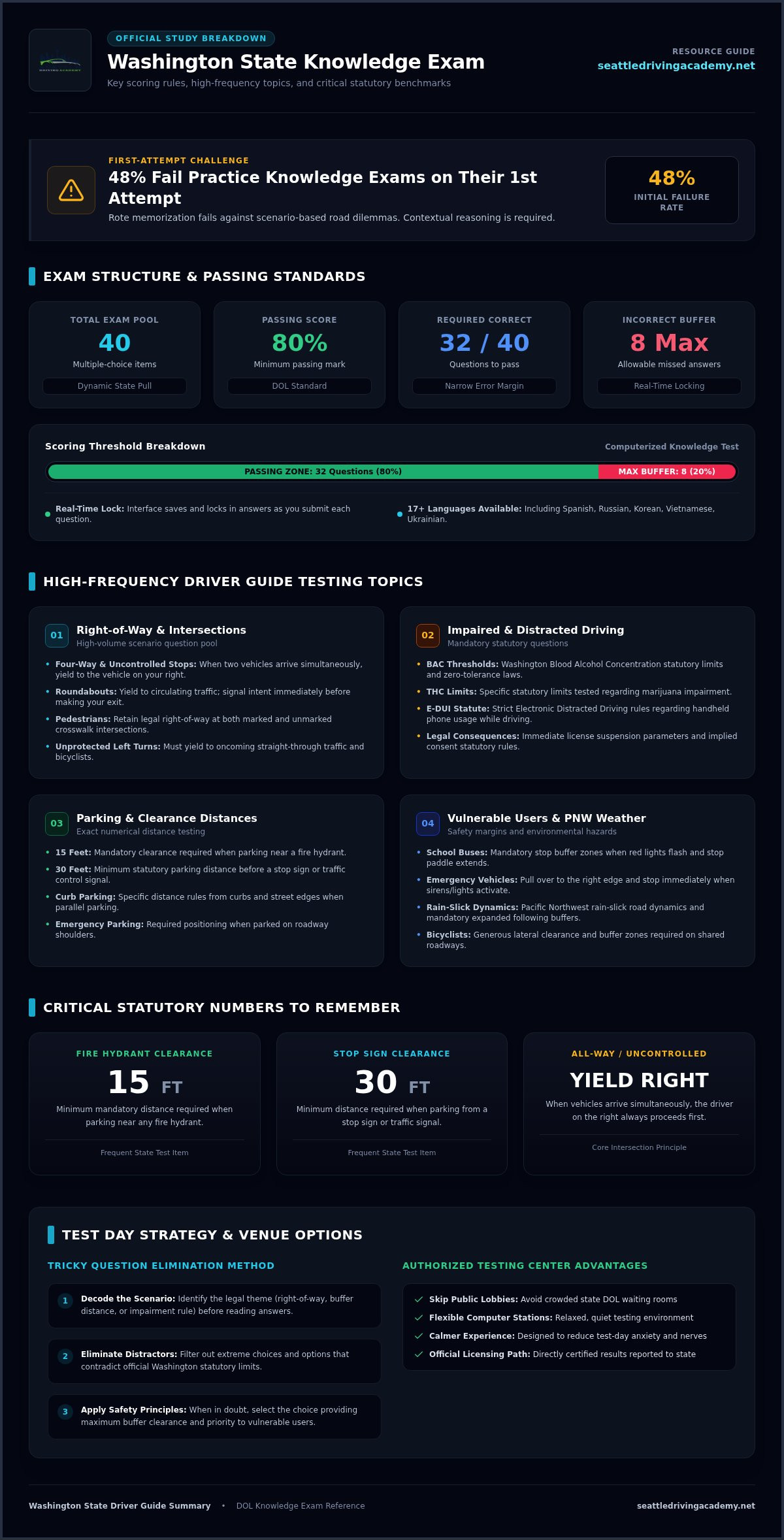
Roughly 48% of test-takers fail practice knowledge exams on their first attempt, and it isn't from a lack of effort; it's because rote memorization quickly falls apart against scenario-based road dilemmas. If you're searching for high-yield Washington State Drivers Guide practice questions, you already know how overwhelming it feels to juggle dense statutory speed limits, mandatory parking distances, and zero-tolerance BAC thresholds. Flipping through dozens of technical pages without knowing what actually matters on test day can leave anyone feeling anxious.
We understand how frustrating that uncertainty can be, especially when delaying your driver's license puts important life milestones on hold. That's why passing requires contextual reasoning around Washington traffic safety principles, not just endless flashcards. In this complete breakdown, we'll walk you through the core topics drawn directly from the official manual, reveal how to eliminate tricky distractor choices, and give you the tools to pass your DOL knowledge test on your first attempt.
Key Takeaways
- Understand the official 40-question format and the 80% passing threshold so you know exactly what to expect on test day.
- Target high-frequency testing topics by studying core Washington State Drivers Guide practice questions covering statutory speed limits, parking clearances, and right-of-way rules.
- Master regional Pacific Northwest driving hazards, including rain-slick road dynamics and mandatory following buffers during severe weather.
- Use a structured elimination strategy to decode tricky scenario questions and confidently spot misleading distractor answers.
- Learn how scheduling your official Knowledge Test at an authorized local testing center can provide a calmer, faster testing experience.
Understanding the Washington State Knowledge Exam Structure and Scoring
The written driver test serves a single, crucial purpose: validating that novice drivers possess the statutory knowledge required to share Washington highways safely. Administered under the regulatory authority of the Washington State Department of Licensing, the exam consists of 40 multiple-choice questions drawn dynamically from a vast pool of official test items. Because every test session pulls a unique combination of questions directly from the state manual, simply memorizing a fixed list won't cut it. Working through realistic washington state drivers guide practice questions helps you connect legal principles to real-world driving dilemmas before test day arrives.
While public DOL offices historically handled all driver examinations, modern testing has largely shifted toward third-party authorized facilities. Scheduling through an approved driver license testing center allows you to skip crowded public lobbies, access flexible computer stations, and take your test in an encouraging, professional environment designed to put your nerves at ease.
Exam Scoring Thresholds and Testing Formats
To pass the computerized knowledge test, you must earn a score of at least 80%, which requires correctly answering 32 out of the 40 questions. This scoring structure leaves you a narrow buffer of just eight incorrect answers. The testing interface tracks your progress in real time, locking in answers as you submit them. For non-native English speakers, testing terminals offer comprehensive language accommodations, providing the official exam in more than 17 languages, including Spanish, Russian, Korean, Vietnamese, and Ukrainian.
Driver Guide Chapters That Dominate the Exam
The state testing database does not weigh every chapter equally. While administrative rules regarding title transfers receive minimal attention, safety-critical chapters dominate each test session. Focusing your review on high-frequency topics gives you the highest return on study time:
- Right-of-Way and Intersections: Four-way stops, uncontrolled intersections, and unprotected left turns make up substantial portions of the question pool.
- Impaired and Distracted Driving: Expect mandatory questions on Washington Blood Alcohol Concentration (BAC) limits, THC thresholds, and the strict Electronic Distracted Driving (E-DUI) statute.
- Parking and Buffer Clearances: Test items frequently check exact distances, such as parking 15 feet from fire hydrants or 30 feet from stop signs.
- Vulnerable Roadway Users: The guide strongly emphasizes safety buffers around school buses, emergency vehicles, and bicyclists.
Targeting targeted washington state drivers guide practice questions within these core safety chapters ensures you master the exact regulatory formulas examiners care about most.
High-Yield Washington State Drivers Guide Practice Questions by Category
Memorizing isolated facts rarely works when the state testing pool reshuffles questions into intricate street scenarios. Real confidence comes from recognizing the specific regulatory patterns examiners build into the test. Every question ties back to exact statutory provisions found within the official Washington Driver Guide, meaning each scenario assesses your grasp of safe driving logic. When you categorize your study around specific legal themes, confusing wording transforms into straightforward rules. If you're exploring testing venues, our guide on Seattle DOL knowledge test locations provides valuable context on where and how these concepts are evaluated.
Right-of-Way and Four-Way Stop Scenarios
Intersection questions trip up many applicants because they demand immediate spatial reasoning under pressure. When two vehicles arrive simultaneously at an uncontrolled intersection or an all-way stop, Washington law mandates yielding to the vehicle on your right. In modern traffic circles, you must always yield to traffic already circulating within the roundabout, signaling your intent just before making your exit. Pedestrians retain legal right-of-way at marked crosswalks as well as unmarked street intersections; stopping short to yield isn't optional. When an emergency vehicle approaches with flashing lights and sirens, safely steer your vehicle as close as possible to the right curb or edge of the road and come to a complete stop.
Speed Limits, School Zones, and Regulatory Signs
Standard statutory limits apply across Washington whenever signs aren't posted under RCW 46.61.400. Mastering these numbers eliminates guesswork on the computerized exam:
- School Zones: 20 mph when lights are flashing or children are present.
- City and Town Streets: 25 mph default limit unless otherwise posted.
- County Roads: 50 mph default statutory speed limit.
- State Highways: 60 mph default limit across regional routes.
Shape recognition matters just as much as numbers. Rectangular signs communicate enforceable regulatory commands like speed limits and turn lanes. Diamond-shaped signs provide advance warnings of road hazards ahead, while round yellow markers exclusively designate highway railroad crossings.
Alcohol, Cannabis, and Washington Impaired Driving Laws
Washington enforces zero-tolerance and per se impaired driving thresholds strictly. For drivers 21 and older, driving with a Blood Alcohol Concentration (BAC) of 0.08% or higher, or a THC level of 5.00 nanograms or higher per milliliter of whole blood, is illegal. For minors under 21, the legal BAC threshold drops to 0.02%, with an absolute 0.00 nanogram limit for THC.
Under Washington's Implied Consent law (RCW 46.20.308), operating a motor vehicle automatically confirms your agreement to submit to lawful breath or blood toxicology testing. Refusing this test triggers an automatic driver's license revocation lasting at least one year. Practicing targeted washington state drivers guide practice questions across these statutory chapters cements these vital legal figures in your memory. When you feel ready to validate your preparation, explore comprehensive support at Seattle Driving Academy to take the next step toward your licensing goals.
Pacific Northwest Driving Scenarios Tested in the Driver Guide
Living in the Pacific Northwest means weather shapes nearly every drive. The state study manual spends extensive real estate addressing damp roads, reduced visibility, and shifting traction. Reviewing realistic washington state drivers guide practice questions will quickly reveal how heavily the state test pulls from regional road conditions. Washington rules of the road adapt directly to drizzle, mountain passes, and morning mist. For adults stepping behind the wheel for the first time, enrolling in structured adult driving lessons helps translate these written rain-driving rules into muscle memory on wet pavement.
Wet Weather Traction and Hydroplaning Protocol
Pavement is most slippery during the first few minutes of rain, as fresh water mixes with residual motor oil. Hydroplaning occurs when water builds in front of your tires, causing your vehicle to ride on a thin liquid film. This risk increases sharply at speeds as low as 35 mph, with tires losing full surface contact above 50 mph. If you begin to slide, do not slam on the brakes. Instead, ease your foot off the gas and steer straight until your tires regain grip. Washington law also requires turning on headlights whenever visibility drops below 1,000 feet, not just between a half-hour after sunset and a half-hour before sunrise.
Following Distance and Space Cushion Management
Generic study guides frequently teach a three-second following buffer, but the Washington Driver Guide explicitly mandates a minimum four-second following distance under normal driving conditions. When weather deteriorates, that buffer must expand significantly.
Official questions often test your ability to evaluate changing margins based on vehicle types and storm intensity:
- Large Commercial Vehicles: Expand your gap when trailing trucks or buses that kick up heavy road spray and block forward sightlines.
- Motorcycles and Vulnerable Road Users: Maintain at least six seconds behind two-wheeled vehicles, which stop faster and can slip easily on wet manhole covers and lane paint.
- Highway Corridors: Avoid lingering in adjacent blind spots on multi-lane freeways, especially along high-speed merges.
Reviewing the Washington knowledge test scoring criteria confirms that situational questions make up an essential portion of the 40-question exam. Practicing these regional scenarios will help you recognize wet-weather risks and keep points safely on your scorecard.
A Step-by-Step Method to Analyze Tricky DOL Test Questions
True test literacy is the skill of methodically eliminating distractor choices using defensive safety principles rather than relying on guesswork. When faced with complex scenarios on the official screen, rushing straight to the answer choices often creates second-guessing. Following a systematic four-step evaluation method keeps your thinking grounded and focused under testing pressure:
- Step 1: Isolate the setting. Identify the specific roadway environment, weather condition, or vehicle type mentioned in the prompt. Are you in a school zone, entering a freeway, or approaching a transit bus?
- Step 2: Pinpoint the core safety statute. Determine what underlying legal concept the question evaluates, such as right-of-way priority, following margins, or emergency stop obligations.
- Step 3: Eliminate obvious distractors. Cross out the two options that actively create traffic hazards, violate established statutes, or represent aggressive driving habits.
- Step 4: Select the most protective action. Between the final two candidates, choose the response prioritizing collision avoidance, broader sightlines, and defensive vehicle spacing.
Applying this four-step sequence while reviewing your washington state drivers guide practice questions transforms confusing multi-choice options into clear, logical deductions.
Deconstructing Absolute Words and Qualifying Terms
Test writers frequently plant subtle verbal clues within question stems and distractors. Watch out for rigid, absolute terms like "always," "never," and "must immediately." Traffic laws frequently depend on real-time road conditions, which makes absolute claims inherently suspect unless they describe mandatory criminal statutes like zero-tolerance impaired driving. Distractors also tend to disguise dangerous actions by using calm, polite phrasing, like suggesting you should "wave another driver through" at a two-way stop. Remember that giving up legal right-of-way unexpectedly can confuse other drivers and create hazards.
Managing Exam-Day Time and Flagging Uncertain Responses
Rushing through questions triggers unnecessary testing anxiety. Computerized exam terminals at certified facilities do not rush you with aggressive countdown timers, giving you ample space to read prompts thoroughly. Most modern systems include a skip button. If a specific statutory question about exact parking distances or towing weights leaves you uncertain, skip it temporarily. Securing points on familiar questions builds immediate momentum and relaxes your mind. Returning to skipped questions later lets you analyze them with renewed clarity. If you want structured support before sitting down at the terminal, you can schedule your knowledge test with Seattle Driving Academy and take your exam in a comfortable, supportive environment.
Booking Your Knowledge Test and Moving Toward Licensing Success
Shifting from prep work to your official testing appointment is a milestone worth celebrating. After putting in the hours reviewing washington state drivers guide practice questions, walking into your exam should feel empowering rather than intimidating. The knowledge you've built gives you the foundation to navigate roads responsibly across the Pacific Northwest. If you're a parent guiding a young applicant through this process, exploring options for driving schools for teens near me provides a clear roadmap for combining theory with behind-the-wheel instruction.
Third-Party Testing Centers vs. State DOL Licensing Offices
Many applicants assume they must test at a regional state branch, but most Washington DOL offices no longer accommodate walk-in written exams. State appointment calendars often fill up weeks out, creating unnecessary delays for your licensing timeline. In contrast, taking your test at an authorized driver license testing center offers significant practical benefits:
- Flexible scheduling: Book sessions that align with your personal routine rather than fighting for limited state agency slots.
- Calm test environment: Modern classrooms and dedicated computer stations keep distractions low and stress manageable.
- Instant score transmission: Results sync automatically with state records, letting you proceed directly to the next licensing phase without delay.
What to Bring on Test Day
Arriving prepared keeps test-day jitters to a minimum. Before booking your session, you must register through the state's online portal to secure your Washington Driver License (WDL) number, as authorized facilities cannot input scores without it. On test day, bring valid government-issued photo identification, such as a passport, state ID card, or certified birth certificate. Teen applicants under 18 must have a parent or legal guardian present to authorize documentation. Arriving 15 minutes early gives you time to complete check-in procedures, settle into your seat, and review your notes one last time.
Once you pass, your written test score remains valid for 24 months toward your license. Pairing your study with official washington state drivers guide practice questions ensures you walk into the exam room feeling confident. When you're ready to secure your testing spot, schedule your session at Seattle Driving Academy to complete your knowledge certification in an encouraging setting.
Take the Wheel with Total Confidence on Test Day
Passing your DOL written exam comes down to understanding the logic behind the law, not just cramming facts. By breaking down high-yield statutory limits, navigating Pacific Northwest weather hazards, and applying a methodical process of elimination, you've replaced uncertainty with genuine road awareness. Reviewing targeted washington state drivers guide practice questions ensures you walk into the exam room fully prepared for any scenario on the screen.
Now, it's time to turn that preparation into your driver's permit. As an official Washington Department of Licensing Authorized Driver Training and Testing Center, Seattle Driving Academy offers a supportive, patient testing atmosphere designed to minimize student anxiety. Skip the crowded lines and test in an environment that puts your comfort first. Schedule your official Knowledge Test at Seattle Driving Academy today, and take this exciting next step toward complete driving freedom.
Frequently Asked Questions
How many questions are on the Washington State DOL knowledge test in 2026?
The official Washington State DOL knowledge exam contains exactly 40 multiple-choice questions. These questions are randomly selected by the testing terminal from a state database covering road signs, traffic rules, and safe driving laws. You must answer 32 questions correctly to pass. Practicing with realistic washington state drivers guide practice questions helps you prepare for this 40-question format before sitting down at an authorized Seattle testing center.
What is the passing score for the Washington State driver knowledge exam?
You must achieve a minimum score of 80% to pass the Washington driver knowledge test. Because the exam contains 40 questions, you must get at least 32 correct, giving you a buffer of eight incorrect answers. As soon as you reach 32 correct responses or accumulate nine misses, the computerized testing system concludes your exam and displays your final score immediately.
Can I take my Washington State knowledge test online from home?
No, Washington does not offer official, unproctored knowledge tests online at home. The Department of Licensing requires all official knowledge exams to be administered in person under certified proctoring standards. You can take your test at an authorized driver license testing center in Seattle or an approved driving school, where dedicated testing terminals provide a secure, quiet, and low-stress testing environment.
What happens if I fail the Washington State knowledge test on my first try?
If you don't pass on your first attempt, you can reschedule the test after reviewing your study manual. Retakes can be scheduled through your local testing center based on appointment availability. You'll receive a newly randomized set of questions on your next attempt, so reviewing challenging topics like statutory speed limits and right-of-way rules will help you return with confidence.
Are the questions on the real DOL knowledge test identical to the practice tests?
Real exam questions are drawn directly from the state manual, but practice tests rarely mirror them word for word. Test examiners frequently adjust wording, scenario layouts, or distractor choices to test your practical understanding rather than simple memorization. Studying high-yield washington state drivers guide practice questions teaches you to apply Washington driving principles properly, regardless of how questions are phrased on screen.
How long is a passing Washington State knowledge test score valid?
A passing knowledge test score remains valid for exactly two years (24 months) in Washington. Once recorded under your Washington Driver License number, that score stays active in the state system. This generous window allows you to hold your learner's permit, complete necessary practice driving, and schedule your skills test without having to retake the written exam.
Do adult drivers have to take the knowledge exam when moving to Washington?
In most situations, adult drivers moving to Washington with an unexpired, valid out-of-state driver's license do not need to take the written knowledge test. However, if your out-of-state license has been expired for more than one year, or if you hold a license from an unrecognized international jurisdiction, the DOL requires you to pass both the knowledge and driving tests before receiving a Washington license.


