

You finally pull into the driveway after a nerve-wracking hour of coaching your teen through the tight turns of Queen Anne, only to realize you haven't updated your records in weeks. It's a common story for many families trying to manage the parent-teen driving log washington state mandates. You want your child to be safe, but the administrative side of tracking 50 hours can feel like a second job you didn't sign up for. We know the pressure of making sure every minute counts toward that final goal while keeping your focus on the road.
We believe that teaching your teen to drive should be a season of growth, not a source of paperwork stress. This guide provides the expert tracking strategies and local Seattle tips you need to turn a stack of loose notes into a DOL-compliant success story. We'll walk through the specific rules for the required 10 hours of night driving, share a checklist for official compliance, and show you how to find the best environments for diverse practice right here in the city. By the time we're finished, you'll have a clear path to that Intermediate License and a teen who's truly ready for the road.
Key Takeaways
- Master the 50/10 rule to ensure your teen completes the mandatory fifty hours of practice and ten hours of night driving required by the state.
- Choose between official paper forms or digital tracking apps to keep your parent-teen driving log washington state accurate and organized throughout the six-month permit period.
- Incorporate Seattle-specific challenges like steep hills and rainy weather into your sessions to build a teen driver who is truly ready for local roads.
- Follow a phased training plan that graduates from quiet residential streets to complex intersections and multi-lane traffic to build lasting confidence.
- Prepare for the final licensing steps by learning how to audit your log for compliance and understanding the legal commitment of the parent's affidavit.
Understanding Washington State Driving Log Requirements
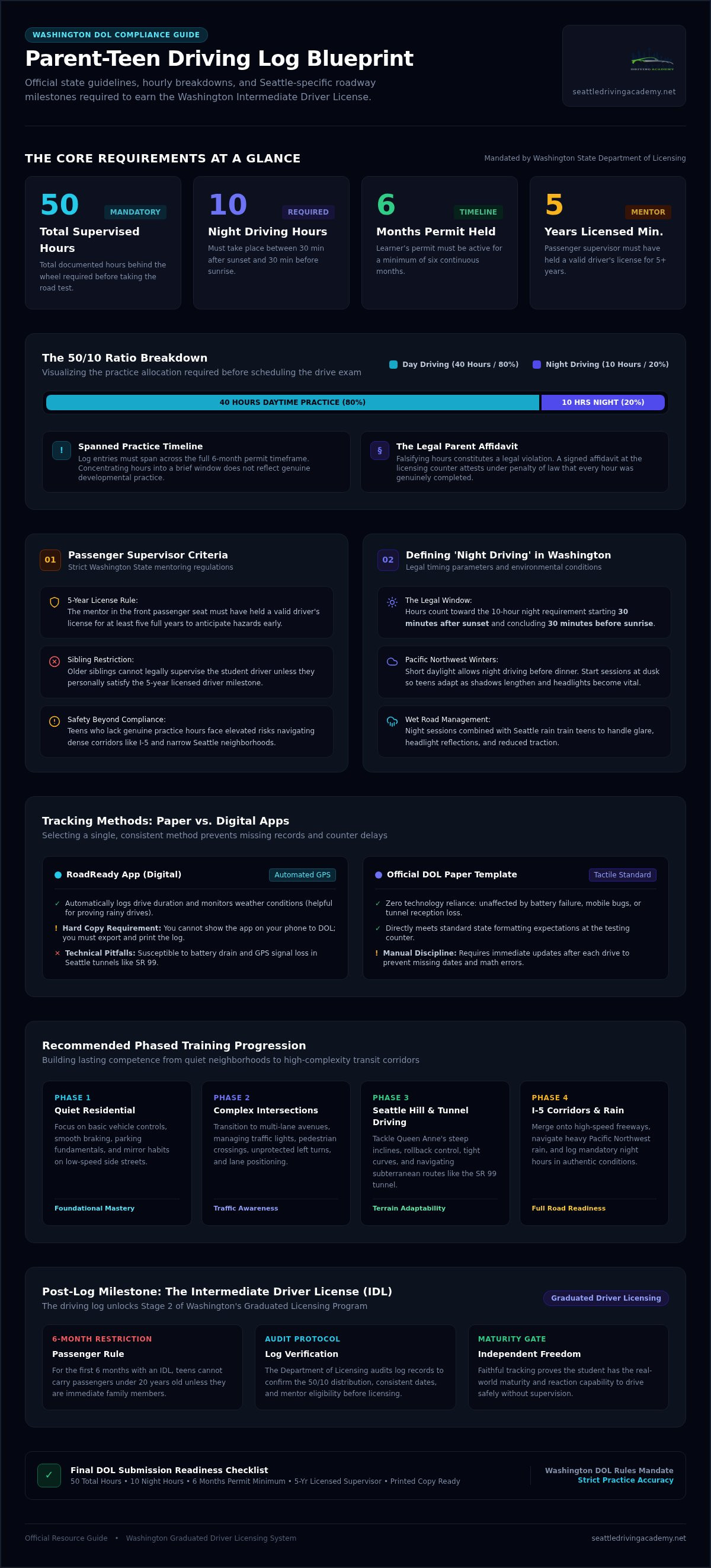
The journey toward a driver's license starts with a simple piece of paper: the parent-teen driving log washington state requires for every young driver. This document isn't just a hurdle to jump; it's a record of your teen's growing competence. The primary rule is the 50/10 requirement. Your teen must complete 50 hours of supervised driving, and at least 10 of those hours must happen after the sun goes down. These hours are the minimum foundation needed before they can even think about scheduling a road test.
Timing is everything in this process. Washington law mandates that a teen holds their learner's permit for at least six months before applying for a license. Your log must reflect practice that spans this entire period. It's also vital to choose the right supervisor. In Washington, the person in the passenger seat must have held a valid driver's license for at least five years. This ensures the mentor has enough experience to anticipate hazards that a novice might miss. It also means you can't have an older sibling help out unless they've reached that five-year milestone themselves.
While it might be tempting to round up a few minutes here or there, honesty is your best policy. Falsifying a log is technically a legal violation, but the real risk is safety. A teen who hasn't actually put in the time is significantly more likely to struggle with the complex traffic patterns of the I-5 corridor or the narrow streets of Seattle neighborhoods. We want our students to be prepared for the reality of the road, not just the requirements of the paperwork.
What Counts as 'Night Driving' in Washington?
In the Pacific Northwest, night can be a moving target. For the purposes of your log, night driving generally begins a half hour after sunset and ends a half hour before sunrise. During our gray Seattle winters, this means your teen will likely get plenty of practice in the dark before dinner time even arrives. We recommend starting these sessions at dusk. This allows your student to adjust as shadows lengthen and headlights become necessary, which is a critical skill for managing our frequent rainy commutes safely.
The Role of the Intermediate Driver License (IDL)
The IDL is the second stage of Washington's Graduated Licensing Program. This system is part of broader graduated driver licensing systems designed to give young drivers freedom in stages. Your completed parent-teen driving log washington state is the gatekeeper to this license. Once they earn it, they'll still face restrictions, such as not driving with passengers under 20 who aren't family members for the first six months. Completing the log faithfully ensures they have the maturity to handle these next steps with confidence.
Paper vs. Digital: Choosing the Best Tracking Method
Choosing how to document your teen's progress is one of the first logistical hurdles you'll face. While the Department of Licensing provides a standard template, many families now look toward modern apps to simplify the process. The core goal remains the same: proving your teen has met the Washington State teen driver licensing requirements through consistent, documented practice. Whether you prefer the tactile reliability of a pen or the automated precision of GPS, your parent-teen driving log washington state must be accurate to avoid delays at the testing counter.
We've found that the most successful families are the ones who pick a system and stick to it from the very first mile. Changing methods halfway through often leads to missing data or math errors that can frustrate both you and the DOL agent. If you find the tracking process overwhelming at first, starting with professional individual driving lessons can help you establish a routine. Our instructors can show you exactly how to categorize different drives so your log looks professional and complete.
The RoadReady App: Is it Right for You?
The RoadReady app is the most popular digital choice for Washington families. It uses GPS to track duration and even logs weather conditions automatically, which is helpful for proving rainy day practice. However, you can't just show the app on your phone at the licensing office. You must export the data and print a hard copy that meets the state's specific formatting standards. We often see tech issues like battery drain or GPS signal drops in Seattle's many tunnels, such as the SR 99, so it's wise to keep an eye on your phone during the drive.
Why the Traditional Paper Log Still Wins for Some
For some, the traditional paper log is still the gold standard. It lives in the glovebox, never needs a charge, and provides a clear physical space for both parent and teen to sign off on specific skills together. This ritual builds a sense of shared accomplishment and accountability. To keep it safe, we suggest keeping the log in a dedicated plastic folder. It prevents the accidental spills or lost pages that lead to a frantic rewrite right before your license appointment. A paper log is essentially fail-proof as long as you remember to fill it out before leaving the car.
Regardless of the method you choose, avoid the common mistake of waiting until the end of the month to record drives. Memories fade, and the DOL looks for specific dates and varied times. Many Seattle parents find success with a hybrid approach; they use an app to capture the raw data but transfer those hours to a paper log every Sunday evening. This ensures you always have a physical backup ready for the big day.
How to Structure Your 50 Hours for Maximum Safety
Think of your parent-teen driving log washington state as a curriculum rather than just a tally. To build a truly safe driver, you need a logical progression that moves from simple control to complex decision-making. We recommend breaking the 50 hours into four distinct phases. During the first 10 hours, focus on the basics in empty parking lots and quiet residential streets. This is where your teen masters smooth braking, steering, and basic vehicle orientation without the pressure of other cars.
As they gain confidence, Phase 2 (hours 11 to 25) introduces light traffic and multi-lane roads. This is the time to practice intersections and right-of-way rules. By Phase 3 (hours 26 to 40), you should be tackling the high-stakes environments of highway merging and downtown Seattle driving. Finally, the last 10 hours in Phase 4 are for polishing skills. Use this time for mock driving tests to ensure they are truly ready for the road. This structured approach aligns with NHTSA teen driving safety recommendations, which emphasize gradual exposure to risk.
Building a Progressive Skills Checklist
It is easy to fall into the habit of logging 50 hours by simply driving to school and back every day. While this builds some experience, it doesn't cover the technical maneuvers required for the official DOL test. Your log should include specific sessions dedicated to parallel parking, lane changes, and backing around a corner. If you find these technical skills difficult to teach, professional teen driving lessons Seattle providers can jumpstart the process. Our expert instructors can lay the groundwork in just a few sessions, making your parent-led practice much more productive and less stressful.
Managing the 10 Night Hours
Night driving presents unique challenges, from reduced visibility to increased glare. Start these mandatory 10 hours on well-lit suburban streets before venturing onto unlit rural roads. Use these sessions to teach high-beam etiquette and how to look toward the right edge of the road when faced with oncoming headlights. In our region, logging night hours during the famous Seattle mist is an essential intermediate skill. These wet, dark conditions require a different level of focus and following distance than a clear summer evening, so make sure to document these varied weather experiences in your parent-teen driving log washington state.
Seattle-Specific Challenges to Include in Your Log
Seattle is a beautiful city, but its geography creates specific hurdles that every new driver must master. When filling out your parent-teen driving log washington state, don't just stick to the flat roads of the suburbs. The DOL looks for a well-rounded experience, and in our area, that means conquering the "Hill Factor." Practice starts and stops on the steep inclines of Queen Anne or Capitol Hill to ensure your teen doesn't roll back when the light turns green. These sessions build the muscle memory needed for smooth acceleration on a grade.
Weather is another critical variable that you should document. We recommend that at least 5 to 10 hours of your total practice happen in wet conditions. Seattle's mist and heavy rain change road traction and visibility significantly. Mastering the I-5 and SR-99 during these conditions is vital. These routes feature short-ramp merges and heavy highway flow that require quick thinking and precise speed control. Additionally, spend time in high-density areas like South Lake Union. This neighborhood is perfect for practicing awareness of cyclists and pedestrians who share the busy urban space.
Navigating Seattle's Unique Infrastructure
Downtown driving presents a maze of one-way streets and bus-only lanes that can confuse even seasoned drivers. Use your log entries to document sessions that navigate these "bottlenecks," including the West Seattle Bridge. It is also a smart strategy to practice driving near the West Seattle driver licensing office. Familiarizing your teen with the streets surrounding the testing center builds confidence for their actual exam. It turns a foreign environment into a known route, reducing anxiety on the big day.
Hilly Terrain and Parallel Parking
Parallel parking on an incline is a classic Seattle challenge. You must include "curbing your wheels" as a mandatory skill in your practice sessions. This is a safety requirement that prevents the vehicle from rolling if the parking brake fails. UCLA: Uphill Curb Left Always. This simple acronym ensures the car is secured correctly on a hill. Finding a hilly residential block with low traffic is the perfect way to polish this skill without the pressure of city center congestion. If your teen needs extra help with these local maneuvers, our individual driving lessons provide professional guidance tailored to Seattle's toughest roads.
From Completed Log to Licensed Driver
Finishing those 50 hours is a massive milestone for both you and your teen. Before you head to your appointment, take a moment to perform a final audit of every signature, date, and hour tally. Ensure your totals for night and day driving are exact and clearly legible. When you sign the Parent's Affidavit, you aren't just checking a box for the state. You are legally certifying that your teen has the experience needed to stay safe on the road. This is why a meticulous parent-teen driving log washington state is so valuable; it provides the proof that they've truly put in the work.
Many families find that scheduling their exam through a private driver license testing center is much faster than waiting for a DOL appointment. It also offers a more personal, less clinical touch for a nervous student. Our goal is to ensure your teen feels confident, not just compliant with the law. We want them to walk into that test knowing they have mastered the skills recorded in their log.
The Final Checklist Before the Road Test
Double check that your teen has their permit and the completed parent-teen driving log washington state ready to present. The vehicle you use for the test must be in good working order. Check the brake lights, turn signals, and tire tread the night before. We suggest using the last five hours of your log for a dedicated "warm-up" session to get your teen back into the testing mindset. Many families also choose a pre-test warm up practice to calm nerves and brush up on technical maneuvers like parallel parking right before the examiner jumps in.
Booking Your Test at Seattle Driving Academy
As a DOL-authorized testing center, we make the transition to an Intermediate Driver License (IDL) seamless and stress-free. We verify your teen's eligibility and help you navigate the final paperwork with ease. Testing in a familiar, supportive environment can make a world of difference for a young driver. Our examiners are seasoned professionals who treat every student with patience and respect. Once the examiner says "You passed!", we'll upload the results directly to the DOL system. From there, you simply finalize the application online to receive the official license in the mail.
Take the Final Step Toward Your Teen's Independence
Completing your parent-teen driving log washington state is a significant achievement that represents months of patience and dedication. By following a structured, phased approach and mastering Seattle's unique hill and rain challenges, you've done more than just satisfy a legal requirement; you've built a lifelong foundation of safety for your child. Whether you preferred the automated precision of an app or the reliable simplicity of a paper folder, your consistent effort ensures a smooth transition when you finally reach the licensing counter.
The hard part is behind you, and it's time to celebrate this milestone. As an official WA DOL Testing Partner, we offer a supportive environment with patient, expert instructors at our convenient Seattle location. We specialize in turning practiced hours into proven skills, ensuring every student feels empowered during their evaluation. Ready to turn those log hours into a license? Book your Teen Complete Package or Road Test with Seattle Driving Academy today! We're honored to be your partner in this journey, and we can't wait to see your teen drive away with confidence and success.
Common Questions About the Washington State Driving Log
Does the 50-hour driving log have to be on an official DOL form?
You aren't strictly required to use the official paper form provided by the DOL, but your record must include all the same data points. This includes specific dates, durations, and the skills practiced during each session. Whether you use a notebook, a spreadsheet, or a digital app, the final submission needs to be clear and organized. Many families find the official template easiest because it ensures no mandatory information is accidentally omitted.
Can I count the 6 hours I spent with a driving instructor toward my 50 hours?
Yes, you can absolutely include professional instruction time in your total. When you enroll in our Teen Complete Package, those six hours of behind-the-wheel training with our expert instructors count directly toward your parent-teen driving log washington state requirements. These professional sessions are a great way to jumpstart the log because they focus on core fundamentals and safety maneuvers that you can then reinforce during your fifty hours of supervised home practice.
What happens if I lose my driving log halfway through the 6 months?
Losing your log can be stressful, but you can reconstruct it if you have other records like calendars or app history. If you've been using a digital tracker, simply export the data again. For paper logs, sit down with your teen and look through your personal schedules to recreate the entries as accurately as possible. It is a good idea to take a photo of your paper log every Sunday night so you always have a backup.
Is there a specific app that the Washington DOL requires for digital logging?
The Washington DOL doesn't legally require one specific app, but RoadReady is currently the state's recognized digital partner. It's designed to align with our local requirements, making it a reliable choice for Seattle families. If you choose a different app, just ensure it allows you to export a formatted report that includes all the necessary signatures and hour tallies. Always remember that you will need a printed version for your final licensing appointment.
Do the 10 night hours have to be completed after the 40 day hours?
No, you don't have to wait until the forty day hours are finished to start practicing at night. In fact, we recommend integrating night sessions early on once your teen has mastered basic car control in daylight. Spreading these ten hours out over the six-month permit period helps your teen experience various night conditions, such as rainy Seattle winters. This gradual exposure builds confidence and ensures they aren't overwhelmed by late-night traffic all at once.
Can more than one person sign off on the driving log entries?
Multiple supervisors can sign off on the entries as long as each person meets the legal requirement of having a valid license for at least five years. Whether it's a parent, a grandparent, or an older sibling who meets the criteria, they just need to initial the sessions they personally supervised. This flexibility makes it easier to reach the fifty-hour goal while ensuring your teen benefits from the different coaching styles and perspectives of various family members.
How detailed do the descriptions of the driving sessions need to be?
Your descriptions don't need to be long essays, but they should be specific enough to show a variety of environments. Instead of just writing "driving," use categories like "residential streets," "highway merging on I-5," or "parallel parking on hills." This level of detail proves to the DOL that your teen has faced diverse challenges. Clear labels also help you track which skills need more work before you book your final driving skill test.
What is the 'Parental Affidavit' and do I need it if I have a log?
The Parental Affidavit is a legal document you sign to certify that your teen has completed the mandatory fifty hours of practice. You need this in addition to your log when applying for the Intermediate Driver License. By signing it, you are taking responsibility for the accuracy of your parent-teen driving log washington state. It is the final official step that confirms your teen has the experience and maturity needed to handle the road without a supervisor.


