

Did you know that waiting until your teen is 15 and a half to start the licensing process might actually make their journey more complicated? Most Seattle families feel a bit of anxiety when they realize how much the rules have changed recently. You want your child to be safe, but the confusion over the 15 versus 15.5 age rule and the new 2026 safety course requirements can make the process feel like a maze. It's natural to worry about whether you're following the latest washington state teen driving requirements correctly.
We're here to help you navigate this milestone with total confidence. This 2026 roadmap breaks down the multi-step journey from getting an instruction permit to mastering the intermediate license. We'll cover the mandatory 50 hours of practice, the new Work Zone and First Responder safety course, and how to successfully schedule your skills test without the usual headache. By the end of this guide, you'll have a clear checklist that ensures your teen isn't just licensed, but truly ready for the road.
Key Takeaways
- Learn how the 15 versus 15.5 age rule affects your timeline and why early enrollment in a driving school simplifies the permit process.
- Stay ahead of the curve with the latest details on the mandatory 2026 Work Zone and First Responder safety course for all new drivers.
- Master the log of 50 supervised practice hours with a clear breakdown of the daytime and nighttime requirements needed for success.
- Prepare for the washington state teen driving requirements by learning what to expect during the knowledge and skills exams at a certified testing center.
- Understand the specific passenger and curfew restrictions of an intermediate license to keep your teen safe and legally compliant during their first year.
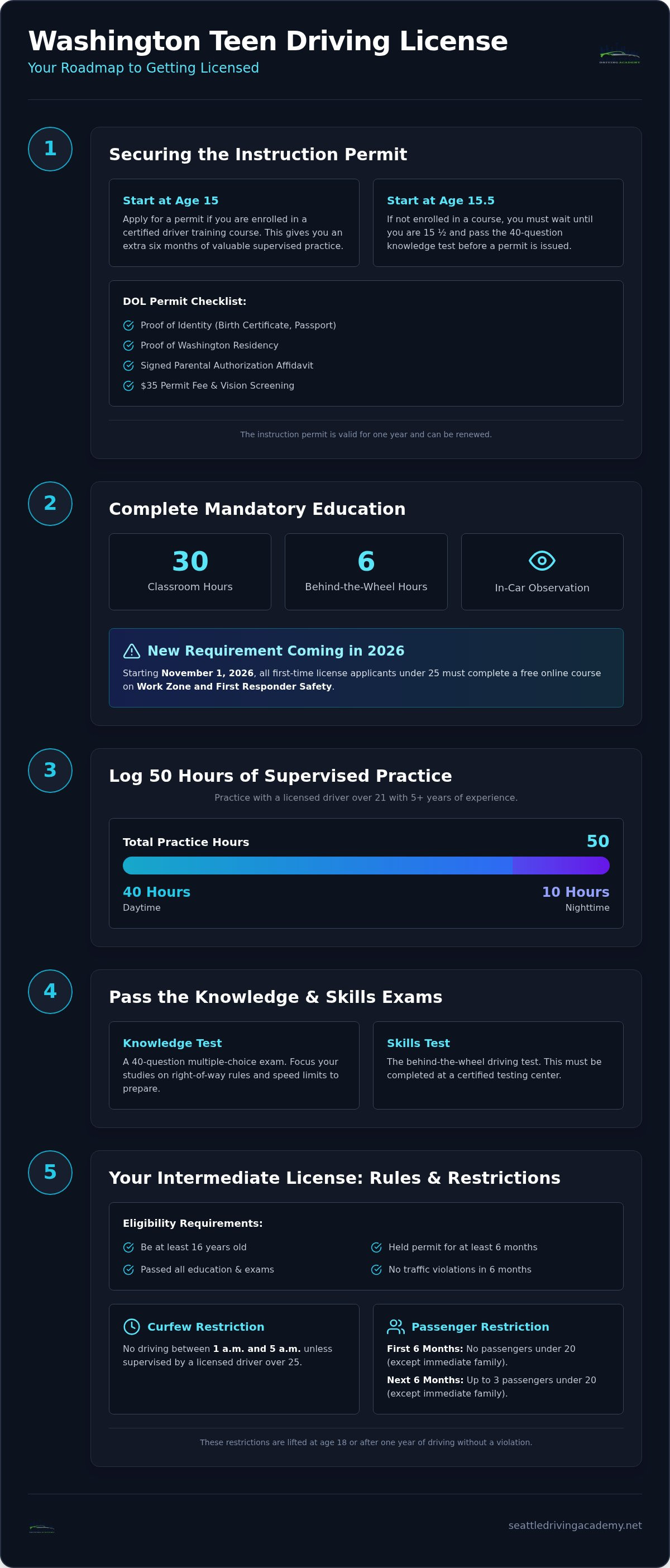
Step 1: Securing the Washington State Instruction Permit
Embarking on the road to independence is an exciting time for any Seattle family. To start, your teen needs their instruction permit, which serves as the foundation for all future skills. Understanding the washington state teen driving requirements early helps you avoid unnecessary delays at the Department of Licensing (DOL). This first step isn't just about paperwork; it's the beginning of a mentorship between you and your new driver.
The Enrolled vs. Unenrolled Timeline
Washington uses a specific Graduated Driver Licensing (GDL) program to keep young drivers safe while they learn. If your teen is 15 years old, they can apply for a permit immediately as long as they are enrolled in a certified driver training course. For those choosing to wait, the minimum age jumps to 15 and a half. We always suggest starting at 15. This gives your student an extra six months of supervised practice to build the deep muscle memory and confidence needed for Seattle's busy streets. When you enroll in our Teen Complete Package, we provide the waiver that allows you to get that permit at the earlier age.
When you head to the DOL to finalize the permit, you'll need to bring specific documentation. Ensure you have proof of identity, such as a birth certificate or passport, along with proof of Washington residency. You'll also need a signed Parental Authorization Affidavit and the $35 permit fee. During the visit, your teen will complete a quick vision screening and a brief medical history questionnaire. It's a simple process, but having your paperwork ready makes the experience much smoother for everyone involved.
The Knowledge Test Prerequisite
Meeting the washington state teen driving requirements involves passing a 40-question knowledge test. If your teen isn't enrolled in a course yet, they must pass this written exam before the DOL will issue a permit. However, students currently in a program can often secure their permit first and take the test as part of their curriculum. To prepare, we recommend diving into the Washington Driver Guide. Focus on right-of-way rules and speed limits; these are the areas where most students feel the most pressure. Practice tests are a great way to turn stress into mastery before the big day.
Your instruction permit is valid for exactly one year. If your teen needs more time to reach their 50-hour practice goal, you can renew it for another year. We always encourage families to take their time and focus on safety over speed. There's no rush when it comes to protecting your family, and we're here to support you through every renewal or milestone.
Step 2: Mandatory Education and the New 2026 Safety Course
Once your teen has their permit, the real learning begins. Meeting the washington state teen driving requirements involves more than just spending time in the car. It requires a structured, state-approved education program designed to turn nervous beginners into confident navigators. This phase is about building a foundation of safety that lasts a lifetime. We believe that professional mentorship during these early hours is the best way to ensure your child feels empowered rather than overwhelmed.
Completing the Teen Driver Training Course
Every teen under 18 must finish a course that includes 30 hours of classroom instruction and 6 hours of behind-the-wheel training. In the classroom, students dive into defensive driving techniques, traffic signs, and the legal responsibilities of being a driver. Beyond the 6 hours of driving, students also complete observation time. This allows them to learn from their peers' successes from the safety of the back seat. When you are looking for a driving school in Seattle, choose one that treats these observation moments as active learning opportunities. It's a chance for students to see the road through a different lens before they take the wheel themselves.
The 2026 Safety Course Requirement
A significant change arrives in late 2026. Starting November 1, all first-time license applicants under the age of 25 must complete a free online course focused on work zone and first responder safety. This isn't just another box to check. It's a vital response to the unique dangers found on our highways. The Washington State Department of Licensing introduced this to ensure new drivers know exactly how to behave when they see flashing lights or orange cones. Integrating this into your timeline early prevents any last-minute stress before your final licensing appointment. We'll help you understand how this fits into your overall training schedule so you never feel rushed.
Professional instruction provides a level of precision that's often difficult to achieve through parent-only training. Our team focuses on the specific nuances of washington state teen driving requirements to make sure nothing is missed. We help students master everything from parallel parking to merging on I-5 with ease. If you want a stress-free path to success, our Teen Complete Package provides the professional mentorship your child deserves. This expert guidance helps lower insurance rates and, more importantly, builds a safer community for everyone in Seattle.
Step 3: The 50-Hour Milestone and Supervised Practice
Reaching the 50-hour practice mark is often the most rewarding part of the journey. It's where classroom theory finally meets the pavement. To satisfy the washington state teen driving requirements, your teen must log 50 hours of supervised driving with a qualified adult. At least 10 of those hours need to happen after the sun goes down. This isn't just a legal hurdle to clear; it's a vital period for exposing your student to as many different scenarios as possible before they begin driving solo.
The person sitting in the passenger seat plays a huge role in this process. Washington law requires the supervising driver to be at least 21 years old and have held a valid license for at least five years. Additionally, your teen must hold their instruction permit for a full six months before they are eligible for a license. This mandatory waiting period ensures every student has enough "seat time" to handle the complexities and Intermediate Driver's License restrictions they'll face once they pass their exams. We encourage parents to view this time as a mentorship rather than a chore.
Structuring Your Practice Sessions
Success starts with a plan. We suggest beginning in empty parking lots to master basic vehicle control without the stress of traffic. Once your teen can steer, brake, and mirror-check without thinking, move to quiet residential areas. Eventually, you'll feel ready to tackle Seattle's busy arterial roads. Using a dedicated app or a physical logbook is essential for tracking hours and identifying which skills still need work. If you find yourself hitting a wall with certain maneuvers, supplemental teen driving lessons in Seattle can help bridge the gap between basic control and advanced city navigation.
Mastering Local Seattle Challenges
Seattle presents unique hurdles that generic state guides often ignore. You'll need to master steep inclines in neighborhoods like Queen Anne or Capitol Hill, where hill starts are a daily reality. Parallel parking on narrow, one-way streets is another skill that requires patience and precision. Since we live in the Pacific Northwest, practicing in the rain is mandatory. Low-visibility winters require a different approach to following distances and braking. Don't forget to practice driving near light rail tracks and our many busy bike lanes. Being aware of these specific local factors is a major part of meeting washington state teen driving requirements with true competence and safety.
Step 4: Testing for Success—Knowledge and Skills Exams
The final hurdle in the licensing process often feels like the most daunting part of the journey. After months of dedicated practice and education, your teen is finally ready to prove their mastery of the washington state teen driving requirements. This stage consists of two distinct evaluations: the written knowledge test and the practical skills exam. While the pressure can feel high, we've found that proper preparation and a supportive environment can turn this stressful milestone into a moment of immense pride and celebration for your family.
Acing the Written Knowledge Exam
The knowledge test consists of 40 multiple-choice questions covering everything from road signs to emergency procedures. Many students find themselves stumped by specific details regarding blood alcohol limits or the nuances of right-of-way at uncontrolled intersections. We recommend reviewing the Washington Driver Guide several times and taking multiple practice tests to build familiarity. For many families, utilizing Seattle DOL knowledge test locations through a certified school provides a more convenient and less intimidating experience than a traditional government office. If your teen doesn't pass on the first try, don't worry. Retake policies are flexible, allowing students to learn from their mistakes and return with even more confidence.
The Road Test: What Examiners Look For
The driving skills test is your teen's chance to show they can handle a vehicle safely in real-world Seattle traffic. It begins with a pre-test safety check where the examiner ensures the signals, brakes, and windshield wipers are all in working order. Once on the road, examiners focus heavily on the "Big Three": scanning, signaling, and speed control. They want to see that the student is constantly aware of their surroundings and communicating their intentions clearly to other drivers. We've seen that a "Pre-test warm up" session can significantly increase pass rates. It gives the student a chance to settle their nerves and refresh their skills right before the official evaluation begins.
Choosing where to take these exams can make a huge difference in your overall experience. Testing at a private driver license testing center is often much faster and more flexible than waiting for an appointment at a busy DOL office. Our instructors are familiar faces who provide a warm, professional atmosphere that helps students perform their best. We understand the unique environment of Seattle and tailor our approach to help every student succeed.
If you're ready to take the final step toward freedom, you can schedule your driver license driving test with us today. We are dedicated to making sure your teen feels prepared, safe, and ready to succeed on the very first try. Our goal is to transform this high-stakes moment into a positive and empowering success story.
Step 5: Your Intermediate License—Rules and Restrictions
Earning your intermediate license is a monumental achievement. It is the moment your hard work pays off and the real freedom of the road begins. However, this stage is not just about independence. It is a period of "supervised freedom" designed to keep you safe as you gain real-world experience. Understanding the final phase of washington state teen driving requirements ensures that this freedom remains uninterrupted by tickets or suspensions. We view these rules as a protective shield that helps you transition into a lifetime of safe driving.
The state implements specific restrictions during your first year of driving. These rules are non-negotiable and focus on the most common distractions for young drivers. You must follow these guidelines strictly:
- First 6 Months: No passengers under 20 years old are allowed in the vehicle, except for immediate family members.
- Second 6 Months: You may carry up to three passengers under the age of 20 who are not members of your immediate family.
- Nighttime Curfew: You cannot drive between 1:00 AM and 5:00 AM unless you are accompanied by a licensed driver who is at least 25 years old.
- Electronic Devices: Washington has a zero-tolerance policy for cell phone use while driving. This includes hands-free devices and texting. The only exception is for reporting a genuine emergency.
Violating these washington state teen driving requirements carries heavy weight. A first offense results in a formal warning letter sent to your parents. A second offense leads to a six-month license suspension. If a third violation occurs, your license is suspended until you turn 18. We want to help you avoid these setbacks by building solid habits from day one.
Navigating the First Year Safely
The first 12 months are statistically the most critical for accident prevention. Every mile you drive during this year builds the intuition needed for a lifetime of safety. It is important to remember that any traffic ticket or at-fault accident during this period will extend your intermediate restrictions. These rules stay in place until you reach age 18. At that point, your license automatically becomes a full, unrestricted driver license, provided you have maintained a clean driving record.
The Seattle Driving Academy Advantage
We take pride in being more than just a training center. Our Teen Complete Package is designed to handle the logistical hurdles and DOL red tape so you can focus on what matters most. Our instructors understand Seattle's specific traffic patterns, from the complex merge lanes on I-5 to the tight, hilly turns in Queen Anne. We want your teen to be a protective partner on the road, not just another statistic. By choosing our team, you are joining a community of safe, competent drivers who treat every neighbor with care and respect.
Start Your Journey Toward Driving Mastery Today
Transforming the licensing process from a high-stress hurdle into an empowering milestone is exactly what we do best. By starting the journey at age 15 and staying ahead of the new 2026 safety course requirements, you give your student the gift of time. This extra practice ensures they aren't just meeting the washington state teen driving requirements; they are becoming truly safe and confident neighbors on our Seattle streets. We believe that professional mentorship is the key to turning a nervous beginner into a skilled navigator who respects the road.
As an authorized DOL testing center, we take the clinical stress out of the final exams and replace it with warm, familial reassurance. Our comprehensive teen and adult packages are designed to handle the logistical details so you can focus on celebrating your child's growth. Whether it's mastering the knowledge test or acing the skills exam, our expert instructors are with you every step of the way. Enroll your teen in our Seattle Teen Complete Package today! We look forward to helping your family achieve this exciting success story with total peace of mind.
Frequently Asked Questions
How old does a teen have to be to get a permit in Washington?
You can get an instruction permit at age 15 if you are enrolled in a state-approved driver training course. If you choose not to enroll in a course, you must wait until you are 15 and a half and pass the knowledge test first. Starting early gives your teen more time to master the washington state teen driving requirements under your supervision. This extra time builds the deep confidence needed for safe solo driving later on.
What is the new 2026 Work Zone and First Responder safety course?
This is a free online course mandatory for all first-time license applicants under age 25 starting November 1, 2026. It focuses on teaching new drivers how to safely navigate work zones and react correctly to emergency vehicles. You should complete this requirement before your final licensing appointment to avoid any delays. It is a vital step in ensuring our Seattle roads remain safe for the brave people working on them every day.
How many hours of driving practice are required for a WA teen license?
Teens must complete 50 hours of supervised driving practice before they can apply for their intermediate license. At least 10 of these hours need to take place at night to ensure the student is comfortable in low-visibility conditions. We recommend keeping a detailed log of these sessions to track progress and identify areas that need more focus. This consistent practice is the best way to turn classroom theory into real-world mastery.
Can a teen drive with friends in the car immediately after getting a license?
No, the intermediate license comes with specific passenger restrictions during the first year of driving. For the first six months, your teen cannot have any passengers under age 20 in the car unless they are immediate family members. During the second six months, the limit increases to three passengers under age 20. These rules are designed to minimize distractions while your new driver gains the experience needed to handle a full car safely.
What happens if a teen driver gets a ticket in Washington State?
Getting a traffic ticket or violating intermediate license rules leads to progressive penalties starting with a warning letter to parents. A second offense results in a six-month license suspension; a third offense suspends the license until the driver turns 18. Following the washington state teen driving requirements carefully helps your teen maintain their independence. We focus on teaching defensive driving habits that keep your teen's record clean and your insurance rates manageable.
Do I have to take the driving test at a DOL office in Seattle?
You do not have to take your skills or knowledge tests at a state DOL office. Certified private schools like ours are authorized testing centers that offer much more flexibility and a more relaxed environment for students. Many families find that testing in a familiar setting with supportive mentors helps reduce the anxiety often associated with the exam. This convenience allows you to skip the long wait times at government locations.
Is driver's ed mandatory for 16-year-olds in Washington?
Yes, completing an approved driver training course is mandatory for anyone under the age of 18 who wants to get a license. This course must include 30 hours of classroom instruction and 6 hours of behind-the-wheel training with a professional instructor. These educational standards ensure that every young driver on the road has a solid understanding of safety and law. It is a foundational requirement that prepares them for the challenges of city driving.
What are the night driving restrictions for intermediate licenses?
Intermediate license holders are prohibited from driving between 1:00 AM and 5:00 AM. The only exception is if the teen is accompanied by a licensed driver who is at least 25 years old. There are also specific exceptions for driving during these hours for agricultural purposes or documented emergencies. This restriction helps keep young drivers off the road during the most dangerous hours while they are still building their nighttime driving intuition.


