
Nearly 70% of aspiring drivers in Washington fail their written exam on the first try, a statistic that can feel incredibly daunting when you're ready to get on the road. It's completely natural to feel anxious about failing and having to pay the testing fee all over again, especially when you're staring at a driver guide that's over 100 pages long. If you're wondering what to expect on washington knowledge test day, you aren't alone in your confusion about the License Express system or which road rules actually matter most. We believe this milestone should be an empowering step toward your freedom, not a source of stress.
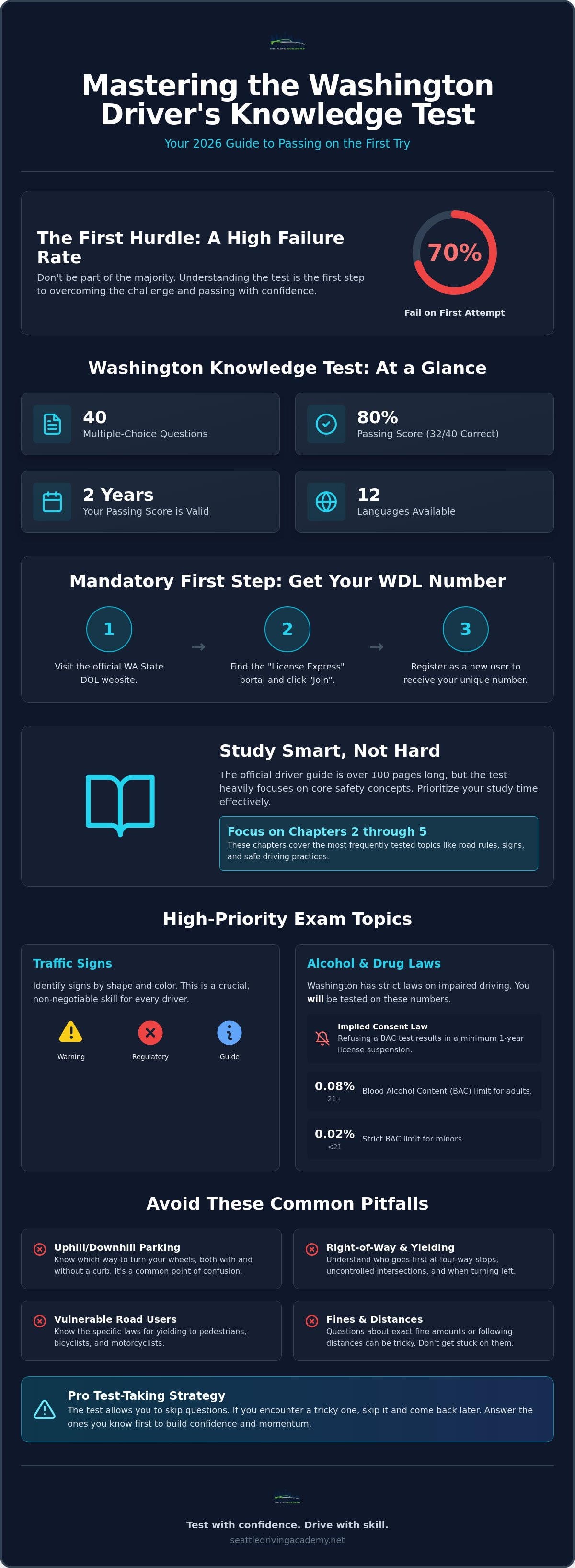
You don't have to tackle the 2026 requirements by guessing what's important. This guide provides a complete breakdown of the 40-question test, from the mandatory WDL registration steps to the specific chapters you should prioritize to ensure you pass. We'll walk you through the scoring system, the latest laws regarding vulnerable road users, and how to navigate the electronic testing transition with total confidence. By the time you finish reading, you'll have a clear roadmap to mastering the material and securing your passing score on the very first attempt.
Key Takeaways
- Discover exactly what to expect on washington knowledge test day so you can transform your anxiety into confidence and pass on your very first try.
- Prioritize your preparation by focusing on Chapters 2 through 5 of the official guide, which cover the most frequent topics on the 40-question exam.
- Learn how to navigate the WDL registration process and avoid common pitfalls, like confusing uphill parking rules or yield requirements.
- Experience a more comfortable environment by choosing a private testing center that prioritizes your success and long-term safety.
Washington State Knowledge Test: The Essential Facts for 2026
Taking your first step toward a driver's license is an exciting milestone, and we're here to help you feel completely prepared. Getting started doesn't have to be confusing; you can think of us as your expert guide through this entire process. Before you even sit down at a computer terminal, you need to understand the basic structure of the exam. The Washington knowledge test consists of 40 multiple-choice questions. These are all pulled directly from the official driver guide. To earn your passing score, you must answer at least 32 of those questions correctly, which is an 80% pass rate. It's also helpful to know that the test is available in 12 different languages, including Spanish, Traditional Chinese, Korean, and Russian, ensuring that every student has a fair chance to succeed in their preferred language.
We want you to feel empowered when you walk into the testing center. Understanding what to expect on washington knowledge test day starts with knowing that this isn't just a memory game. It's a test of your ability to make safe, logical decisions on the road. Once you finish the exam, your results are uploaded to the state database within 24 hours. This passing score remains valid for two years, giving you a generous window to complete your behind-the-wheel training and final skills test.
The Mandatory First Step: Getting Your WDL Number
You can't simply walk in and take the test without some logistical preparation. The very first thing you need is a WDL number. This is a unique identification number issued by the Washington State Department of Licensing. Without this number, testing centers cannot record your scores or link them to your future permit. To get yours, visit the official DOL website and look for the License Express portal. You'll click the Join button and follow the prompts to register as a new user. It's a simple step, but it's the foundation of your entire driving record. In 2026, this registration is mandatory for all testers, so make sure you have your WDL confirmation ready before you try to schedule an appointment with us or any other testing location.
Test Format and Scoring Logistics
When you finally sit down for the exam, you'll be using a modern digital interface designed for clarity. You don't have to answer every question in order. If you encounter a tricky question about fine amounts or specific distance requirements, you can skip it and return to it later. This is a great strategy to build your confidence by answering the questions you know for certain first. Don't feel pressured to rush through the 40-question block. While you should keep a steady pace, taking an extra moment to read each option carefully can prevent simple mistakes. Once you submit your final answer, the computer will show you your score immediately. We'll be right there to celebrate your success and help you plan your next steps toward total road mastery.
The 40 Questions: What Content Areas Are Covered?
While the official guide is thick, the actual exam focuses on core safety concepts that every driver needs to master. Knowing what to expect on washington knowledge test day means shifting your focus from memorizing every page to understanding how these rules keep us all safe. You'll encounter 40 questions that test your judgment on everything from basic lane changes to high-pressure emergency situations. These questions aren't just about facts; they're about the logic of safe driving.
Traffic signs are a significant part of the mix. You should be able to identify signs by their shape and color alone. For instance, a yellow diamond always warns you of upcoming hazards, while a red and white triangle tells you to yield. If you're feeling a bit nervous about these technical details, scheduling a knowledge test with a supportive team can make the experience feel much more manageable and less like a clinical exam.
High-Priority Topics: Alcohol and Drug Laws
Washington state places a heavy emphasis on impaired driving prevention. You will certainly see questions about the Implied Consent law. This rule states that simply by getting behind the wheel, you've already given your consent to have your breath or blood tested if a police officer has reasonable grounds to believe you are driving under the influence. If you refuse the test, you risk losing your license for at least a year. It's a serious law designed to keep our community safe.
The specific numbers matter here. For adults, the Blood Alcohol Content (BAC) limit is 0.08. However, for minors under the age of 21, the limit is a very strict 0.02. Marijuana laws are also a frequent point of confusion on the exam. You need to know that for drivers 21 and older, the legal limit is 5.00 nanograms of THC per milliliter of blood. These questions ensure you understand the legal boundaries and the responsibilities you carry every time you start your engine.
Right-of-Way and Pedestrian Safety
Safety-logic is the key to passing the right-of-way section. Washington law is very protective of pedestrians. You must yield to them at all intersections, whether the crosswalk is clearly marked with white paint or is an unmarked crosswalk. This is a common question that catches many people off guard. When it comes to school buses, the rules depend on the lanes. On a two-lane road, traffic in both directions must stop for a bus with red lights flashing. On a road with three or more marked lanes, only the traffic following the bus is required to stop.
Roundabouts are another priority area. Always remember to yield to traffic already inside the circle before you enter. You should never change lanes while inside a roundabout; stay in your lane until you reach your intended exit. Mastering these specific scenarios shows the state that you're ready to navigate our roads with the care and confidence of a seasoned professional.
Proven Strategies to Pass on Your First Attempt
Passing your exam isn't just about how long you study; it's about how smart you study. We see many students who feel overwhelmed by the sheer volume of the driver guide. To stay focused, you should prioritize Chapters 2 through 5. These sections contain the highest concentration of test questions. Chapter 2 covers the rules of the road, while Chapter 3 dives into the signs and signals you'll see every day. Chapter 4 is critical for understanding impaired driving laws, and Chapter 5 prepares you for those rare but serious emergency situations. When you know what to expect on washington knowledge test forms, you can spend your time mastering the rules that actually keep you safe.
A major key to success is focusing on number-based questions. The exam often tests your knowledge of specific distances and time intervals. For example, you must stay at least 200 feet behind an emergency vehicle with its lights on. You also need to know that your high beams must be dimmed when you are within 500 feet of an oncoming vehicle or 300 feet of a vehicle you are following. These specific figures are easy to overlook, but they make up a significant portion of the test bank. Treat these numbers like the vital safety tools they are; you'll find the multiple-choice options much easier to navigate.
How to Use Practice Tests Effectively
Practice tests are your best friend during this journey, but only if you use them correctly. Don't just memorize the correct answer for a specific question. Instead, try to understand the logic behind the rule. If a question asks about yielding at a four-way stop, visualize yourself in the driver's seat. Ask yourself why the vehicle on the right goes first. You can find excellent resources for Washington State Knowledge Test Practice that mimic the actual 2026 testing environment. Use these tools to identify your weak zones. If you consistently miss questions about parking on hills or merging onto the freeway, go back to the guide and review those specific sections until the logic feels second nature.
The Night Before: Final Review Checklist
Your mental state is just as important as your knowledge of the rules. The night before your test, do a light review of the Emergency Situations chapter. This helps keep those high-stakes procedures fresh in your mind. Double-check that your WDL number is written down or saved on your phone; you don't want to be hunting for it while you're standing at the check-in desk. Most importantly, get plenty of rest. A clear, well-rested mind is your best defense against test-day nerves. We believe in your ability to master these skills, and taking care of yourself is the final step in ensuring you're ready to succeed. When you walk into the room, remember that you've done the work, and we're here to support you every step of the way.
Common Mistakes and 'Trick' Questions to Watch For
Even the most dedicated students can feel a bit of pressure when faced with the specific phrasing used in the state exam. Understanding what to expect on washington knowledge test questions means recognizing that the state often tests your ability to choose the safest possible option among several similar choices. For instance, misinterpreting the difference between a "Yield" and a "Stop" sign at a complex Seattle intersection is a frequent error. While both require you to give way to others, a stop sign is an absolute requirement regardless of whether other cars are present. If you feel overwhelmed by these nuances, you can always schedule your driver license driving test or knowledge exam with our patient team to ensure a low-stress experience.
We've noticed that many testers tend to second-guess their first instinctual answer on multiple-choice options. Research suggests that your first choice is often based on the safety logic you've already mastered, so try to remain confident in your preparation. These questions aren't designed to trick you; they are designed to ensure you can make split-second decisions that keep our community safe. Trust your training and take a deep breath before hitting the submit button.
Hill Parking: The Curb Conundrum
This topic is consistently one of the top five most failed areas on the entire exam. The rules for parking on a hill depend entirely on the direction of the slope and the presence of a curb. When you are parking uphill and there is a curb present, you must turn your front wheels away from the curb. This simple action ensures that if your brakes fail, the vehicle will roll back and the curb will stop it from moving into traffic. In every other scenario, including parking downhill or parking on a hill without a curb, you should turn your wheels toward the edge of the road or the shoulder. It's a small detail that carries significant weight on your final score.
Following Distances and Speed Limits
Another area where students often lose points is by using outdated standards for following distances. While older materials might have suggested a two-second gap, the 2026 standard emphasizes the 4-second rule. This extra cushion provides the vital reaction time needed to avoid collisions in varied weather conditions or sudden traffic stops. You should also memorize the default speed limits that apply when no signs are visible. In Washington, the limit is 20mph in school zones and 25mph on city streets.
You must also understand the Basic Speed Rule, which defines your legal responsibility to drive at a speed that is reasonable and prudent for current conditions regardless of the posted sign. If it is raining or foggy, driving the speed limit might actually be unsafe and illegal. Finally, don't overlook the financial consequences of breaking safety laws. For example, a first offense for violating Washington's law against handheld device use is $136, and a second offense increases to $234. Mastering these facts shows the state that you're ready to be a responsible, safety-minded neighbor on the road.
Why Testing at Seattle Driving Academy Beats the DOL
Choosing where to take your exam is just as important as how you study. While government offices provide the necessary services, they often come with long wait times, crowded lobbies, and a sterile atmosphere that can spike your anxiety. We believe that your journey toward independence should start in an environment that feels encouraging and safe. When you're deciding what to expect on washington knowledge test day, the physical setting can make a massive difference in your ability to focus and recall the safety rules you've worked so hard to master. Our academy combines professional authority with a warm, familial touch to ensure you feel like a person, not just a number in a queue.
For our older students, we understand that starting this process later in life comes with its own set of unique pressures. We offer specialized support through our 3-Hour Adult Driving Package, which is designed to bridge the gap between theory and real-world application. Whether you're a teen or an adult, you'll receive immediate feedback on your results and clear, compassionate guidance on your next steps toward the road.
A Supportive Environment for Nervous Testers
Test anxiety is a real hurdle for many aspiring drivers. The high-pressure environment of a government building can make even simple questions feel complex. Our "Supportive Mentor" approach is designed to lower those stress levels from the moment you walk through our doors. We provide a quiet, focused space that is a far cry from the noisy, high-traffic lobbies found at many state offices. This calm atmosphere allows you to process the 40 questions with a clear mind.
- Access to small, dedicated testing rooms that minimize outside distractions.
- A friendly team that treats you with the same care we would extend to our own family members.
- The opportunity to ask "what now" questions immediately after you finish your exam.
- A proactive, problem-solving attitude that helps you navigate any logistical hurdles with your WDL number or registration.
Next Steps: Transitioning to the Skills Test
Passing your knowledge exam is a huge win, but it's only the first half of the journey. Once your score is uploaded to the state database, you'll be ready to look for a Driver License Testing Center that can help you cross the finish line. We make this transition seamless by offering everything you need in one location. You don't have to start over with a new school or a different set of instructors.
Many of our successful students choose to combine their knowledge pass with a pre-test warm-up practice session. This allows you to get behind the wheel with a professional instructor who can help you master the specific skills needed for the final driving test. We're here to guide you from your very first permit application to the moment you hold your permanent license. Your success is our primary goal; we're honored to be your partner in unlocking the freedom and confidence that comes with being a safe, licensed driver in Washington.
Take the Final Step Toward Your Driving Freedom
You now have a clear roadmap for your journey to becoming a licensed driver. By mastering the mandatory WDL registration process and focusing your study on the core safety logic in Chapters 2 through 5, you've already overcome the biggest hurdles. You understand the nuances of hill parking, the importance of the 4-second following rule, and exactly what to expect on washington knowledge test day. This knowledge is your foundation for a lifetime of safe and confident travels.
We believe that every student deserves a testing experience that is both professional and deeply supportive. As an authorized DOL testing center with a convenient Seattle location, we provide expert instructors who offer a compassionate environment to help you manage test-day nerves. We're here to ensure this milestone feels like an empowering achievement rather than a stressful obstacle. You've put in the effort to learn the rules; now it's time to claim your success. Book Your Washington Knowledge Test at Seattle Driving Academy today and let us help you unlock your full potential on the road. We can't wait to see you succeed.
Frequently Asked Questions
How many questions are on the Washington state knowledge test?
The Washington State knowledge test consists of 40 multiple-choice questions. These questions are pulled directly from the official Washington Driver Guide and cover vital road rules, traffic signs, and safety regulations. You'll encounter scenarios that test your judgment on everything from right-of-way at intersections to the specific laws regarding impaired driving. We'll help you feel prepared to tackle each one with total confidence.
What is the passing score for the WA knowledge test?
You must answer at least 32 questions correctly to achieve a passing score of 80%. The digital interface allows you to see your progress as you go, which helps you stay focused on each individual question. If you've spent time understanding what to expect on washington knowledge test day, reaching this threshold becomes a manageable goal rather than a source of stress.
Do I need to make an appointment for the knowledge test in Seattle?
Yes, we strongly recommend scheduling an appointment to ensure you have a dedicated space and time for your exam. While some government offices may offer limited walk-in availability, a scheduled appointment at a private academy allows you to avoid long lines and a high-pressure environment. This proactive step ensures your testing day in Seattle is as smooth and supportive as possible.
What should I bring with me to the knowledge test center?
You must bring your WDL (Washington Driver License) confirmation number and a valid form of identification. Your WDL number is essential because it's the only way the testing center can record your passing score and link it to your future permit. We also suggest bringing a positive attitude and the confidence you've gained from your preparation. We're here to help you through every step.
Can I take the Washington knowledge test online?
No, you cannot take the official Washington knowledge test online from your home. The exam must be completed in person at an authorized Department of Licensing office or a certified third-party testing center like ours. This ensures the integrity of the testing process and allows you to receive immediate support if you have questions about the digital interface or the registration process.
What happens if I fail the knowledge test?
If you don't pass on your first attempt, don't be discouraged, as many students need a second try to master the material. You can retake the test, though you'll need to pay the standard testing fee for each new attempt. We'll provide you with feedback on your performance so you can focus your study on the specific areas where you might have struggled.
How much does the knowledge test cost in Washington State?
The cost for a knowledge test attempt is a standard fee set by the state, which applies at both DOL offices and private testing centers. This fee covers a single attempt at the 40-question exam. We recommend checking our current scheduling page for the most up-to-date information regarding our specific testing packages and the pre-test practice options we offer to help you succeed.
How long is the Washington knowledge test score valid?
Your passing score on the knowledge test remains valid for two years. This gives you a significant window of time to complete your supervised driving hours and prepare for your final skills test. Knowing what to expect on washington knowledge test results helps you plan your path toward your license with total confidence and zero rush. We're here to support you whenever you're ready.


