

What if feeling nervous behind the wheel isn’t proof you’re unready, but a sign you need a clearer way to judge your skills? If you’re searching “assess my driving skills seattle,” you may already know that confidence can be hard to measure, especially when Seattle traffic adds pressure. A useful self-check helps you look beyond nerves and notice what you can do consistently.
This practical checklist helps you identify strengths, spot skills to practise, and choose a next step. You’ll consider everyday basics such as scanning for hazards, making turns, changing lanes, parking, and staying composed when conditions feel busy. If an area feels uncertain, treat that as a specific skill to work on, not a final judgment of your ability.
A self-assessment can guide your practice, while an individual driving lesson offers feedback focused on your needs. A pre-test warm-up is practice before an official skills test, not the test itself. Seattle Driving Academy offers individual lessons, warm-up practice, and Department of Licensing driving skills tests. Start by identifying what feels reliable, then choose the kind of preparation that fits your next goal.
Key Takeaways
- Use a self-check to reflect on how consistently you drive, not as a guarantee that you’re ready for an official skills test.
- Assess my driving skills seattle by reflecting on awareness, communication, vehicle control, and decision-making in everyday situations.
- Choose the right kind of feedback: self-reflection helps you spot questions, while guided practice can turn skill gaps into specific goals.
- Keep your practice manageable by recording observations, prioritizing one or two skills, then reviewing your progress.
- Understand how individual lessons and pre-test warm-ups differ from an official Department of Licensing skills test as you plan your next step.
Assess Your Driving Skills in Seattle: Start With a Clear Self-Check
A useful self-check turns a vague feeling of “I’m probably fine” or “I’m not ready” into observations you can act on. It’s a first reflection, not a formal evaluation or a guarantee that you’re ready for a road test. Notice what you do reliably, what feels rushed or uncertain, and what deserves more practice.
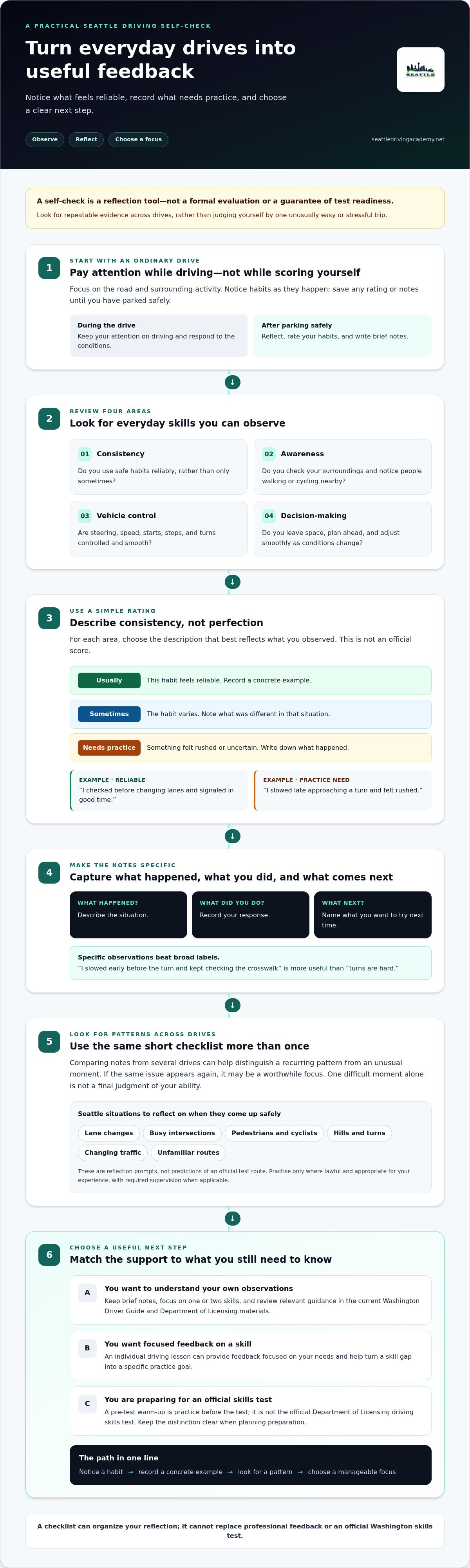
After an ordinary drive, reflect on four areas: consistency, awareness, vehicle control, and decision-making. You might use a simple rating such as “usually,” “sometimes,” or “needs practice.” This isn’t an official score. It’s a way to spot patterns without expecting yourself to drive perfectly on every trip.
Keep the distinction clear: a checklist can organize your thoughts, but it can’t replace professional feedback or an official Washington skills test. If you’re unsure how your observations relate to licensing, compare them with the current Washington Driver Guide and official Department of Licensing information. For broader context on how licensing systems vary, see Driver's license in the United States.
What should you include in a basic driving skills checklist?
Review a few observable habits after each drive. Did you check your surroundings before moving or changing position, signal clearly, choose a suitable speed, maintain a steady lane position, and control the vehicle smoothly? Also consider whether you stayed composed when traffic changed, a pedestrian approached a crossing, or your route called for an unfamiliar turn.
- Reliable: “I checked before changing lanes and signaled in good time.”
- Needs practice: “I slowed late when approaching a turn and felt rushed.”
Write one concrete example beside each strength and each practice need. Details make your notes more useful than labels like “good driver” or “bad at turns.” If the same issue appears on different drives, it may be a worthwhile focus. One difficult moment, by itself, is a prompt to reflect rather than a final judgment of your ability.
How can you make your self-assessment more useful?
Reflect only after you’ve parked safely. Don’t try to rate your skills or take notes while operating the vehicle; your attention belongs on driving. Use the same short checklist after several drives to distinguish a recurring pattern from an unusual situation. Keep entries brief: note what happened, what you did, and what you’d like to try next time.
For example, if lane changes often feel rushed, note whether you planned ahead, checked around you, and communicated your intention. Then review the relevant guidance in the current Washington Driver Guide and DOL materials. If you still can’t tell whether a habit is sound, bring that question to an individual driving lesson. To assess my driving skills seattle in a practical way, look for repeatable evidence and use it to choose one manageable skill to work on.
Which Driving Skills Matter Most on Seattle Roads?
Seattle driving asks you to do more than steer and follow signs. Strong everyday driving combines awareness, clear communication, steady vehicle control, and decisions that leave room for changing conditions. To assess your driving skills in Seattle, consider how consistently you use those abilities across familiar and less familiar routes, rather than judging yourself by one unusually easy or stressful trip.
Use local situations as reflection prompts, not predictions of an official test route. Traffic patterns, visibility, pedestrians, and road layouts can change from one trip to the next. Practise only where it’s legal and appropriate for your experience, with required supervision when applicable. Don’t seek out busy or difficult situations just to test yourself.
Assess observation and decisions in changing traffic
After a drive, think through how you handled a lane change or busy intersection, if those situations came up safely. Did you check your mirrors and blind spot, signal clearly, and notice people walking or cycling nearby? Did you leave space and adjust smoothly when traffic slowed or gaps changed? Look for decisions made with time to spare, rather than last-second reactions.
Check control on hills, turns, and varied routes
Notice whether starts and stops felt controlled, your steering stayed steady, and your speed suited the conditions. On a hill, did you feel able to manage the vehicle without rushing? Through a turn, could you keep your attention on the road and surrounding activity? Seattle’s varied streets can offer useful reflection prompts, but don’t choose a route that exceeds your current ability.
For each situation, note what you observed and how you responded. For example, “I slowed early before the turn and kept checking the crosswalk” is more useful than “turns are hard.” Patterns can show whether your next goal is better planning, calmer control, or stronger awareness. If a situation feels overwhelming, simplify your route and build experience gradually instead of forcing a challenge.
Keep local practice lawful and suited to your experience. Follow applicable supervision requirements, choose conditions you can manage, and focus on driving rather than trying to score yourself in real time. A passenger’s presence doesn’t replace any supervision required for your circumstances.
Seattle Driving Academy’s Seattle driving-school guide can help you think about the support available as you build skills. If your reflections point to a specific challenge, an individual driving lesson can provide a constructive setting to work on targeted goals. Focus on progress: adapting calmly and consistently matters more than trying to prove you can handle every road at once.
Self-Assessment, Driving Lesson, or Official Skills Test: What Tells You More?
Each option answers a different question. A self-check helps you identify what feels consistent and where you’re unsure. A driving lesson gives you a chance to receive guidance and practise specific skills. An official Washington Department of Licensing (DOL) skills test evaluates your driving under current DOL procedures. These options aren’t interchangeable: practice and feedback don’t produce an official test result, and the test isn’t a coaching session.
If you’re wondering how to assess my driving skills seattle, start by asking what you need to learn next, not which option sounds most reassuring. Choose the kind of feedback that fits the question you’re trying to answer.
- Self-assessment: Helps you name strengths and uncertainties based on your own driving. It’s a useful starting point, but you may not notice every habit or know how consistently you perform.
- Instructor-guided lesson: Gives you a chance to work on a particular concern with guidance. The goal is to practise and improve, not to receive an official pass or fail.
- Official DOL skills test: Provides an official evaluation of your performance under the applicable testing procedures. It can tell you the result of that test, but it isn’t designed to teach or practise skills during the assessment.
When is self-assessment enough to identify a next step?
A self-check may be enough to set a practice goal when you can describe what you do reliably and identify a specific uncertainty. For example, you might feel steady on familiar roads but want to plan decisions sooner in unfamiliar settings. That’s a clear starting point. Confidence by itself, though, doesn’t show whether a skill is safe and consistent.
Consider guided feedback if the same concern keeps appearing in your notes, or if you can’t tell whether a driving habit is effective. That uncertainty isn’t a verdict on your ability. It’s useful information: an experienced instructor can help you focus on what to practise instead of guessing at the cause.
What can instructor feedback and an official test each provide?
In an individual lesson, you can discuss a concern, practise a targeted skill, and receive feedback to help shape your next goal. A pre-test warm-up is also practice, not an official evaluation. By contrast, a DOL skills test assesses your performance using current procedures, so review official DOL information for up-to-date testing details. Seattle Driving Academy offers lessons and warm-up practice and facilitates official skills tests.
If an official evaluation is the next step you’re considering, the Seattle testing-center guide can help you understand the testing-center decision. Needing practice isn’t evidence that you can’t succeed. It points to a skill to strengthen before you decide whether you’re ready to test. If focused practice would help, an individual driving lesson offers a constructive way to work on your goals.
Use This Seattle Driving Skills Checklist to Plan Your Next Practice
A useful practice plan doesn’t try to fix everything at once. Use your notes to select one or two skills, practise them safely, then review what happened. This gives you a manageable way to assess your driving skills in Seattle and decide whether your next step is more independent practice or guidance.
Follow this sequence after a drive:
- Record: Note the situation and what you did, without judging yourself. For instance, write, “I noticed the lane ending early but hesitated before choosing where to merge.”
- Prioritize: Pick one or two skills that affect awareness, control, communication, or safe decisions. Focus first on the concern that appears repeatedly or makes it harder to respond calmly.
- Practise: Choose a suitable, legal opportunity to work on the skill. Follow any supervision requirements that apply to you, and stay within your experience level.
- Review: After you’ve parked, use the same reflection questions to compare what happened. Look for a more consistent action, not a flawless drive.
- Decide: If you still feel uncertain, consider whether an instructor’s feedback would make your next practice goal clearer.
Turn skill gaps into specific practice goals
Replace broad goals like “drive better” with an action you can notice. If planning feels difficult, aim to identify the next turn earlier on a familiar, appropriate route. If signaling feels inconsistent, focus on communicating your intention clearly before changing direction. Keep practice safe and within your ability; don’t create a risky situation just to test a skill.
Track the goal across different drives when it’s safe and practical. A brief note can capture the setting, the action you tried, and whether it felt more controlled. Improvement may vary from one drive to another, so use repeated observations to spot progress and remaining questions. This is a way to guide practice, not a promise of a particular test result.
Know when guided practice may help
If the same uncertainty persists, or you can’t tell what adjustment would help, an individual driving lesson gives you a chance to practise with guidance. Adult learners looking for structured instruction can explore this guide to adult driving lessons. A pre-test warm-up can also provide practice before an official skills test, but it isn’t the test and can’t guarantee a result.
One skill at a time is enough to make practice purposeful. If you’d like focused support with a goal from your checklist, book an individual driving lesson with Seattle Driving Academy.
Get a Professional Driving Skills Check in Seattle With Supportive Next Steps
Your checklist can help you see where you feel steady and where more practice could help. From there, take a practical progression: talk through your goals, practise a focused skill, and consider official testing when you feel prepared. If you’re asking, “assess my driving skills seattle,” guided instruction can turn that question into a specific plan without treating uncertainty as failure.
Seattle Driving Academy serves teen and adult learners through driver training and individual lessons. In a lesson, you can practise skills with guidance. Pre-test warm-up practice is also available for drivers preparing for an official skills test. Both support preparation, but neither is an official test result. The Academy also facilitates official Department of Licensing skills tests, which are distinct from coaching and practice.
What can you expect from a guided skills practice session?
Bring your checklist notes and name the situations that feel challenging. You might point to a skill you find hard to perform consistently or ask what to focus on next. Sharing a specific concern gives the practice a clear direction, rather than leaving you to work on everything at once.
Guided practice can help you focus on identified skills and use feedback to shape your next goal. Treat it as an opportunity to learn, not a judgment of your potential. Practice and feedback don’t guarantee a particular outcome on a future test, and they don’t replace the official evaluation. They can help make your preparation more purposeful.
Choose a next step that matches your readiness
If you want focused practice before deciding about a test, an individual driving lesson can help you work on a skill you’ve identified. If you’re preparing for an official skills test, a pre-test warm-up offers a chance to practise beforehand. Choose based on what would help you most now: building a skill, getting a clearer practice focus, or moving toward an official evaluation.
You don’t need to rush from self-reflection to testing. Teen and adult learners can use training or individual lessons to build their skills, then decide whether an official test is the appropriate next step. If you’re ready to turn your checklist into a focused plan, explore Seattle Driving Academy services for training, lessons, warm-up practice, and official DOL testing.
Let Your Next Step Build on What You’ve Learned
Readiness doesn’t have to be a yes-or-no judgment made in one moment. Treat it as a process: notice what’s becoming more consistent, stay honest about what still feels uncertain, and choose the next step that helps you keep moving safely. If you’re still asking how to assess your driving skills in Seattle, you don’t need to figure it all out alone. A focused conversation about your goals can help turn uncertainty into a practical plan.
Bring your questions, observations, and the skill you most want to strengthen. You can decide what support fits at your own pace, without expecting yourself to master everything at once. Each thoughtful practice drive is a chance to build steadier habits and greater confidence.
Explore Seattle Driving Academy training and testing options and choose a next step that feels right for you. Keep going, one skill at a time.
Frequently Asked Questions
Is a driving self-assessment enough to know whether I am ready for a Seattle road test?
No. A self-assessment can help you identify strengths and questions, but it can’t confirm official readiness or replace the Washington skills test. If you search “assess my driving skills seattle,” use your notes to choose a useful next step, not to predict a test result. For example, if you’re unsure whether you consistently notice signs or changing traffic, guided feedback can help you decide what to practise before booking a test.
Can I assess my driving skills without an instructor in the car?
Yes, you can reflect on your driving after a trip, but don’t try to score yourself while the vehicle is moving. After parking, write down a specific moment, such as whether you noticed a changing signal early enough to respond calmly. Self-review can miss habits you don’t recognize in yourself. If you can’t tell what caused a concern, an instructor can observe your driving and offer focused feedback.
How do I know which driving skills I need to practise most?
Prioritize skills that feel uncertain repeatedly, rather than letting one awkward moment define your ability. Think about whether the challenge involves noticing what’s around you, communicating your intentions, controlling the vehicle, or choosing a safe response. For instance, if you often realize late that you need to turn, planning ahead may be a useful focus. If the cause isn’t clear, an instructor can help identify a practical goal.
Does a driving lesson count as an official Washington skills test?
No. A lesson is for instruction and practice; an official driving skills test evaluates your performance under Washington Department of Licensing procedures. During a lesson, you can work through questions and receive guidance. A test is an evaluation, not a coaching session, and a lesson or warm-up doesn’t produce an official result or guarantee a pass. Review current DOL information for official testing requirements before you schedule.
What happens if my driving skills assessment shows areas I need to improve?
Use what you learn to shape your next practice step, not as a judgment of your potential. Choose a safe opportunity to work on one skill, then note what felt different afterward. If you’re uncertain how to practise, an individual lesson can provide structured feedback. For example, explain where you feel unsure and work toward a manageable goal with support.
Can Seattle Driving Academy help me practise before my driving skills test?
Yes. Seattle Driving Academy offers individual driving lessons and pre-test warm-up practice for learners preparing to drive. Use a lesson to focus on a particular learning goal, or a warm-up to practise before an official skills test. A warm-up is not the DOL evaluation, and neither practice option guarantees a particular test outcome. They offer preparation, while the official test provides the result.
How often should I reassess my driving skills?
Revisit your notes after you’ve had a chance to practise a specific skill, rather than turning every trip into a detailed scorecard. Compare similar situations when possible, such as familiar routes or comparable traffic conditions, and look for consistency rather than perfection. If the same concern continues to appear, or you’re unsure what to change, seek guided feedback instead of relying only on repeated self-ratings.


