

What if the biggest obstacle to getting your license isn't your ability to steer a car, but your ability to remember a single, specific number? Most people assume the permit exam is just common sense. The reality is that many students walk out of the DOL feeling defeated because they missed the mark by just one or two points. It's completely normal to feel anxious about the common mistakes on washington knowledge test, especially when dealing with specific distances and legal limits. We understand that you don't just want to pass. You want to avoid the stress and extra cost of a retake while proving you're ready for the road.
This guide will help you navigate those technical traps so you can walk into your appointment with total confidence. You'll discover the psychological barriers that lead to failure, along with the specific facts you need to master to pass on your first try. We'll cover everything from tricky alcohol and marijuana laws to the precise distances required for signaling and parking. By the time you're done, you'll have a clear roadmap to achieving a 32/40 score and securing your freedom on the Seattle streets with ease.
Key Takeaways
- Master the 40-question format and the 80% passing threshold. Knowing exactly what's required helps you walk into the room with total confidence.
- Identify common mistakes on washington knowledge test regarding specific DUI and marijuana laws. These technical details are often where students lose points.
- Learn to spot visual traps. We'll show you how to distinguish between similar signs like Yield and Merge so you aren't caught off guard.
- Move beyond simple memorization with the Chapter-by-Chapter study method. It's a smarter, more effective way to absorb the Washington Driver Guide.
- Connect your test prep to real-world driving. Mastering the theory today makes your future time behind the wheel much safer for everyone.
Understanding the Washington State Knowledge Test Framework
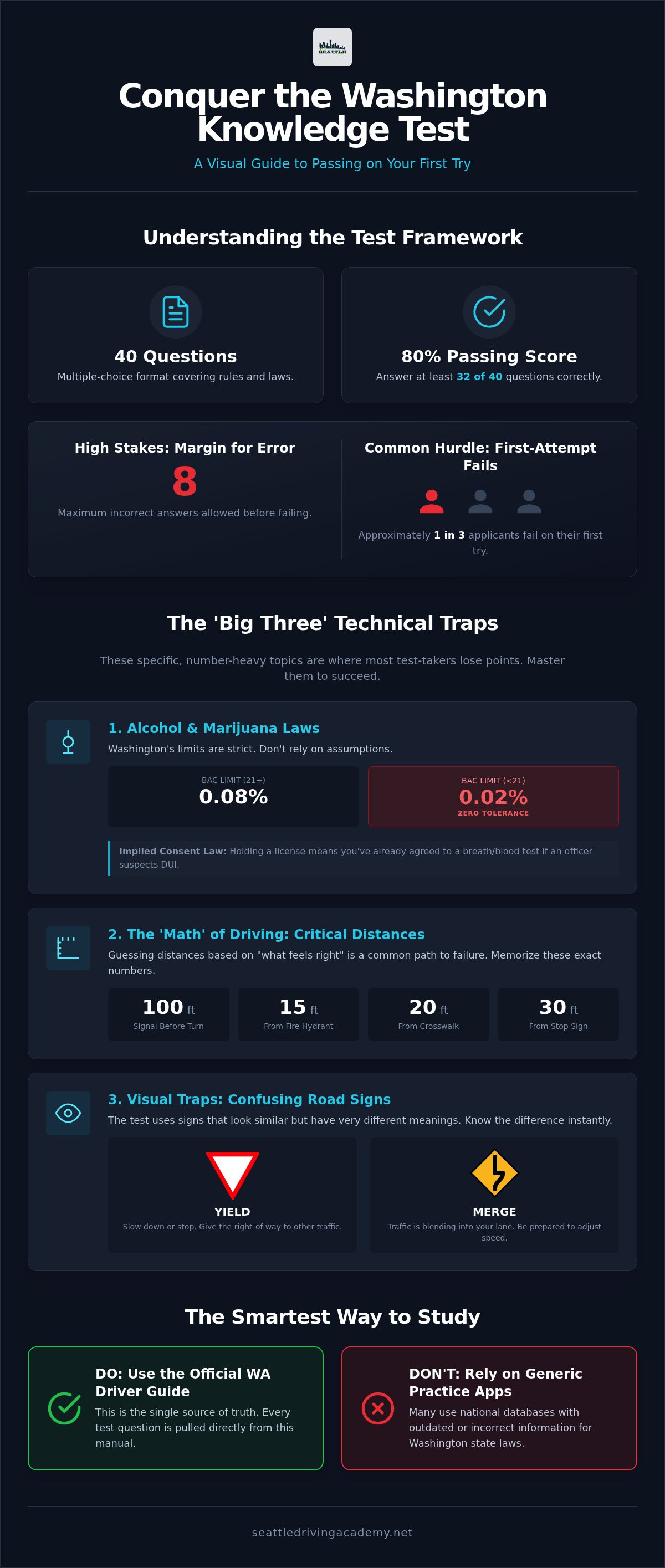
The Washington Knowledge Test consists of 40 multiple-choice questions designed to ensure you're ready for the responsibility of the road. You need to answer at least 32 questions correctly to reach the 80% passing threshold. While that might sound like a comfortable margin, it leaves very little room for error. Washington's exam is widely considered more rigorous than many other states because it focuses heavily on specific numerical values and precise legal definitions rather than just general driving logic.
The test is generally divided into two categories: rules of the road and legal responsibilities. Rules of the road focus on the mechanics of driving, such as how to handle uncontrolled intersections or when to yield to a transit bus. Legal responsibilities cover the "paperwork" and safety side of things, including insurance requirements, title transfers, and the specific penalties for driving under the influence. Understanding this split helps you organize your study time effectively.
Data from various testing sources suggests that about 1 in 3 test-takers fail on their first attempt. This often happens because of psychological barriers rather than a lack of intelligence. We notice distinct patterns between our students. Teens often struggle with the "number-heavy" questions, such as how many feet you must park from a fire hydrant. Adult learners, on the other hand, frequently fall into the trap of relying on their years of observation. They might answer based on what they see people doing on the road every day rather than what the law actually dictates. Falling into this gap is one of the most common mistakes on washington knowledge test attempts.
The 80% Rule: Why Precision Matters
Getting 32 out of 40 correct means you can only miss eight questions. In a high-pressure environment, it's easy for a few "small" mistakes to snowball into an automatic fail. If you're unsure about a specific distance or a fine amount, those points slip away quickly. We often see students start to second-guess themselves halfway through the exam. This anxiety can lead to changing a correct answer to a wrong one. We always tell our students that their first instinct, if they've studied the manual, is usually the right one. Precision comes from confidence, and confidence comes from knowing the specific data points the DOL loves to test.
Official Resources vs. Third-Party Apps
The Washington Driver Guide is your absolute source of truth. Every single question on the test is pulled directly from the text of that manual. While there are dozens of practice apps available, many of them use generic national databases. These apps might tell you the wrong distance for a turn signal or give you outdated information about marijuana THC limits. If a resource isn't specifically tailored to the 2026 Washington standards, it might actually be teaching you how to fail. We recommend using official materials or working with an authorized driver license testing center to ensure your practice sessions are accurate and productive.
The 'Big Three' Technical Mistakes That Trip Up Students
While the exam covers a wide variety of topics, most failures stem from three specific categories. These aren't just minor oversights. They are technical traps that require precise memorization rather than just general intuition. By focusing your energy here, you can avoid the most common mistakes on washington knowledge test attempts and ensure you pass without a second appointment. We want you to feel empowered, not overwhelmed, as you tackle these specific details.
The first major hurdle involves Washington's strict substance laws. Many students assume they know the limits, but the state uses specific thresholds that differ by age and substance. The second trap is the "uncontrolled intersection." Without a stop sign or light to guide you, do you know who goes first? Finally, the "Math of Driving" category catches people off guard. You'll be asked about exact distances in feet and time in seconds. If you guess based on what feels right, you'll likely be wrong. These three areas account for the majority of incorrect answers because they demand absolute accuracy.
Alcohol, Marijuana, and the Law
Washington state law is very clear about limits. For adults 21 and over, the Blood Alcohol Content (BAC) limit is 0.08. For those under 21, that limit drops significantly to 0.02. It's a "zero tolerance" approach that catches many young drivers by surprise. You also need to know about the Implied Consent law. By simply signing for your permit or license, you've already agreed to a breath or blood test if a police officer suspects you're driving under the influence. Refusal results in an automatic license suspension. Marijuana rules are equally specific. For drivers over 21, the limit is 5.00 nanograms of THC per milliliter of blood. For minors, the limit is strictly 0.00 nanograms. These numbers are non-negotiable on the test.
The Math of Driving: Distances and Seconds
Memorizing distances is often the hardest part of preparation. You must maintain a 4-second following distance under normal conditions. This time increases when roads are slippery or visibility is poor. Parking rules are another frequent source of errors. To keep yourself and others safe, you must follow these specific spacing requirements:
- Fire Hydrants: You must park at least 15 feet away.
- Stop Signs or Traffic Signals: You must stay at least 30 feet back.
- Railroad Crossings: You must stop within 15 to 50 feet of the nearest rail.
- Driveways: You must park at least 5 feet away from a driveway.
Regarding visibility, you must dim your high beams within 500 feet of an oncoming vehicle and within 300 feet when following someone from behind. These specific figures are exactly what you'll encounter at our driver license testing center during your exam. Mastering these technical details transforms the test from a guessing game into a predictable win. We see students succeed every day simply by prioritizing these high-weight questions during their final review sessions.
Road Signs and Pavement Markings: The Visual Traps
Visual processing is just as vital as memorizing numbers. Many students fail because they skim the images in the manual, assuming they already know what the pictures mean. One of the most common mistakes on washington knowledge test attempts is misidentifying signs that look similar at a glance. For example, a Yield sign is a red and white downward-pointing triangle that requires you to slow down and stop for cross traffic. A Merge sign is a yellow diamond warning you that two lanes are becoming one. They require different actions, yet they're frequently swapped during the heat of the exam.
Pavement markings are another area where students lose easy points. You must remember that yellow lines always separate traffic moving in opposite directions. White lines separate lanes moving the same way. If a line is solid, you stay in your lane; if it's broken, you can cross when safe. Additionally, you'll need to understand traffic light logic. A "protected" turn is indicated by a green arrow, meaning oncoming traffic is stopped. An "unprotected" turn is a solid green circle. You can still turn, but you must yield to oncoming vehicles and pedestrians first. Construction zones also use specific orange diamond signs. You must follow these temporary instructions even if they contradict permanent signs.
The Geometry of Signs: Shapes and Colors
The shape of a sign tells you its meaning before you're close enough to read the text. Octagons are always for stopping, while pennant shapes (sideways triangles) always mark no-passing zones. Regulatory signs, like speed limits, are vertical rectangles with black text on white backgrounds. Warning signs are yellow diamonds. You might also encounter a technical question about the "Penny Test" for tire safety. In Washington, your tire tread must be at least 2/32 of an inch deep. If you stick a penny into the tread and can see the top of Lincoln's head, your tires are no longer safe for the road.
Intersections and Turning Logic
Washington has a unique rule regarding red lights that often surprises test-takers. You can actually turn left on a red light if you're turning onto a one-way street, regardless of whether you're coming from a one-way or two-way street. You must stop completely and yield to everyone else first. Roundabouts also require specific etiquette; you must always yield to traffic already inside the circle. If you miss your exit, don't stop. Simply drive around the circle again. For U-turns, they're generally permitted unless a sign forbids them, but you must have at least 500 feet of visibility in both directions to perform one safely.
Effective Study Strategies and Test-Day Preparation
Passing the exam isn't just about what you know. It's about how you approach the learning process. Many people treat the Washington Driver Guide like a novel. They read it once from cover to cover and hope for the best. This is a recipe for stress. One of the most common mistakes on washington knowledge test takers make is trying to cram 100 pages of information into a single night. Instead, you should aim for conceptual understanding. Ask yourself why a rule exists. When you understand that a 4-second following distance is about reaction time, the number becomes much easier to remember than if you just treat it as a random fact.
During the actual exam, your mental state is your biggest asset. If you hit a difficult question about a specific fine or distance, don't let it derail your focus. Use the "Skip and Return" strategy. The testing software allows you to move past a question and come back to it later. This keeps your momentum high. You'll often find that answering easier questions helps jog your memory for the harder ones. By staying in a "success loop," you avoid the panic spiral that leads to simple errors.
Creating a 7-Day Study Plan
A structured week of preparation is the most effective way to avoid common mistakes on washington knowledge test attempts. Break your study sessions into manageable blocks. During Days 1 through 3, focus exclusively on laws and legal penalties. These are the technical details that require the most repetition. On Days 4 and 5, shift your attention to the visual elements like signs, signals, and pavement markings. Spend the final two days taking full-length practice tests under timed conditions. Aim for a score of 36 out of 40. This gives you a safety net for the real 32-point requirement.
What to Bring to the Testing Center
Preparation extends to the logistics of your appointment. You must bring a valid form of identification and your WDL number if you've already started your application online. It's also wise to double-check the current fee schedule for 2026 to ensure you're prepared for the payment process. While the official government offices can feel cold and clinical, taking your Knowledge Test at a private academy offers a much calmer environment. We pride ourselves on being a supportive partner in your journey. Our goal is to help you feel like a person, not just a number in a waiting room. If you're ready to secure your first-time pass, schedule your testing appointment with us today and take the first step toward the freedom of the road.
Beyond the Knowledge Test: Preparing for the Road
Passing your written exam is a major milestone. It proves you've successfully avoided the common mistakes on washington knowledge test attempts that hold many others back. However, the 40 questions you just answered are more than just a hurdle to jump. They're the blueprint for your life as a driver. While the theory tells you "what" the rules are, the road will quickly teach you "how" to apply them in real-time. Transitioning from a computer screen to a steering wheel is where your true journey begins.
Many students find that the jump from reading about a 4-second following distance to actually maintaining it in Seattle traffic is quite large. It's one thing to know the law; it's another to anticipate the actions of other drivers on a rainy afternoon. This is why professional instruction is so valuable. It transforms abstract rules into muscle memory and split-second decision-making skills. Whether you're a teen or an adult, having a mentor by your side can turn a stressful learning curve into a manageable path toward mastery.
The Seattle Driving Academy Advantage
We believe in teaching the "why" behind the rules. When you understand that a specific parking distance is about visibility for emergency vehicles, you're more likely to remember it forever. Our Adult Drivers Training 3 Hour Package is specifically designed to bridge the gap for new learners who have passed their theory but need focused, behind-the-wheel experience. For younger drivers, our Teen Complete Package offers a seamless transition from the classroom to the final DOL exam. We treat every student like family, ensuring you have the patience and support needed to build genuine confidence.
Scheduling Your Drive Test
Once you've secured that passing score on your Knowledge Test, your next step is the driving skill test. This is where you demonstrate your ability to operate a vehicle safely in a variety of traffic situations. Choosing the Right Driver License Testing Center is a key part of your strategy. A supportive, private environment can significantly lower your anxiety compared to a busy government office.
Before you take that final step, consider a Pre-test warm up practice session. This brief review with an instructor helps sharpen your maneuvers, like parallel parking and backing in a straight line, right before the actual test. It's the best way to ensure you're ready to join the thousands of safe Seattle drivers who started their journey with us. You've done the hard work of studying; now it's time to enjoy the freedom and independence that comes with your new license.
Ready to Claim Your Independence on the Road?
Mastering the rules of the road is about more than just checking off a requirement; it's about building a lifetime of safe habits. By focusing on the technical data and visual signs we've discussed, you'll easily avoid the most common mistakes on washington knowledge test attempts. Remember that precision with specific numbers and clarity on right-of-way rules are your best tools for success. You've already taken the most important step by educating yourself on the traps that often trip up others during the exam.
As an Official WA DOL Testing Center, we're here to make your experience as smooth and stress-free as possible. Our supportive, expert instructors and convenient Seattle location are dedicated to helping you succeed on your very first try with flexible scheduling that fits your busy life. Book Your Washington Knowledge Test at Seattle Driving Academy Today!
You've done the hard work and have the right strategy in place. We can't wait to see you at our center and help you unlock the freedom and confidence that comes with your new license. You've got this, and we're proud to be part of your journey toward the road.
Frequently Asked Questions
How many questions can you miss on the WA Knowledge Test?
You can miss a maximum of 8 questions and still receive a passing score. Since the exam consists of 40 multiple choice questions, you must answer at least 32 of them correctly to reach the 80% threshold. If you miss a 9th question, the computer will automatically end the session. We recommend taking your time to avoid common mistakes on washington knowledge test attempts so you stay within this margin.
Is the Washington State Knowledge Test hard?
The test is considered rigorous because it requires precise knowledge of Washington's specific laws and numerical values. Many students find it difficult if they only rely on general driving logic rather than studying the official 2026 manual. While the concepts are straightforward, the technical traps regarding alcohol limits and parking distances require dedicated preparation. With the right study plan, you can transform this high-stress milestone into a manageable success.
Can I take the Washington Knowledge Test online?
You cannot take the official Knowledge Test online from your home. Washington state requires all applicants to complete the exam in person at an authorized driver license testing center or a DOL office. This ensures the integrity of the testing process and allows you to receive your results immediately. We offer a calm and professional environment in Seattle where you can focus entirely on your success without the distractions of a busy government lobby.
How many times can you fail the knowledge test in Washington?
There is no state-mandated limit on how many times you can attempt the exam. However, you'll need to pay the testing fee for every retake, which can become expensive and frustrating over time. Most students who fail on their first try find that they simply didn't spend enough time on the specific numbers found in the driver guide. We aim to help you pass on your first attempt so you can move forward with confidence.
What happens if I fail the knowledge test at the DOL?
If you don't reach the passing score at a DOL office, you'll be asked to leave and reschedule for another day. You generally cannot retake the test immediately on the same afternoon. This waiting period is designed to give you time to review the sections where you struggled. To avoid the long lines and clinical atmosphere of the main office, many people choose to test at our private academy for a more supportive experience.
What is the passing score for the WA permit test in 2026?
The passing score for 2026 remains a strict 80%. This means you must correctly answer 32 out of the 40 questions provided on the testing computer. This threshold is higher than many other states, which is why understanding common mistakes on washington knowledge test versions is so helpful. We focus on teaching you the specific legal and technical details that make up the bulk of these questions to ensure you hit that mark.
Are the questions the same on every Washington Knowledge Test?
The questions are not the same for every student. The testing system pulls 40 questions from a much larger database containing hundreds of potential options. While core topics like right-of-way and road signs are always present, the specific scenarios and wording will change every time you sit for the exam. This is why rote memorization of a single practice test usually isn't enough; you need to understand the actual laws.
Do I need to schedule an appointment for my knowledge test in Seattle?
Yes, you should definitely schedule an appointment to ensure a spot is available for you. While some locations might offer limited walk-in availability, a scheduled time slot guarantees that you won't be stuck waiting for hours. Our Seattle facility offers flexible scheduling to fit your life, providing an organized and methodical flow to your testing day. This proactive approach helps reduce test-day anxiety and keeps you focused on your goal of getting licensed.


