

Have you ever found yourself staring up a rain-slicked Queen Anne hill, wondering if your parallel parking skills are truly ready for the Washington Department of Licensing examiner? It's a common fear, and for many, the thought of failing and paying for a re-test is enough to keep them off the road. When you're looking for the driving test practice seattle requires, you aren't just looking for a car. You're looking for the peace of mind that comes with being fully prepared for every local road challenge.
We understand that the path to your license can feel like a high-stakes hurdle. That's why we've designed this 2026 guide to be your supportive mentor through every turn and hill start. You'll learn exactly what the DOL examiners are looking for, from the precision of your backing maneuvers to how you handle our city's unique traffic flow and bike lanes. We've helped countless students transform their anxiety into mastery by focusing on the specific skills that matter most.
By the end of this article, you'll have a clear checklist of test maneuvers and expert strategies to ace your exam. We're going to cover the specific road challenges found in Seattle, the latest DOL requirements, and a structured practice plan that ensures you walk into the testing center with total confidence.
Key Takeaways
- Learn how the Washington State Skill Test scoring works so you can avoid common mistakes and "danger acts" that might stall your progress.
- Discover the exact steps to master parallel parking and backing around corners, two maneuvers that often cause the most anxiety for new drivers.
- Gain the skills needed to handle Seattle's steep hills and rainy weather, transforming local driving challenges into a showcase of your control.
- Follow a proven week by week plan for your driving test practice seattle routine to build your confidence from the ground up.
- See how a pre-test warm-up session acts as a mental reset, helping you enter your exam feeling calm, focused, and ready to succeed.
What to Expect on the Washington State Driving Test in 2026
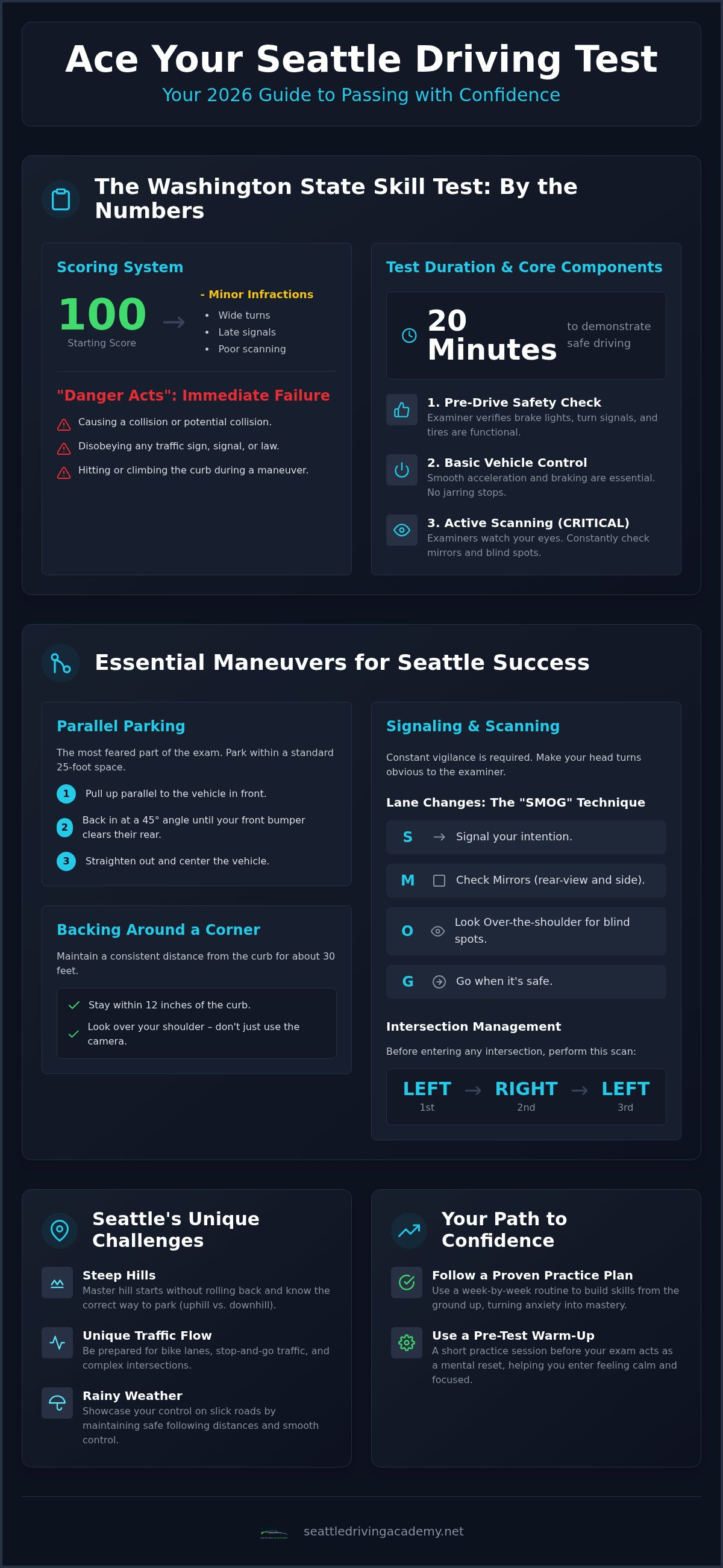
The Washington State Skill Test is a concise, 20-minute window where you demonstrate your ability to keep yourself and others safe on the road. While every state has its own specific rules for Driver's licenses in the United States, Washington focuses heavily on your decision-making and awareness. You'll start with a perfect score of 100, and points are deducted for minor infractions like wide turns or late signals. However, "danger acts" such as causing a collision or disobeying a traffic sign result in an immediate disqualification. Understanding this balance is key to staying calm during your exam.
The Core Components of the Skill Test
Your journey begins before you even put the car in gear. The examiner will perform a pre-drive vehicle safety check to ensure your brake lights, turn signals, and tires meet safety standards. Once you're on the move, you'll need to show mastery over basic vehicle control. This includes smooth acceleration and stopping that doesn't jar your passenger. The most common pitfall for students is scanning. Examiners watch your eyes constantly. If you aren't visibly checking your mirrors and performing head checks at every intersection or lane change, you'll lose points quickly. Effective driving test practice seattle sessions should prioritize these active observations until they become second nature.
Authorized Testing Centers vs. DOL Offices
While the Department of Licensing (DOL) sets the rules, you aren't required to take your test at a state office. Authorized private centers like Seattle Driving Academy offer a more personalized experience while maintaining the exact same rigorous standards. Choosing a private center often means shorter wait times and the ability to test in a familiar environment. When you engage in driving test practice seattle at the same location where you'll eventually take the exam, your anxiety levels drop significantly. You already know the parking lot layout and the general traffic patterns of the neighborhood. This familiarity allows you to focus entirely on your driving skills rather than the stress of a new location. We take pride in acting as your supportive mentor, ensuring you feel like a capable driver rather than just another number in a crowded waiting room.
Essential Maneuvers You Must Master for Seattle Success
Mastering the specific technical skills for your road exam is about more than just passing a test. It's about safety and confidence. Your driving test practice seattle sessions should focus on the maneuvers that examiners watch most closely. Seattle's unique topography makes certain tasks, like hill parking, absolutely vital for daily life. We're here to help you turn these high-stress moments into second nature through clear, repeatable steps.
Mastering the Curb: Parking and Backing
Parallel parking is often the most feared part of the exam, but it doesn't have to be. You'll typically be asked to park in a standard 25-foot space. Use a reliable three-point approach: pull up parallel to the vehicle in front, back in at a 45-degree angle until your front bumper clears their rear, and then straighten out. Remember that hitting the curb too hard or climbing it results in an automatic failure.
Backing around a corner requires you to maintain a consistent distance from the curb, usually within twelve inches, for about thirty feet. Don't rely solely on your backup camera. You must look over your shoulder to show the examiner you're aware of your surroundings. If you're feeling unsure about your precision, our individual driving lessons can provide the hands-on coaching you need to perfect these movements.
Signaling and Scanning Techniques
Seattle's stop-and-go traffic demands constant vigilance from every driver. The examiner will look for the "SMOG" technique during every lane change: Signal, Mirror, Over-the-shoulder, and Go. It's a simple rhythm that ensures you never miss a vehicle in your blind spot. This isn't just a suggestion; it's a core part of the Washington State driving test requirements. Make your head turns obvious so the examiner can see your eyes moving and confirming the path is clear.
Intersection management is another area where points are easily lost. You must demonstrate active scanning by looking left, right, and then left again before entering any intersection. This includes when you're the first car at a green light. Don't forget the hills, either. Whether you're in Capitol Hill or West Seattle, you must know where to turn your wheels when parking:
- Uphill with a curb: Turn your wheels away from the curb (to the left).
- Downhill with a curb: Turn your wheels toward the curb (to the right).
- Uphill or downhill without a curb: Always turn your wheels toward the edge of the road (to the right).
This ensures that if your parking brake were to fail, the car would roll away from traffic rather than into it. Consistent driving test practice seattle makes these habits automatic, allowing you to stay calm when the pressure is on.
Navigating Seattle's Unique Driving Challenges
Seattle isn't your average grid-based city. Between the steep inclines and the unpredictable Pacific Northwest weather, your driving test practice seattle needs to account for variables that many other regions simply don't face. Examiners here look for more than just technical skill; they want to see that you can adapt to a dynamic, high-density environment while maintaining total control of your vehicle. We've seen many students master the basics only to be surprised by the specific demands of our local streets.
Hill Driving and Gravity Management
Managing gravity is a daily reality for local drivers. During your test, you'll need to demonstrate smooth starts on steep inclines without rolling backward. This requires a delicate balance of brake and accelerator. Because our geography is so vertical, hill parking is a mandatory part of the Seattle area test. It's not just about turning your wheels correctly; it's about proving you understand how to secure a multi-ton machine against the pull of gravity. If the thought of starting on a 15 percent grade makes your heart race, you might benefit from specialized Seattle driving lessons for hilly terrain to build that muscle memory.
Visibility and Weather Conditions
We're famous for our "Grey Days," and these conditions can significantly impact your visibility during a morning or afternoon test. You should always use your headlights in the rain, even if it's daytime. This isn't just for your own vision; it's so other drivers can see you through the mist. Wet pavement also requires you to adjust your following distance. A standard three-second gap should be increased to four or five seconds to account for longer stopping distances. This proactive adjustment shows the examiner that you are a safety-conscious driver who respects the environment.
Protecting Vulnerable Road Users
High-density areas like Capitol Hill or Downtown are teeming with pedestrians and cyclists. Seattle is a Vision Zero city, which means there is a heavy emphasis on protecting vulnerable road users. When you're performing driving test practice seattle, pay extra attention to bike lanes. Before making a right-hand turn, you must check your side mirror and look over your shoulder specifically for cyclists who might be approaching from behind. In neighborhoods with heavy foot traffic, always stop completely behind the limit line at crosswalks. A single wheel over that line can be seen as a failure to yield, and examiners take these infractions very seriously.
Creating Your 2026 Driving Test Practice Routine
While knowing the specific maneuvers is essential, building a structured schedule is what turns knowledge into muscle memory. A consistent driving test practice seattle routine prevents last-minute cramming and reduces the anxiety that leads to simple mistakes. We recommend a four week approach to ensure you're fully prepared for the road. This methodical progression allows you to master one skill before moving to the next, building a foundation of confidence that carries you through test day.
- Week 1: Basic Control. Spend your time in quiet residential areas. Focus on smooth acceleration, gentle braking, and precise steering. You want the car to feel like an extension of yourself.
- Week 2: Technical Maneuvers. This is the time to master the curb. Practice your parallel parking and backing around corners until you can do them consistently within the required distance from the sidewalk.
- Week 3: Traffic Integration. Move into moderate traffic. Focus on your scanning patterns and the SMOG technique for lane changes. Practice managing intersections and yielding to pedestrians in busier neighborhoods.
- Week 4: Simulation and Refinement. Conduct full mock tests. This week is about building the stamina to stay focused for the entire 20 minute evaluation period.
The Mock Test Strategy
To truly simulate the pressure of the exam, have a friend or family member act as an examiner. They should sit silently with a clipboard and grade your performance against a checklist. Have them watch specifically for your head turns and signal timing. Identifying your "trouble spots" in a low-stakes environment allows you to fix them before they cost you points on the actual test. If you find yourself consistently struggling with a specific hill or intersection, dedicate extra time to that location during your driving test practice seattle sessions.
Professional Help for Adult and Teen Learners
Sometimes, a supportive mentor is the missing piece of the puzzle. For younger drivers, our Teen Complete Package offers a comprehensive foundation that goes far beyond the basics. Adult learners often have different needs, which is why our 3-hour Adult Driving Package is designed to fast-track your readiness by focusing on the specific skills you need to polish. Getting professional feedback before you pay for your official exam can save you the time and cost of a re-test. It's an investment in your safety and your future freedom.
Ready to prove your skills? You can schedule your driver license driving test with us today and take the final step toward earning your license with confidence.
The Secret Weapon: Pre-Test Warm-Up Practice
What if you could walk into your exam feeling like you've already passed? Most students treat the moments before their test as a time for nervous waiting, but there's a better way to handle that energy. A pre-test warm-up is a focused 30 to 60 minute session held immediately before your scheduled exam. It's the ultimate tool for license readiness. This isn't just about more driving test practice seattle sessions; it's about the psychological shift from student to master. You're giving yourself permission to succeed by getting into the right mindset before the pressure is on.
We've seen it time and again: the physical act of driving right before the test calms the nerves and settles the mind. Instead of letting your heart race in a waiting room, you're behind the wheel, getting a feel for the car's braking and acceleration. It's a low-pressure environment where you can shake off any last-minute jitters with a supportive mentor by your side. Students who engage in these sessions often report feeling significantly more prepared, leading to a much smoother experience when the examiner finally joins them. You aren't starting cold; you're already in the flow of safe, observant driving.
What Happens During a Warm-Up Session?
During this time, we focus on the high-points of the exam. It's a quick, efficient review designed to keep the most important maneuvers fresh in your mind. We don't want you overthinking; we want you reacting with confidence. Your instructor will provide those final, gentle reminders that make all the difference in your scoring.
- Parallel Parking and Backing: We'll run through these maneuvers one last time to ensure your spacing and angles are perfect.
- Scanning Habits: We'll practice those vital head turns and intersection checks so they're top-of-mind during the test.
- Vehicle Safety Check: We'll perform a final walk-around to ensure your lights and signals are functioning correctly, avoiding any mechanical surprises that could delay your test.
Booking Your Test and Warm-Up Together
Efficiency is key when you're aiming for success. By scheduling your practice and your exam at the same authorized center, you create a seamless transition. You'll already be familiar with the vehicle and the local streets, which removes a huge layer of stress from the day. We believe in being your partner in this journey, offering the convenience of a combined session where you can master the road and earn your license in one visit.
Choosing the right environment can make all the difference in your performance. If you're still deciding where to go, take a look at our guide to choosing the right testing center. It's designed to help you find a supportive location that prioritizes your success. You've put in the hours of driving test practice seattle needs. Now it's time to claim your freedom. Schedule your pre-test warm up and driving skill test today!
Take the Wheel with Total Confidence
You've done the hard work of learning the rules and mastering the maneuvers. Now, it's time to bring everything together. From understanding the scoring system to navigating those steep Capitol Hill inclines in the rain, you have the tools to succeed. The right driving test practice seattle strategy isn't just about repetition; it's about building the specific confidence needed for our local roads. Mastering these skills transforms a stressful exam into a manageable milestone.
As an Official DOL Authorized Testing Center, we're here to be your supportive mentor. Our expert instructors bring deep Seattle-specific knowledge to every session, ensuring you're ready for exactly what the examiners look for. Whether you're a teen starting out or an adult looking for a quick refresh, our flexible scheduling makes it easy to fit your goals into a busy life. Don't leave your license to chance when you can arrive for your exam feeling calm, prepared, and ready to pass on your first attempt.
Book Your Seattle Driving Test & Warm-Up Session Now and start your journey toward driving freedom today. We're excited to see you master the road and earn your license with ease.
Frequently Asked Questions
How many times can I fail the driving test in Washington State?
You can take the Washington State driving test as many times as you need to pass, but you must pay the testing fee for each attempt. If you don't pass on your first try, there is a mandatory waiting period of one week before your second attempt. For third or subsequent attempts, the waiting period increases to 30 days. This time is best used for extra driving test practice seattle to ensure you're ready.
Can I use my own car for the Seattle driving test?
Yes, you can use your own vehicle as long as it is currently registered, insured, and passes a basic safety inspection. The examiner will check that your brake lights, turn signals, and windshield wipers are all in working order. If your car doesn't meet these requirements, you won't be able to start the test. We also offer vehicles for use if your personal car isn't test-ready for the exam.
What is the most common reason for failing the driving test in Seattle?
The most frequent reason for failure isn't a lack of technical skill but a failure to demonstrate proper scanning and observation. Many students lose points because they don't visibly turn their heads to check blind spots or mirrors at every intersection. Another common issue is "danger acts," such as failing to yield to a pedestrian or rolling through a stop sign. Consistent observation is the foundation of a successful exam.
Do I need to practice parallel parking if I have a backup camera?
You absolutely need to practice parallel parking even if your car is equipped with a backup camera. While you can use the camera as a secondary aid, the examiner requires you to look over your shoulder and use your mirrors as your primary source of information. Relying solely on the screen can lead to a deduction or failure. Mastering the three-point approach ensures you're prepared for any vehicle or situation.
How long should I practice before taking the driving test?
The amount of time varies by individual, but the state recommends at least 50 hours of supervised driving, including 10 hours at night, for teen drivers. Adults should practice until they can perform all required maneuvers without hesitation or coaching. A structured driving test practice seattle routine over four weeks is usually enough to build the muscle memory and confidence needed to pass on your very first try.
Is the knowledge test required before I can take the skill test?
Yes, you must pass the Washington State knowledge test before you are eligible to schedule your driving skill test. The knowledge test covers traffic laws, road signs, and safe driving practices. Once you've successfully completed the written exam, your results are entered into the DOL system. This allows you to proceed with the practical portion of your licensing journey at an authorized center like ours.
What documents do I need to bring to my Seattle driving test appointment?
You must bring your valid Washington State learner's permit or a valid photo ID to your appointment. If you are using your own vehicle, you need to provide proof of current insurance and registration. It's also a good idea to have your confirmation number ready when you arrive. Being organized with your paperwork helps reduce stress, allowing you to focus entirely on your performance during the actual driving evaluation.
Can I take the driving test in the rain or snow in Seattle?
Driving tests proceed in the rain, which is a common reality for all Seattle drivers. You should be prepared to use your wipers and defrosters effectively while maintaining a safe following distance on wet roads. However, if weather conditions like heavy snow or ice make the roads unsafe, the testing center may reschedule your appointment. Safety is always the primary concern for both you and the examiner.


