

What if the hardest part of a lane change on your Washington driving test isn’t steering, but remembering what to check before you move? When nerves rise, it’s easy to signal late, skip a shoulder check, or start moving before the next lane is clear. A simple lane change checklist for driving test practice can turn those separate actions into a calm, repeatable routine.
It’s normal to wonder when to signal, how to judge a safe gap, and whether you’re making a lane change, turn, or merge. Washington’s Department of Licensing outlines the core steps: signal, check your mirrors, look back over your shoulder, then change lanes carefully. This guide turns that guidance into a practical sequence you can rehearse, while helping you recognize when to wait rather than force a move. Practise the steps calmly before test day so you can focus on the road and make each decision with care.
Key Takeaways
- Use a lane change checklist for driving test practice to make each observation deliberate, not automatic.
- Assess traffic and road conditions before moving. Signal as part of a safe, well-timed maneuver.
- Check your mirrors and blind spot, and avoid drifting or moving abruptly into another lane.
- Practise with a qualified supervising driver in suitable conditions. Let the sequence support your awareness rather than distract you.
- Before test day, review the Washington Driver Guide and current DOL skill-test information so you know what to expect.
Why a Lane Change Checklist Helps on a Washington Driving Test
A lane change moves your vehicle from its current lane into another lane when the movement is safe and permitted. A simple lane change checklist for driving test practice helps you organize what to observe and when to act, especially under pressure. It’s a memory aid, not a substitute for attention: traffic, road markings, and conditions can change while you prepare to move.
It also helps to know what the maneuver isn’t. A turn changes your direction at an intersection or driveway. A merge joins traffic where lanes come together, such as at an on-ramp. Following a bend means staying in your lane as the road curves. You don’t cross into another lane. Understanding what is a traffic lane can help clarify how lanes and markings organize traffic, but always follow the signs and road markings where you’re driving.
For official test expectations, review the current Washington State Department of Licensing (DOL) Driver Guide and skill-test information. The DOL’s safe lane-change guidance includes signaling, checking mirrors, looking back over your shoulder, and changing lanes carefully. A checklist can help you remember those actions, but it can’t tell you whether a particular gap is safe. You have to judge that based on what’s happening around the car.
What the examiner needs to observe during a lane change
Make your decisions clear through deliberate actions. Signal to communicate your intention, check your mirrors and blind spot, then move smoothly only when traffic and road conditions allow. Keep observing your surroundings instead of treating each step as a box to tick. Follow the examiner’s directions, but don’t rush or make an unsafe move just to respond quickly. Consult current DOL materials for official evaluation details, and don’t rely on unofficial claims about fixed point deductions or automatic failures.
Why learners miss steps when they feel nervous
Test pressure can narrow your attention. You might focus on the examiner’s instruction and nearby traffic, then forget the blind-spot check or signal and steer before confirming the lane is clear. Rushed steering can also turn a controlled movement into an abrupt one.
Practising one consistent sequence can reduce hesitation and leave more attention for the road. At first, you can say the steps aloud with a qualified supervisor. As the routine becomes familiar, focus on observing traffic rather than reciting words. Observation isn’t a single glance before you move; it continues until the lane change is complete.
The Lane Change Checklist: Check, Signal, Recheck, Move
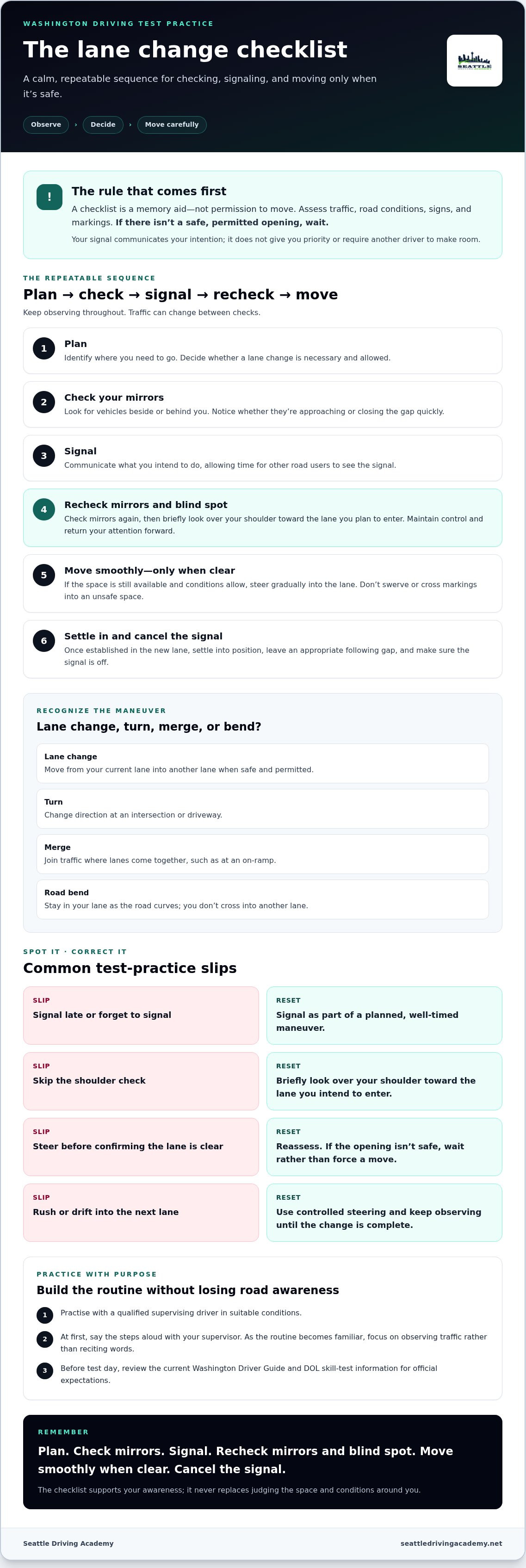
Use this sequence as a prompt for careful decisions, not as a set of motions to perform automatically. Before changing lanes, assess the road, traffic, signs, and markings. If there isn’t a safe, permitted opening, wait. A signal communicates your intention; it doesn’t give you priority or require another driver to make room.
- Plan. Identify where you need to go and whether a lane change is necessary and allowed.
- Check your mirrors. Look for nearby vehicles and judge whether they’re approaching or closing the gap quickly.
- Signal. Let other road users know what you intend to do, allowing time for them to see your signal.
- Check your blind spot. Briefly look over the shoulder toward the lane you plan to enter while maintaining control of the vehicle.
- Move smoothly. If the space is still available and conditions allow, steer gradually into the lane.
- Cancel your signal. Once you’re established in the new lane, make sure the signal is off.
In short: plan, check your mirrors, signal, check your blind spot, move smoothly when clear, and cancel your signal. This lane change checklist for driving test practice gives you a consistent order, but traffic can change between checks. Keep observing and reassess before moving.
Mirror checks, signaling, and blind-spot observation
Use your mirrors to notice vehicles beside or behind you, how quickly they’re closing, and whether there appears to be enough space. Signal, check the mirrors again, then briefly look over your shoulder for anything the mirrors may not show. Keep the head check brief so you can maintain control and return your attention forward. Washington-specific test wording and expectations can change, so confirm current details in DOL materials. A visual reference can also help reinforce the lane-change procedure.
Moving smoothly and completing the lane change
When the lane is clearly available, guide the vehicle across with controlled steering rather than a sudden swerve. Once you’re in the new lane, settle into position and leave an appropriate following gap. Check that your signal has cancelled; if it hasn’t, switch it off. Don’t cross markings or follow a signal into a space that traffic, signs, or road conditions make unsafe. You can practise the routine during pre-test warm-up practice if you’d like support before your test.
Common Lane Change Mistakes, and How to Correct Them Safely
Many lane-change errors happen when a driver acts before confirming the space is safe. Signaling without checking, relying on mirrors alone, or steering abruptly can prompt unexpected reactions from other road users. A signal tells them what you intend to do; it doesn’t make the lane clear or guarantee another driver will yield.
A reliable lane change checklist for driving test practice helps you catch these habits before test day. Use it to guide your attention, not to rush through a memorized routine. If your observations show that the gap isn’t safe, stay in your lane and reassess.
What to do when the lane is not clear
If a vehicle is occupying the space you need, or approaching quickly enough to close the gap, don’t force your way in. Keep your vehicle steady in its current lane and wait for another opportunity. Avoid sudden braking or crossing solid lane markings to complete a maneuver. Signs, markings, and traffic conditions can make a lane change unsafe or unavailable, even if you’ve already signaled.
If the examiner asks you to change lanes, follow the direction when you can do so safely. You don’t need to move immediately into an unsafe gap. Continue under control and respond to the next direction or safe opportunity rather than treating the instruction as a reason to force your way in.
How to recover after a missed signal or observation
Realizing you missed a step can feel unsettling, but a sudden correction may create a bigger hazard. If you haven’t started moving, remain in your lane and begin again only when it’s safe. If you’re already changing lanes, keep control, avoid abrupt steering, and make the safest controlled decision available based on the traffic around you.
Don’t dwell on the mistake while the car is moving. Return your attention to the road, listen for the examiner’s next direction, and wait for a new safe opportunity before attempting another lane change. A missed signal or observation doesn’t mean you should assume the test is over. The examiner evaluates your driving according to current Washington Department of Licensing criteria, so avoid relying on unsupported claims about automatic failures.
During practice, ask your qualified supervising driver to help you notice patterns. Do you signal before checking? Do you forget the shoulder check when traffic gets busy? Does the car drift when you look over your shoulder? Work on one habit at a time in suitable conditions. Calm, repeated practice can help you respond thoughtfully instead of reacting to nerves.
Practise the Checklist Before Your Washington Driving Test
Practice helps the lane-change routine feel familiar, so you can give more attention to traffic instead of trying to remember every step. Work with a qualified supervising driver, choose legal places where lane changes are appropriate, and practise only when road and traffic conditions feel manageable. You don’t need to seek out challenging situations; safe judgment is part of the skill.
A simple practice routine for consistent lane changes
Begin on a quieter road with your supervising driver. Before each attempt, decide whether a lane change is needed and check that signs, markings, visibility, and traffic allow it. During early practice, saying the steps aloud can help you remember their order. As the routine becomes familiar, stop reciting and focus on what you can see and how traffic is changing.
After each attempt, take a moment to review it. Name one thing you did well, such as checking the blind spot before moving, and one observation to improve next time. If the space closes or conditions change, stay in your lane and wait. Build toward busier traffic gradually, only when your supervising driver agrees it’s appropriate. Seattle-area roads can present different traffic and lane-marking situations, but practice should never be treated as rehearsal for a particular test route.
Prepare for local testing with the right support
Use the current Washington State Department of Licensing Driver Guide and skill-test information to confirm official expectations before test day. For general information about testing centers, see our guide to passing your driving test at a license testing center. Check current testing and scheduling details directly before making plans.
If you’d benefit from extra feedback, individual driving lessons or pre-test warm-up practice can give you an opportunity to work on lane changes with support. Confirm current availability and booking details with the provider. Seattle Driving Academy offers individual lessons and pre-test warm-up practice. You can learn about driving practice options as you prepare. Keep the goal simple: build a steady habit, then let your observations guide each decision.
Feel Ready for Your Driving Test: Your Next Steps in Seattle
You don’t need to rush through a memorized routine to show safe driving. Before changing lanes, decide whether the move is needed and permitted, check your mirrors, signal, look in your blind spot, then move only when the space is safe. Stay in control, keep observing, and wait if conditions aren’t right. Sound judgment matters more than completing the sequence quickly.
Before test day, review the current Washington Driver Guide and DOL skill-test information so you’re familiar with official expectations. For adult learners looking for structured support, read our guide to adult driving lessons in Seattle.
Use a final pre-test self-check
Before practising or heading to your test, ask yourself:
- Can I identify the lane I intend to enter and check the signs and road markings first?
- Can I check my mirrors, signal, and look in the blind spot, while staying ready to wait if the lane isn’t clear?
- Can I keep the vehicle under control and follow the examiner’s directions without rushing?
If any answer feels uncertain, treat it as a useful practice goal, not a reason to panic. Revisit the lane change checklist for driving test practice in a safe setting with a qualified supervising driver. Focus on noticing what’s around you rather than simply reciting steps.
Get supportive practice before test day
Seattle Driving Academy offers individual driving lessons and pre-test warm-up practice. These are optional ways to work on your skills with support; check current availability and booking details directly. Practice can help you feel more prepared, but no lesson can guarantee a particular test result.
Take the next step at your own pace. Explore Seattle Driving Academy’s training and testing services to learn about available options before your Washington driving test.
Build Confidence for Your Seattle Driving Test
A calm, safe lane change is about more than steering into an open space. Use your checklist to plan first, check mirrors, signal, look over your shoulder, and move only when the lane is clear. If conditions change, wait rather than forcing the maneuver. Practise until the sequence feels familiar, while keeping your attention on traffic and road markings.
Before test day, review the current Washington Driver Guide and DOL skill-test information. The lane change checklist for driving test practice in this guide can help you prepare, but sound judgment matters more than racing through the steps.
Seattle Driving Academy is an authorized DOL testing center for knowledge and skill exams, and offers individual driving lessons and pre-test warm-up practice. These are options if you’d like support practising before your test. Explore Seattle Driving Academy’s lessons and pre-test warm-up practice.
Keep practising with care. You’re building skills for the road, not just test day, and every safe, thoughtful decision helps you move forward with confidence.
Frequently Asked Questions
How do you change lanes correctly on a driving test?
Plan the move, check your mirrors, signal, check your blind spot, then move smoothly only if the lane is clear and the change is permitted. Keep observing traffic as you move, settle into the lane, and cancel your signal. This lane change checklist for driving test practice is a guide, not a script to follow without thinking. In Washington, review current Department of Licensing guidance for official test expectations.
Do you have to check your blind spot during a lane change on a driving test?
Yes. Include a brief head check to look for vehicles your mirrors may not show before moving into another lane. Keep the glance short, maintain control, and return your attention forward. A mirror check alone may not reveal a vehicle alongside your car. Continue monitoring traffic during the maneuver, since a space that appeared open can change before you move. Check current Washington DOL materials for test guidance.
When should you signal before changing lanes on a driving test?
Signal before you begin moving so other road users have a clear chance to understand your intention. First assess the road and traffic, then signal as part of preparing for a safe lane change. Don’t treat the signal as permission to enter or assume another driver will yield. This guide doesn’t give a timing figure, so consult current Washington Department of Licensing guidance and practise signaling clearly without rushing.
What should you do if there is no safe gap to change lanes?
Stay in your current lane and wait for a safe, permitted opportunity. Don’t force your way into a small gap, brake abruptly, or cross lane markings to complete the move. If the examiner has asked you to change lanes, follow the direction when conditions allow, but safety comes first. Keep driving under control, continue observing traffic, and respond to the next instruction rather than rushing.
Can you fail a driving test for forgetting to signal during a lane change?
Forgetting to signal can affect how your driving is assessed, but don’t assume one missed signal automatically means you’ve failed. The exact outcome depends on the examiner’s evaluation under current Washington DOL criteria, and this answer can’t confirm a fixed penalty or automatic-fail rule. If you notice the omission, keep control and avoid a sudden correction. Focus on driving safely and follow the examiner’s next direction.
How can I practise lane changes before my Washington driving test?
Practise with a qualified supervising driver in legal settings and suitable traffic conditions. Start somewhere quieter, say the sequence aloud while learning, then focus on traffic and observation instead of reciting. After each attempt, identify one thing that went well and one step to improve. Seattle learners can also consider individual driving lessons or pre-test warm-up practice with Seattle Driving Academy. Check current service availability and DOL guidance before test day.


