

The safest place to learn a three-point turn may not be a busy Seattle street. If you’re looking for three point turn practice Seattle learners can approach safely, begin in a calm setting where you can focus on the sequence without reacting to impatient traffic.
It’s easy to second-guess when to signal, check around you, stop, and change direction, especially when a curb or nearby vehicle feels too close. Build a clear routine in a space that gives you room to practise. That helps you focus on smooth steering and careful observation before trying the manoeuvre in more demanding conditions.
This guide explains each step, how to choose a suitable place to practise, and how to reduce the risk of striking a curb or entering traffic unsafely. It also covers when an individual driving lesson or pre-test warm-up practice could provide useful feedback. Test requirements can change, so check current Washington Department of Licensing guidance rather than assuming this manoeuvre is assessed. Take it one step at a time, with safety guiding every turn.
Key Takeaways
- A three-point turn can change your direction when there isn’t room for a simple turn, but choose a safer alternative if conditions aren’t suitable.
- For three point turn practice seattle, start in a quiet, level area where practice is permitted and there’s room to manoeuvre.
- Prioritize observation and controlled movement at every stage. Don’t rush the steering or reverse.
- Move to more challenging settings only after you can complete the checks and movements calmly and consistently.
- If you’re unsure, anxious, or repeating mistakes, ask about individual lessons or pre-test warm-up practice for feedback.
Three-point turn practice in Seattle: what the manoeuvre does and when to practise
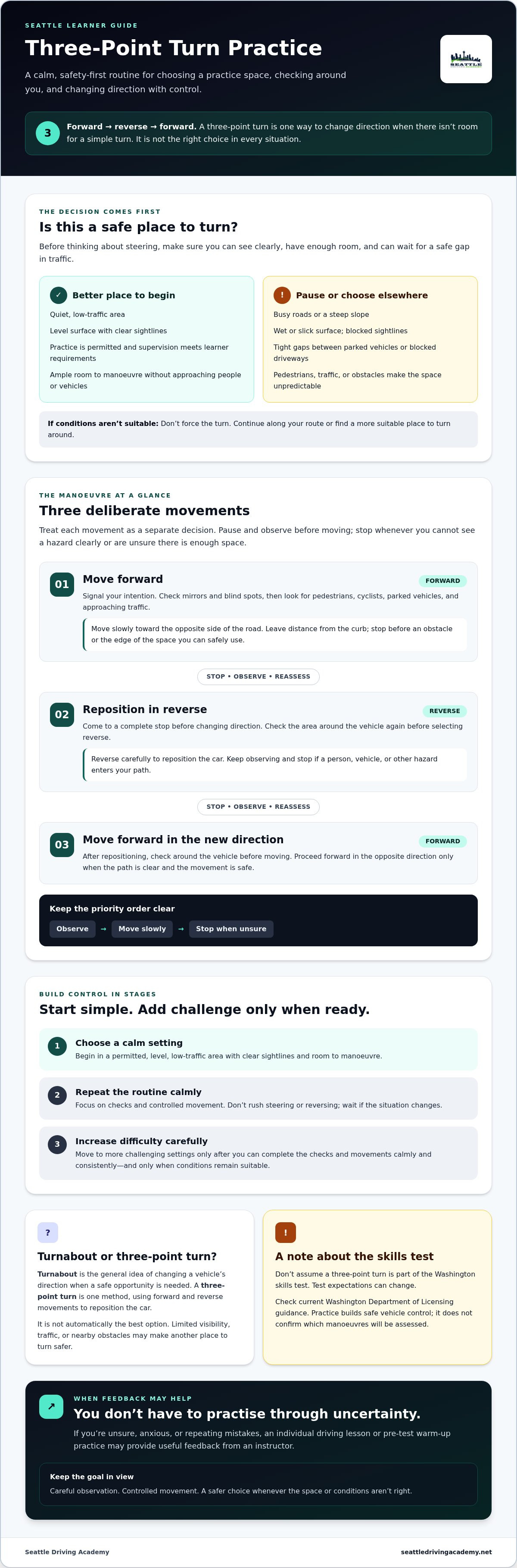
A three-point turn is a controlled way to change direction using forward and reverse movements when the road is too narrow for a simple turn. You move across the road, reverse to reposition, then move forward in the opposite direction. A three-point turn is one type of turnabout, not a manoeuvre to attempt automatically whenever you need to change direction.
Seattle conditions can affect whether the turn is a sensible choice. Hills can make it harder to move and stop smoothly. Narrow streets, parked cars, pedestrians, and wet pavement can limit space or visibility. If you can’t see clearly, have enough room, or wait for a safe gap in traffic, don’t force the turn. Continue along your route or find a more suitable place to turn around.
For three point turn practice seattle learners should first find a permitted, low-traffic, level area with clear sightlines and ample room. Before practising on a public street or private property, check current local restrictions and make sure you have supervision that meets applicable learner requirements. Avoid steep slopes, busy roads, blocked driveways, and tight gaps between parked vehicles.
Is a three-point turn the same as a turnabout?
Turnabout is a general term for changing a vehicle’s direction when a safe opportunity is needed. A three-point turn is one way to do it, using forward and reverse movements to reposition the car. It isn’t always the right option. If traffic, limited visibility, or nearby obstacles make the manoeuvre unsafe, continue to a more suitable place instead of squeezing into a turn.
Choose a safe Seattle practice setting
Start somewhere calm and uncomplicated. Look for a level area where practice is allowed and you have room to move without approaching other vehicles or people. Seattle’s slopes, wet surfaces, narrow streets, and parked cars can add pressure. Leave those challenges for later, if they’re appropriate at all. Confirm local rules and supervision requirements before you begin.
Keep the conditions simple until you can focus on the task without rushing. If the surface is slick, sightlines are blocked, or pedestrians and traffic make the space unpredictable, pause and choose another time or location. A driveway or quieter route may be a safer alternative only if you’re permitted to use it and can enter, turn, and leave safely.
Don’t assume a three-point turn is part of the Washington skills test. Test expectations can change, so check current Washington Department of Licensing guidance before preparing for an assessment. Treat practice as a way to build safe vehicle control, not as proof that a particular manoeuvre will be tested.
How to practise a three-point turn: the sequence, checks, and steering
Think of the manoeuvre as a series of deliberate decisions, not a quick spin of the steering wheel. Before each movement, pause to check what’s around you. Observe continuously before moving, and stop whenever you can’t see a hazard clearly or aren’t sure you have enough space.
The steps below are general practice guidance, not a statement about what will be assessed on a Washington skills test. Review the current Washington Driver Guide and Department of Licensing test information for official guidance. A practice routine can help you develop control, but it doesn’t confirm which manoeuvres are required during an assessment.
Set up, check, and move forward
Start only where turning is permitted and there’s enough clear space to complete the movements without obstructing others. Signal your intention, then check your mirrors and blind spots. Look for pedestrians, cyclists, parked vehicles, and approaching traffic before moving. If anyone enters your path, wait.
- From a safe starting position, signal and check around the vehicle.
- Move forward slowly while steering toward the opposite side of the road. Leave enough distance from the curb. Don’t mount it or enter an area that isn’t safe to use.
- Stop before the car reaches an obstacle or the edge of the space you can safely use.
There’s no need to rush the steering. Move at a pace that lets you stay in control and reassess what you can see. If a parked car, pedestrian, or other vehicle changes the situation, stop and wait until the path is clear.
Reverse, check again, and finish in the correct direction
Come to a complete stop before changing direction. Select reverse only after checking the area around the vehicle again. Look in the direction you’re travelling as you back up, while continuing to watch for hazards on all sides. Stop if your view is blocked or anything moves into your path.
- Reverse slowly toward the side you started from, steering to guide the vehicle into the available space.
- Stop with room to move forward. Check around the car again before selecting drive.
- When the forward path is clear, move ahead at low speed, steering into the new direction and straightening the vehicle within the appropriate lane.
During three point turn practice seattle learners may find that space or sightlines change partway through the manoeuvre. Don’t force a finish if conditions no longer feel safe. An instructor can give real-time feedback on observation and vehicle control during an individual driving lesson. Ask whether a lesson suits the practice you need.
Practising alone or with an instructor: which approach builds better control?
Repetition can make a three-point turn feel more familiar, but repeating a rushed or poorly observed attempt can reinforce the wrong habit. The useful question isn’t simply how many times you practise. Ask whether you can check carefully, move with control, and get help when you’re unsure.
For three point turn practice seattle learners can compare options by the supervision available, the feedback they’ll receive, and whether the practice area is suitable. Follow current Washington rules for learner supervision, and don’t practise alone if you aren’t legally permitted to do so.
| Practice option | Safety and feedback | Best fit |
|---|---|---|
| Instructor-led lesson | Offers direct feedback on observation, steering, stopping, and vehicle control. | You’re uncertain about the sequence or want help correcting a repeated habit. |
| Practice with a qualified accompanying driver | Can support repetition, though the value depends on the driver’s attention and clear, consistent guidance. | You can follow the steps calmly in a permitted, low-risk area. |
| Unsupervised practice when supervision is required | Isn’t appropriate. There’s no qualified person to guide or support the learner. | Choose permitted, supervised practice instead. |
When independent repetition may be useful
Once you have clear guidance, supervised practice can help you get familiar with the sequence. Make one controlled attempt, then review whether you checked around, kept safe spacing, and stopped before changing direction. Continue only if you and your accompanying driver agree the area remains safe and the instructions are clear.
Pause if you feel rushed, can’t see hazards, or receive conflicting directions. More attempts won’t help if attention and control are slipping. For local guidance on driving expectations, consult the current Washington Driver Guide and Department of Licensing materials.
When an instructor can help correct a habit
Consider professional feedback if your steering, blind-spot checks, stopping points, or reversing feel inconsistent. An instructor can help identify which step needs attention and explain what to observe before each movement. Seattle Driving Academy offers individual driving lessons in Seattle. Ask whether a lesson can support the practice you need.
Choose the approach that keeps observation and movement controlled. Neither repeated practice nor a lesson guarantees a test result. Check current Department of Licensing guidance for Washington assessment requirements.
A Seattle practice routine: build confidence without rushing into traffic
Build confidence in stages. Begin in a quiet, level area where practice is permitted, with a qualified supervisor if required. Don’t move to a low-traffic street just to make practice feel more realistic. First, make sure you can complete the checks and movements calmly and consistently in a simpler setting.
For three point turn practice seattle learners should consider the conditions around them, not just the steering. Hills can make smooth starts and stops harder. Parked vehicles and narrow streets can limit room, while pedestrians or restricted sightlines can change what’s safe. Rain may also affect visibility and the road surface. If conditions make it harder to see, judge space, or stay in control, pause or choose another setting.
Before each session, confirm the site is permitted and level, arrange qualified supervision if required, check that visibility and sightlines are clear, and make sure you can stop safely if conditions change.
Use a short practice session with clear goals
Keep each session focused. Choose one skill to work on, such as scanning before moving, maintaining low speed, or judging the space around the car. Trying to fix everything at once can make it harder to notice progress.
- Before an attempt, agree on the skill you’re focusing on.
- Afterward, pause and discuss what you saw, where you stopped, and what you might adjust next time.
- End the session if fatigue, frustration, weather, or traffic starts to reduce attention.
Pausing is useful practice, too. You don’t need to keep repeating the manoeuvre if you or your supervisor can’t give it full attention.
Prepare for a Washington skills test without assuming the test manoeuvre
Use current Washington Department of Licensing instructions and the Washington Driver Guide to prepare for a skills test. Don’t assume a three-point turn is assessed. Test requirements can change. The broader skills apply to everyday driving: observing carefully, controlling speed, and positioning the vehicle thoughtfully.
If you’re also planning a test, this Seattle road test preparation guidance can help you consider testing-centre choices. For personal feedback, Seattle Driving Academy offers individual driving lessons and pre-test warm-up practice. Ask about practice support that fits your learning needs.
Get three-point turn feedback from a Seattle driving instructor
Practice can be difficult to judge from the driver’s seat. An instructor may offer a useful outside perspective if you’re unsure whether you checked thoroughly, keep repeating the same steering or reversing error, feel anxious about nearby traffic, or can’t find a suitable place to practise.
Seattle Driving Academy offers individual driving lessons and pre-test warm-up practice for teen and adult learners. These options give you an opportunity to ask for feedback on observation and vehicle control, but don’t assume a particular lesson includes three-point-turn practice. Ask what support suits your goals before arranging a session.
What to ask before booking driving practice
Be specific about what feels challenging. Ask whether an instructor can assess your observation, reversing control, and judgment of the turning space. Explain whether you’re new to the manoeuvre or working on a particular habit, such as checking blind spots before moving.
Before making arrangements, confirm your eligibility to practise, any supervision requirements, the lesson details, and current availability directly with the school. If you’re preparing for a Washington skills test, bring your questions and check current requirements in official Department of Licensing guidance. Don’t assume a three-point turn will be included in the test.
Choose the next step that fits your experience
If you’re a new learner, focus first on foundational vehicle control and observation in a suitable practice setting. There’s no need to rush into complex turns in traffic. A more experienced driver may benefit from targeted feedback on a specific gap, such as choosing a safe stopping point or staying aware of hazards while reversing.
For three point turn practice seattle learners can treat coaching as an option, not a requirement or a promise of a particular outcome. The right next step depends on your confidence, practice opportunities, and the feedback you need. You can explore driving practice and test-preparation options and ask whether available support fits your situation.
Build confidence with a safe, steady practice plan
A smooth three-point turn depends on more than steering. Choose a permitted, low-traffic place with enough room, check around the vehicle before each movement, and stop if visibility or space becomes uncertain. Practise one step at a time. Move to more challenging conditions only when you can manage the checks and movements calmly.
For three point turn practice seattle, remember that coaching may help if you feel anxious, repeat the same mistake, or aren’t sure what to improve. Check current Washington Department of Licensing guidance for skills test requirements rather than assuming this manoeuvre will be assessed.
Seattle Driving Academy offers individual driving lessons for teen and adult learners, pre-test warm-up practice, and official licensing tests. Contact Seattle Driving Academy to ask about lessons or test-preparation support for your goals. Keep practice patient and safety-focused. Confidence grows one careful decision at a time.
Frequently Asked Questions
What is a three-point turn?
A three-point turn changes direction using forward and reverse movements when there isn’t enough room for a simple turn. You move forward toward the opposite side, stop, reverse toward your starting side, then move forward into the new direction. The available space and conditions matter. If traffic, visibility, or obstacles make the manoeuvre unsafe, choose a safer way to change your route.
How do you do a three-point turn step by step?
First, stop in a permitted place with enough space, signal, and check mirrors, blind spots, pedestrians, cyclists, and traffic. Move slowly forward while steering toward the opposite side, then stop. Check around again before selecting reverse. Back up slowly while looking in your direction of travel and watching for hazards. Stop, check once more, then move forward into the new direction when the path is clear.
Can I practise a three-point turn on a Seattle residential street?
You may be able to practise on a residential street only if turning is permitted, the area is suitable, and you meet applicable supervision requirements. Choose a quiet, level stretch with clear sightlines and ample space. Avoid busy streets, steep slopes, blocked driveways, pedestrians, and tight gaps between parked cars. Check local restrictions first, and stop if traffic or visibility makes the manoeuvre uncertain.
Is a three-point turn required on the Washington driving test?
Don’t assume a three-point turn is required on the Washington driving test. Test requirements can change, so check current Washington Department of Licensing guidance before you prepare. Practising the manoeuvre can still help develop observation, speed control, and vehicle positioning, but that doesn’t mean it will be assessed. Seattle Driving Academy provides official licensing tests, but confirm current test expectations through DOL materials.
Where can I practise a three-point turn in Seattle?
For three point turn practice seattle learners should look for a permitted, quiet, level area with clear sightlines and plenty of room, rather than starting in traffic. Confirm that you’re allowed to practise there and arrange qualified supervision if required. Don’t assume a particular public or private location is suitable. Check local restrictions, and avoid hills, blocked driveways, and spaces where parked cars limit visibility.
Should I practise a three-point turn with a driving instructor?
An instructor may help if you feel anxious, keep missing observation checks, or aren’t sure how to control the vehicle while reversing. Seattle Driving Academy offers individual driving lessons for teen and adult learners, as well as pre-test warm-up practice. Ask whether the available support fits your needs. Don’t assume a lesson includes this specific manoeuvre or guarantees a test result.
What should I do if there is not enough room to turn?
Don’t force the manoeuvre or squeeze between parked vehicles. If you can’t see hazards clearly or don’t have enough space, stop and choose a safer option, such as continuing along the road or using a suitable driveway where you’re permitted to do so. Reassess traffic, pedestrians, and visibility before changing direction. If no safe option is available, keep going until you find one.


