

Imagine sitting in the driveway with your teenager, keys in hand, and realizing that the path from the passenger seat to the driver's side feels like a maze of red tape. You aren't alone if you feel overwhelmed by shifting regulations and strict mandates. Learning how to get a drivers license in washington state under 18 involves more than just a quick trip to the DOL. It requires a strategic approach to driver education and a solid understanding of the 2026 requirements. From mandatory safety courses to specific hours of night driving, it's easy to feel like you're falling behind before the engine even starts.
We understand that this milestone is a mix of excitement and nerves for both parents and students. It's a huge step toward independence, but the pressure of passing that skills test on the first try can be daunting. This guide provides a clear, step-by-step roadmap to help you navigate the graduated licensing process with confidence. We'll walk through the essential checklist of requirements, explain the new 2026 work zone safety course mandate, and show you how a comprehensive training package can turn a stressful checklist into a smooth journey toward your intermediate license.
Key Takeaways
- Learn the specific age requirements and the tiered steps of the Washington State Graduated Licensing Program to ensure a smooth transition from learner's permit to intermediate license.
- Understand the exact timeline for holding your permit and how to get a drivers license in washington state under 18 by meeting the state's 50-hour supervised practice mandate.
- Find out how the Teen Complete Package simplifies your journey by combining the mandatory 30 hours of classroom instruction with professional behind-the-wheel training.
- Get expert tips on passing the official DOL Knowledge and Skills tests on your first attempt with pre-test warm-up practice and professional guidance.
- Stay compliant with the latest 2026 regulations, including the mandatory online safety course on work zones and first responders for all first-time applicants.
Understanding the Washington State Graduated Licensing Program
The journey to the driver's seat is an exciting time for any teenager. It's a major step toward independence. In Washington, this path is guided by the Graduated Driver License (GDL) system. This isn't just a collection of rules; it's a safety-first framework designed to help new drivers gain experience in low-risk settings before they take on more challenging conditions. While Driver's licenses in the United States are handled differently in every state, Washington's tiered approach is specifically built to protect our youngest drivers as they build their skills.
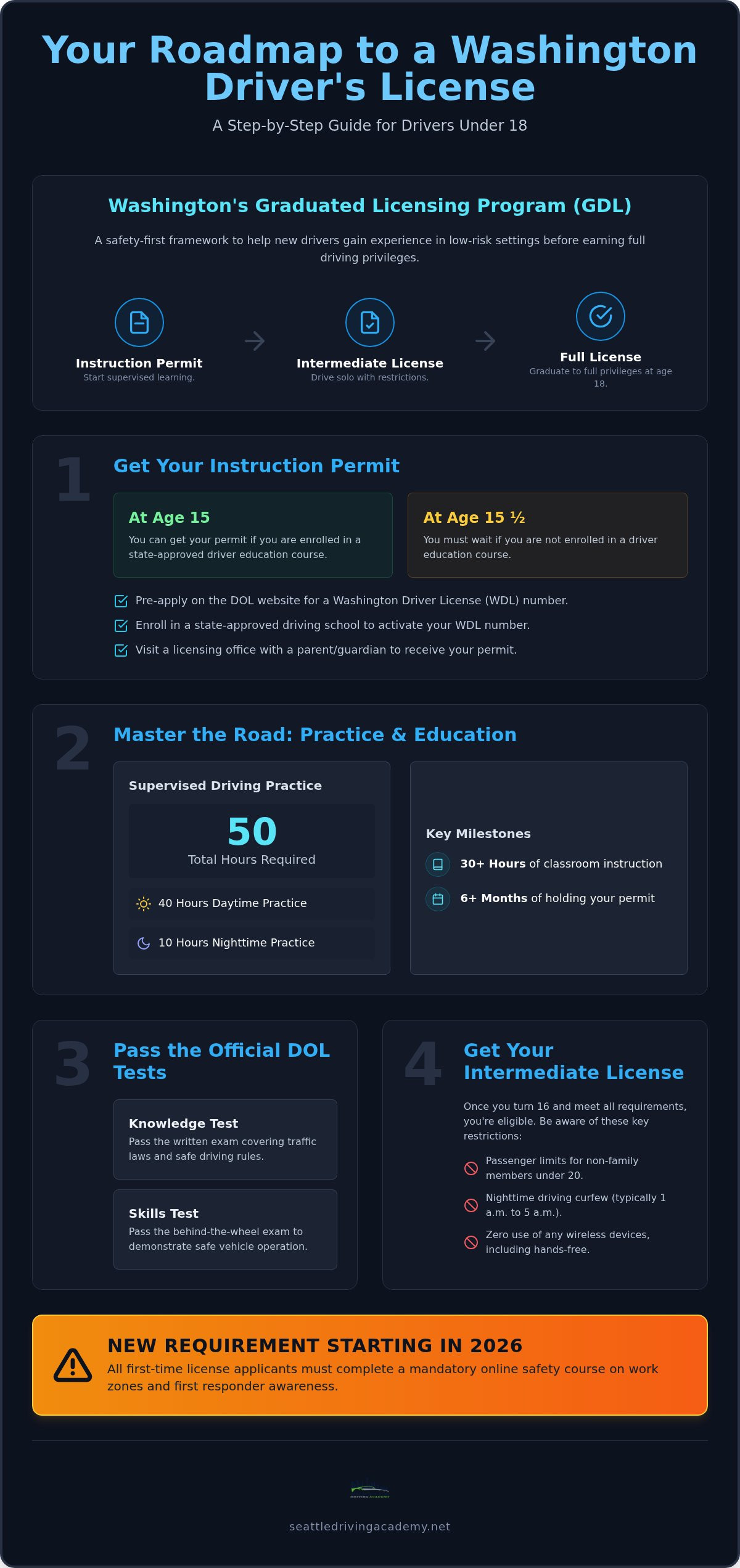
If you are researching how to get a drivers license in washington state under 18, you'll find that the process is broken into three distinct phases. Each phase offers a different level of freedom and responsibility. First, your teen will obtain an Instruction Permit to start their supervised learning. Once they've met specific milestones, they move to an Intermediate License, which allows for independent driving with certain restrictions. Finally, at age 18, they graduate to a Basic Driver License with full privileges. This methodical progression ensures that by the time they're driving solo, they've already mastered the basics under the watchful eye of a mentor.
The Purpose of the GDL System
The primary goal of the GDL system is simple: safety. Statistics consistently show that teen accident rates drop significantly when drivers are given time to practice under supervision. By requiring a set number of practice hours and mandatory education, the state ensures that teenagers don't just learn how to operate a vehicle, but also how to anticipate hazards. This comprehensive education prepares them for real-world scenarios that a simple test might miss. We view this system as a partnership between the state, the driving school, and the parents to create a protective environment for learning.
- Supervised Practice: It mandates 50 hours of practice, including 10 hours at night, to build muscle memory and situational awareness.
- Education First: It requires professional training to ensure teens understand the rules of the road before they start driving.
- Gradual Exposure: It limits distractions, like young passengers, during the first year of independent driving.
Key Age Requirements for 2026
Timing is everything when it comes to licensing. Your teen can start their journey as early as 15 years old, provided they are enrolled in a state-approved driver education course. If they choose to wait and not enroll in a course, they must be at least 15 and a half to get their permit. It's a good idea to start early so they have plenty of time to meet the six-month permit holding requirement. This mandatory waiting period is non-negotiable; it's the time when the most growth happens behind the wheel. Once they turn 16 and have completed all their requirements, they can finally apply for their Intermediate License.
Step 1: Securing Your Instruction Permit and Enrolling in Driver’s Ed
The first official step in your journey involves a bit of digital paperwork. Before your teen can even touch a steering wheel, they need a Washington Driver License (WDL) number. You can secure this by pre-applying on the Department of Licensing website through their License eXpress portal. This unique number is essential because it allows your chosen driving school to electronically notify the state once your teen is enrolled. If you're wondering how to get a drivers license in washington state under 18, starting this process early is the best way to stay ahead of the curve.
Under Washington law, there's a significant advantage to enrolling in a professional program early. While most teens have to wait until they're 15 and a half to get a permit, those enrolled in a state-approved course can get their Instruction Permit at age 15. This extra six months of practice is invaluable. Knowing how to get a drivers license in washington state under 18 means taking advantage of these early milestones. Once you have your WDL number and are signed up for a course, head to the licensing office with your identity documents and a parent or guardian to sign the consent forms.
Choosing a State-Approved Driving School
Selecting the right environment for your teen's education is about more than just checking a box. Professional instruction is mandatory for everyone under 18 in Washington for a reason; it builds a foundation of safety that lasts a lifetime. In Seattle, this means mastering unique challenges like steep hills and heavy rain. For a deeper look at what to look for in a provider, check out our guide on Driving Schools for Teens Near Me: The Ultimate 2026 Seattle Parent’s Checklist. At Seattle Driving Academy, we pride ourselves on being a supportive partner for local families during this transition.
Classroom and Behind-the-Wheel Requirements
The state has set a high bar for teen training to ensure every new driver is truly ready for the road. Your teen will need to complete 30 hours of classroom instruction, where they'll dive deep into traffic laws and defensive driving strategies. Alongside this, they must finish 6 hours of professional behind-the-wheel training with a certified instructor. There is also a requirement for 1 hour of observation time, where students learn by watching their peers navigate real-world traffic. Our Teen Complete Package is designed to cover all these bases in one seamless, stress-free experience that prepares students for success.
Step 2: Mastering the Road with Practice Hours and Professional Lessons
After your teen has their permit, the focus shifts to building real-world experience. The state requires a minimum of 50 hours of supervised driving practice. This isn't just a number to hit; it's the foundation of their safety. Out of these 50 hours, at least 10 must be completed at night. This breakdown ensures that new drivers are comfortable in various visibility conditions before they ever drive solo. While you are figuring out how to get a drivers license in washington state under 18, remember that this practice period is where the most significant skill growth happens.
Parents play a vital role here as supportive mentors. It can be a high-stress time, but your patience is the key to their confidence. Focus on teaching them to anticipate hazards rather than just reacting to them. We recommend starting in quiet parking lots before moving to residential streets and eventually busier arterials. Your goal is to create a calm environment where they feel safe to make mistakes and learn from them.
Structuring Your 50 Hours of Practice
Don't save all your hours for the weekend. It's much more effective to practice in short, frequent sessions across different environments. Log your time in rain, heavy traffic, and on winding backroads to ensure a well-rounded experience. Nighttime driving is a critical separate requirement because it forces teens to rely more on their headlights and road markings. While 50 hours is the legal minimum, logging more practice time directly correlates with higher confidence during the final exam.
The Value of Individual Driving Lessons in Seattle
Seattle presents unique challenges that can rattle even experienced drivers. From the steep inclines of Queen Anne to the high-speed merging required on I-5, local expertise is a huge advantage. Our Individual Driving Lessons provide a professional perspective that supplements your home practice. Instructors can identify and fix small technical errors, like improper hand placement or mirror checks, before they become ingrained habits. This professional intervention often saves time and reduces the tension that can sometimes arise during parent-led lessons.
During these sessions, we focus on the specific skills your teen will need for the skills test:
- Parallel parking between real vehicles or markers.
- Backing around a corner while maintaining a consistent distance from the curb.
- Smooth lane changes with proper signaling and blind-spot checks.
- Maintaining steady speeds on steep Seattle hills.
Step 3: Passing the Official DOL Knowledge and Skills Tests
Once you've logged your 50 practice hours and completed your driver's education course, you're ready for the final hurdles. This stage is often where the most anxiety kicks in, but remember that these tests are simply a way to prove you have the skills to stay safe. If you're researching how to get a drivers license in washington state under 18, you'll find that you must pass both a written knowledge exam and a practical skills test. We recommend scheduling these at an authorized testing center like ours to avoid the long wait times often found at municipal offices.
Acing the Knowledge Test
The Knowledge Test consists of 40 multiple-choice questions covering traffic laws, road signs, and safe driving practices. To succeed, you'll want to dive deep into the Washington Driver Guide. Don't just skim it; pay close attention to the specific numbers, such as following distances and alcohol limits. Taking your exam at a private academy offers a quieter, more focused environment than a busy government building. For more details on where to go, take a look at our guide on Seattle DOL Knowledge Test Locations: Your 2026 Guide to Passing. We've seen that students who take the time to study the guide thoroughly have a much higher first-time pass rate.
The Road Test: What to Expect
The Skills Test is your chance to show an examiner that you can handle real-world Seattle traffic with poise. You'll be evaluated on basic maneuvers like parallel parking and backing around a corner, but the examiner is also looking for your awareness. Scanning your mirrors and physically checking your blind spots isn't optional; it's a critical part of the score. Automatic failures can happen for things like jumping a curb, speeding, or failing to stop at a red light. It's vital to stay calm and focus on the road ahead rather than the examiner's clipboard.
To help settle those pre-exam jitters, we offer a Pre-test warm up practice and driving skill test package. This session allows you to brush up on tricky maneuvers right before the official test begins. It's the perfect way to build immediate confidence and ensure your skills are sharp when they matter most. You've worked hard to get to this point, and we're here to help you cross the finish line. Book your Department of Licensing Test Package with our patient instructors to take the next step toward your independence.
Step 4: Applying for Your Intermediate License and Understanding Restrictions
You've passed the tests. You've logged the hours. Now, the final step in learning how to get a drivers license in washington state under 18 is the official application. Once your training and test results are electronically submitted by your testing center, you can apply for your Intermediate Driver License (IDL) online through the License eXpress portal or in person at a DOL office. This isn't just a piece of plastic; it's a badge of achievement that comes with specific responsibilities designed to keep you safe during your first years on the road.
Washington's IDL program acts as a probationary period. It allows teens to gain solo driving experience while minimizing the most common distractions. We view this phase as a safety net rather than a set of limitations. It's a time to solidify the habits learned during your professional training while enjoying the independence you've earned. Understanding these restrictions is a key part of how to get a drivers license in washington state under 18 and, more importantly, keeping it.
Intermediate Driver License (IDL) Rules
For the first six months, you cannot carry any passengers under age 20 unless they are members of your immediate family. After that initial period, for the next six months, you are limited to carrying no more than three passengers under age 20 who aren't family members. These rules exist because data shows that the risk of an accident increases with every young passenger in the car. It's about giving you the space to focus entirely on the road.
There is also a strict nighttime curfew. You cannot drive between 1 AM and 5 AM unless you're with a licensed driver who is at least 25 years old. Additionally, Washington has a zero-tolerance policy for electronic devices. This means no texting, no calling, and no using hands-free devices while behind the wheel. Violating these rules can lead to a formal warning for a first offense; however, subsequent violations can result in license suspension or extended restrictions.
Next Steps: Your Journey as a Safe Driver
If you maintain a clean driving record for one full year, the passenger and nighttime restrictions are lifted. Your license will automatically transition to a basic driver license when you turn 18. This journey doesn't end with the plastic card; it's a lifelong commitment to safety and mastery. We're proud to have been part of your training and look forward to seeing you thrive as a responsible member of the Seattle driving community. Staying safe on the road is a team effort, and you've already taken the most important steps toward success.
Ready to start? Enroll in our Teen Complete Package today!
Your Road to Independence Starts Today
Mastering the steps of the Washington State Graduated Licensing Program is about more than just checking boxes; it’s about building a foundation for a lifetime of safe driving. By securing your permit at age 15 and diligently logging those 50 practice hours, you’re setting yourself up for success long before you reach the testing center. Remember that the intermediate license restrictions are a protective safety net designed to help you gain confidence during your first year behind the wheel. Understanding how to get a drivers license in washington state under 18 is the first step toward your true freedom.
We’re here to guide you through every milestone, from your very first classroom session to your final skills exam. As an official DOL Testing Center featuring Seattle’s most patient instructors, our comprehensive teen training and testing bundles take the stress out of the journey. We treat every student with the care we’d give our own family members, ensuring you feel empowered every time you turn the key. Ready to hit the road? Start Your Teen Driving Journey with the Seattle Driving Academy Complete Package. You’ve got this, and we can’t wait to see you thrive on the road.
Frequently Asked Questions
How long do I have to have my permit before I can get my license in Washington?
You must hold your instruction permit for at least six months before you can apply for an intermediate license. This mandatory waiting period is designed to give you ample time to practice in various road conditions. During this time, you should focus on completing your 50 hours of supervised driving. It is a critical phase for building the muscle memory and confidence needed to pass your skills test on the first try.
Can I take my driving test at a driving school instead of the DOL?
Yes, you can take both your knowledge and skills tests at an authorized driver license testing center like Seattle Driving Academy. Many students find this option much more comfortable than the busy atmosphere of a DOL office. We offer professional testing services in a familiar environment, which can help reduce those pre-test jitters. Once you pass, we'll upload your results directly to the state system so you can finalize your application.
What happens if I fail the knowledge test in Washington state?
Don't worry if you don't pass on your first attempt; it happens to many great drivers. You can retake the exam as early as the next day, though you'll need to pay the testing fee again. We encourage you to use the failure as a learning opportunity to review the Washington Driver Guide more thoroughly. Our instructors are always here to help clarify any traffic laws or road signs that might have been confusing for you.
Do I need to go to driving school if I am over 18 in Washington?
Currently, if you're over 18, formal driving school isn't mandatory yet. However, a new requirement for 18-year-olds begins on January 1, 2027. Additionally, starting November 1, 2026, all first-time applicants under 25 must complete a free online safety course regarding work zones and first responders. Even if you aren't strictly required to enroll in a full teen program, our adult training packages offer the professional guidance needed to navigate Seattle streets safely and confidently.
What are the passenger restrictions for a 16-year-old driver in WA?
When you're learning how to get a drivers license in washington state under 18, understanding the intermediate license restrictions is vital. For the first six months, you cannot have any passengers under age 20 unless they are immediate family members. For the following six months, you're limited to a maximum of three passengers under 20. These rules help you stay focused on the road while you're still gaining valuable solo driving experience in local traffic.
How many hours of driving practice are required for a teen in Washington?
The state requires a total of 50 hours of supervised driving practice before you can graduate to an intermediate license. At least 10 of those hours must be completed at night to ensure you're comfortable driving in low-visibility conditions. We recommend logging these hours in a variety of Seattle neighborhoods to prepare for the diverse challenges you'll face. Remember that your supervising driver must have been licensed for at least five years to qualify.
Can I drive out of state with a Washington Instruction Permit?
Most states recognize a Washington instruction permit, but you must follow the laws of the state where you're driving. Some states have different age requirements or supervision rules that you must respect while crossing borders. Always check the specific driving regulations for your destination before you head out on a road trip. It's also important to ensure your supervising driver meets the local requirements of that specific jurisdiction to stay fully compliant with their laws.
What documents do I need to bring to the DOL for my intermediate license?
To finalize the process of how to get a drivers license in washington state under 18, you'll need to bring specific documents to the DOL. These include proof of identity, like a birth certificate or passport, and your Social Security number. You'll also need a parent or guardian present to sign the parental consent form. Since we upload your test scores and education completion electronically, you won't need to bring paper certificates from our academy to the office.


