

Did you know that most people who fail the Washington DOL exam don't fail because they didn't study, but because they got tripped up by a handful of technical "threshold" questions? It's completely normal to feel overwhelmed when you're staring at a 100-page handbook filled with fine print and complex diagrams. You've probably heard horror stories about "trick" questions designed to make you fail; the thought of paying for a retake or losing more time is enough to make anyone anxious. We're here to help you cut through the noise and focus on the hardest questions on washington knowledge test so you can walk into that testing center with total confidence.
We understand that you want to get your license and start your journey on the road without the stress of "gotcha" moments. This 2026 prep guide is your roadmap to success. We've curated a list of the most challenging topics, from the specific signaling distances of 100 feet to the latest 2026 regulations regarding vulnerable road users and work zone safety. You'll get simple explanations for complex laws and the exact technical details the state uses to separate guessers from experts. Let's transform that test-day anxiety into a manageable, empowering win for you and your family.
Key Takeaways
- Learn why the 2026 exam focuses on real-world application rather than simple memorization to help you prepare more effectively.
- Master the technical thresholds for alcohol limits and following distances that frequently appear in the hardest questions on washington knowledge test.
- Get clear explanations for the most missed scenarios, such as when you must stop for school buses on multi-lane roads.
- Boost your memory and reduce anxiety by using focused study sessions and the "hand-write hack" for complex fines and distances.
- Understand how testing in a professional and supportive environment can help you feel more comfortable and ready for success.
Why the Washington Knowledge Test Trips Up Even Good Drivers
Many experienced drivers assume the written exam is a simple formality. However, the 2026 Washington Knowledge Test is a sophisticated assessment designed to measure your ability to apply safety principles in real-time scenarios. It isn't just a memory game. Washington has heavily weighted the exam toward the "Target Zero" initiative, which aims to eliminate traffic fatalities by 2030. This means you'll see a higher concentration of questions regarding vulnerable road users, such as cyclists and pedestrians.
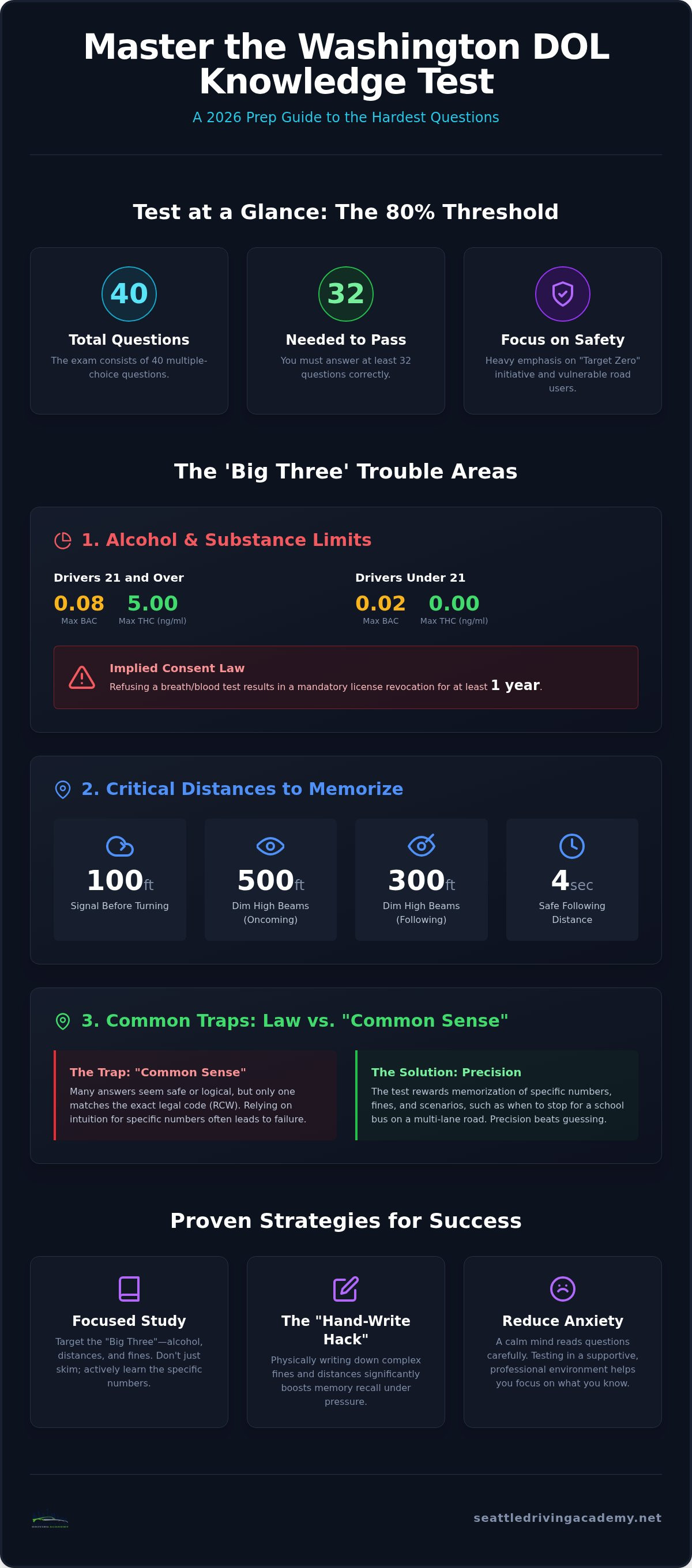
The format is straightforward but strict. You'll face 40 multiple-choice questions. To pass, you must answer at least 32 correctly, which requires an 80% score. While that might sound manageable, skimming the handbook for 15 minutes usually leads to a "Try Again" result. The test is specifically built to identify the hardest questions on washington knowledge test by focusing on technical details that general intuition simply can't solve.
The Difference Between 'Common Sense' and 'Washington Law'
One of the biggest traps for students is relying on "common sense" alone. On the road, common sense is vital; however, on the exam, the Revised Code of Washington (RCW) is the only authority. You might find questions where two answers look perfectly safe. Only one matches the exact legal precision required by state law. For example, technical distance questions about when to dim your high beams or how far to park from a fire hydrant require exact numbers. If you try to "wing it," you'll likely miss the marks that differentiate a legal maneuver from a "safe-looking" guess.
The Emotional Hurdle of Testing
Anxiety is often the silent reason for failure. When you're nervous, it's easy to misread small but critical qualifiers like "always" or "never." These words change the entire meaning of a rule. We've seen many bright students struggle because the pressure of a government office feels cold and clinical. This environment can make it difficult to recall what you've studied.
Choosing to take your Knowledge Test at a friendly, local academy can make a world of difference. A supportive environment lowers the stakes and helps you stay calm. Your first attempt is often the most stressful because of the unknown. By preparing for the hardest questions on washington knowledge test in a space that feels like a partnership, you can focus on the content instead of the clock. We treat you like family, ensuring you feel empowered to succeed rather than just another number in a queue.
The 'Big Three' Trouble Areas: Alcohol, Distances, and Fines
Most test-takers lose points on the hardest questions on washington knowledge test because they struggle to remember specific numerical thresholds. While general safety is often intuitive, legal limits are not. Washington law is incredibly specific about three core categories: what you put in your body, how much space you leave on the road, and how much insurance you carry. Mastering these numbers is the fastest way to secure your passing score and move one step closer to your license.
Alcohol and Substance Limits (The Most Failed Category)
Washington's "Implied Consent" law is a frequent stumbling block for students. By simply signing for your permit or license, you've already agreed to a breath or blood test if a police officer suspects you're driving under the influence. If you refuse this test, you don't just get a ticket; you face a mandatory license revocation for at least one year. This law is a cornerstone of state road safety, ensuring that everyone is held to the same high standard of accountability.
The exam also targets the difference between age groups and substances. For adults 21 and over, the Blood Alcohol Content (BAC) limit is 0.08, while for those under 21, it's a strict 0.02. Marijuana laws follow a similar pattern. Adults are limited to 5.00 nanograms of THC per milliliter of blood, but drivers under 21 must have a reading of 0.00. It's also vital to remember that your body takes about one hour to process a single drink. There's no way to "hack" this timeline with coffee or food.
Distances and Dimensions You Must Know
Technical distance questions are designed to be precise, leaving no room for guessing. You must signal at least 100 feet before making a turn or changing lanes to give others enough time to react. When it comes to visibility, you must dim your high beams within 500 feet of an oncoming vehicle and within 300 feet when following someone from behind. Following distances are just as critical; while the "4-second rule" is the standard for dry pavement, you need to increase this gap when roads are wet or visibility is poor.
When you're looking for a spot, remember that parking distances are non-negotiable. You must stay at least 15 feet away from a fire hydrant and 30 feet away from any stop sign or traffic signal. The "Danger Zone" is the 10-foot area directly surrounding a school bus where children are most vulnerable, and you must stop for flashing red lights and an extended stop paddle unless you are traveling in the opposite direction on a highway with three or more marked lanes.
Finally, don't overlook the financial requirements. To drive legally in 2026, you must carry insurance with minimum coverage of $25,000 for bodily injury to one person, $50,000 for two or more people, and $10,000 for property damage. If these numbers feel like a lot to juggle, don't worry. Our team at Seattle Driving Academy sees these hardest questions on washington knowledge test every day and can help you make sense of the math during your prep.
Deconstructing the 5 Most Missed Questions on the WA DOL Exam
Knowing the rules is only half the battle. To pass, you have to understand the specific logic the state uses to frame its scenarios. Many students fail because they choose the "safest sounding" answer rather than the legally correct one. By deconstructing the hardest questions on washington knowledge test, we can see exactly where the confusion starts and how you can avoid the same mistakes. These five scenarios represent the technical hurdles that lead to the most "Try Again" results at the testing center.
The School Bus 'Gotcha'
This is perhaps the most famous "trap" on the entire exam. While it's common knowledge that you must stop for a school bus with red lights flashing, Washington law adds a layer of complexity with the three-lane rule. You don't have to stop if you're traveling in the opposite direction on a roadway with three or more marked traffic lanes, provided those lanes are separated by a physical barrier or a median. This includes roads with a dedicated turn lane in the center. If you're on a simple two-lane road, however, every driver in both directions must stop. The DOL prioritizes this because the fines for bus violations are exceptionally high, often starting around $400, to protect children in the "Danger Zone" near the bus.
Intersections and Right-of-Way Logic
Four-way stops often leave students second-guessing themselves. If you and another driver arrive at the same time, always remember the "Yield to the Right" mantra. The vehicle on the right has the legal right of way. This same logic applies to uncontrolled intersections where there are no signs or lights. It's a common misconception that the faster vehicle or the one on the "busier" street goes first; in reality, the law focuses entirely on positioning. When turning right on a red light, you must come to a complete stop and yield to all pedestrians and approaching traffic. You can only proceed if there isn't a sign explicitly prohibiting the turn.
The remaining "most missed" scenarios often involve split-second decisions. If you're hydroplaning, the counter-intuitive secret is to stay off the brakes. Instead, ease your foot off the gas pedal and keep the steering wheel straight until your tires find the pavement again. If an emergency vehicle with sirens approaches while you're actually inside an intersection, don't stop there. You must clear the intersection entirely before pulling over to the right. Finally, when navigating multi-lane roundabouts, always choose your lane before entering and signal your intent to exit just after you pass the exit prior to your own. Mastering these specific hardest questions on washington knowledge test will give you the edge you need to finish your exam with confidence.
Proven Strategies to Ace Your Knowledge Test on the First Try
Mastering the hardest questions on washington knowledge test isn't about locked-room marathon study sessions. Most students find that their brains stop absorbing technical data after about 30 minutes. We recommend breaking your prep into 20-minute focused bursts. This keeps your mind fresh and prevents the "handbook fatigue" that leads to silly mistakes on test day. It's much better to study for a short period three times a day than to try and cram for four hours straight.
While digital tools are great, don't underestimate the power of the "Hand-Write" Hack. Physically writing down the specific fines, distances, and BAC levels we discussed earlier creates a stronger neural connection than simply clicking a screen. You should use the WA DOL Drivers License Practice Test as a diagnostic tool. Don't just take it to see if you pass; use it to pinpoint exactly which chapters you need to revisit before you schedule your official appointment.
Active Recall vs. Passive Reading
Passive reading is the enemy of retention. Instead of just highlighting text, turn to the "Key Terms" at the end of each handbook chapter and quiz yourself. If you can explain the 4-second rule or the three-lane bus exception to a friend, you truly understand the logic. Identifying your "Weak Zones" early in your prep week allows you to spend more time on the technical thresholds and less on the things you already know. This targeted approach builds genuine mastery rather than just temporary memory.
What to Do When You Get Stuck on a Question
If you encounter a question that leaves you stumped, use the process of elimination to strip away the "distractor" answers. Washington DOL questions often include one answer that is clearly wrong and one that is "safe but imprecise." Look for context clues in keywords like "immediately," "gradually," or "only." These words often signal the legal boundary you're being tested on. Remember, there is no penalty for guessing on the WA test. You should never leave a question blank because a guess gives you a 25% chance of being right.
Your mindset on the day of the exam is just as important as your knowledge. Arriving 15 minutes early to our Seattle testing center helps clear the "brain fog" and allows you to settle into a calm, focused state. When you're ready to prove your skills, come visit us at Seattle Driving Academy to take your test in a supportive environment.
Testing with Confidence at Seattle Driving Academy
Studying for the hardest questions on washington knowledge test is a significant achievement, but where you take the exam can be just as important as how much you've prepared. We've seen many students who know the material inside and out still feel a wave of anxiety when they walk into a sterile government building. That's why so many Seattle families choose to test in our supportive, professional environment. At Seattle Driving Academy, we don't just see you as a number in a queue; we treat you like a member of our own family. Our goal is to transform a high-stress milestone into an empowering step toward your independence.
Authorized Testing vs. The DOL Office
Choosing an authorized testing center means you get to skip the long lines and bureaucratic hurdles often found at the main DOL offices. We offer flexible scheduling that fits into your busy life, ensuring you don't have to wait weeks for an open slot. Our instructors act as your "Expert Guides," providing a calm atmosphere that helps you focus on the task at hand. We've designed our space to be student-centric and stress-free, allowing you to recall those technical distances and fines without the pressure of a clinical environment. You deserve a partner that is invested in your success.
Beyond the Written Test
Passing the written exam is a fantastic first step, but it's only the beginning of your journey on the road. For our younger drivers, the knowledge test is the perfect lead-in to our Teen Complete Package. This comprehensive program ensures that the theories you've just mastered become second nature behind the wheel. If you're an adult learner who feels a bit nervous about the transition to actual traffic, our specialized Adult Drivers Training 3 Hour Package bridges that gap perfectly. It provides hands-on experience in a safe, controlled way that builds real-world mastery.
We also offer pre-test warm-up practice and driving skill test options that are incredibly popular for those preparing for their final evaluation. These sessions help you shake off any lingering nerves and ensure you're fully "test-ready" before the examiner hops in the car. Thousands of Seattle drivers have started their journey with us, and we'd be honored to help you achieve your goals too. When you're ready to tackle the hardest questions on washington knowledge test and move on to the driver's seat, you can easily schedule your Department of Licensing Test Package through our website. Let's get you on the road with confidence and safety.
Your Journey to the Driver's Seat Starts Here
Mastering the hardest questions on washington knowledge test is about shifting your perspective from simple memorization to genuine understanding. You now have the tools to navigate tricky scenarios like multi-lane school bus stops and technical parking distances with total precision. By focusing on active recall and utilizing our 2026 prep strategies, you're already ahead of the curve. Remember that the goal isn't just to pass a test; it's to become a safe, confident driver for your family and community. We believe in your ability to succeed and are here to support you every step of the way.
As an Official WA State Authorized Testing Center, Seattle Driving Academy has been trusted by local families for over 10 years. Our patient, professional instructors are dedicated to providing a supportive environment where you can perform your best. When you're ready to prove your mastery and take that final step, we invite you to Schedule Your Official WA Knowledge Test at Seattle Driving Academy Today. We're excited to be part of your success story and can't wait to see you on the road.
Frequently Asked Questions
How many questions can you miss on the Washington Knowledge Test?
You can miss up to 8 questions on the 40-question exam. To pass, you must answer at least 32 questions correctly, which equals an 80% score. This margin allows some room for error, but many students find that missing just a few of the hardest questions on washington knowledge test can quickly put their passing grade at risk. We recommend focusing on the technical sections of the handbook to ensure you stay within this limit.
What happens if I fail the Washington Knowledge Test on my first try?
If you don't pass on your first attempt, you can retake the exam. Washington state law does not limit the total number of attempts, but there are often waiting periods between tests to allow for more study time. At our Seattle testing center, we encourage you to review your results and focus on your weak zones before trying again. Our instructors are here to offer guidance and help you feel more confident for your next session.
Is the Washington State Knowledge Test multiple choice?
Yes, the Washington State Knowledge Test is entirely multiple choice. Each of the 40 questions provides four possible answers, and your job is to identify the single most legally accurate option. While some answers might look safe or logical, only one matches the specific Revised Code of Washington (RCW) requirements. This format is designed to test your ability to distinguish between general driving intuition and actual state law.
How much does it cost to take the Knowledge Test in Seattle?
The cost for the Knowledge Test in Seattle varies depending on whether you test at a private academy or a government office. Because we are an authorized testing center, we provide a more supportive and flexible environment than a standard DOL branch. To see our current rates for the Knowledge Test or our Department of Licensing Test Package, please visit our scheduling page. We strive to keep our services accessible for all Seattle families.
Can I take the Washington Knowledge Test in a language other than English?
Yes, the official exam is available in several languages beyond English. Common options include Spanish, Chinese, Korean, Russian, and Vietnamese. If you prefer to take the test in a specific language, it is a good idea to confirm availability when you schedule your appointment at our Seattle location. We want every student to feel comfortable and clear about the questions being asked so they can demonstrate their true knowledge.
Do I need to make an appointment for the Knowledge Test at Seattle Driving Academy?
We highly recommend making an appointment to ensure you have a dedicated spot and a stress-free experience. While some locations might offer walk-in availability, a scheduled time at Seattle Driving Academy allows you to arrive prepared and avoid long wait times. This structure helps you maintain a calm mindset, which is essential when you're tackling the hardest questions on washington knowledge test. You can easily book your session through our online portal.
What documents do I need to bring to my Knowledge Test appointment?
You must bring a valid form of photo identification to your appointment. This could be a passport, a state-issued ID, or a school ID card. If you've already started your application with the Department of Licensing, please bring your WDL (Washington Driver License) number with you. Having these documents ready ensures a smooth check-in process so you can focus entirely on your exam rather than worrying about paperwork or logistical hurdles.
How long is the Washington Knowledge Test valid once I pass?
Once you pass the exam, your results are valid for two years. During this time, you must complete your driving skills test and apply for your official license. If you don't finish the licensing process within this 24-month window, the state requires you to retake the written knowledge portion. We suggest moving forward with your behind-the-wheel training, such as our Teen Complete Package, while the rules of the road are still fresh in your mind.


