
You're circling the block in Capitol Hill, your palms are sweating as you eye a tight gap between two Subarus, and the line of cars behind you is growing longer by the second. We've all been there; that heart-pounding anxiety of attempting a parallel parking practice seattle session on a narrow, rain-slicked street is a rite of passage for every local driver. It's completely normal to feel a bit overwhelmed by the thought of a DOL examiner watching your every move, especially with the new digital scoring systems rolling out in 2026.
You don't have to face your driving test with that same sense of dread. We're here to guide you through this milestone with patience and expert insight, ensuring you feel like a pro before you even turn the key. In this guide, you'll discover the best low-stress neighborhoods for practice, the official state requirements you need to know, and the specific tricks for mastering Seattle's unique hills. We'll break down the 12-inch curb rule and show you exactly how to pass your skills test on the very first attempt.
Key Takeaways
- Learn why Seattle’s steep hills and narrow residential streets require a specialized approach to parking, helping you build the confidence needed for complex city driving.
- Identify the most student-friendly neighborhoods for parallel parking practice seattle to build your spatial awareness in a quiet, low-pressure environment.
- Master the 12-inch rule and other official Washington State DOL requirements to avoid unnecessary point deductions during your licensing exam.
- Understand how professional instruction and dual-brake safety features can help you master tricky maneuvers faster and more safely than practicing alone.
- Discover how training at an authorized testing center can transform your driving test from a high-stress milestone into a manageable and empowering success story.
Why Parallel Parking Practice in Seattle is the Ultimate Skill Test
Mastering the art of slotting your vehicle into a tight spot is often considered the ultimate skill test for any new driver. In our corner of the Pacific Northwest, that challenge is amplified by a landscape that seems designed to test your nerves. Between the legendary inclines and the century-old residential layouts, parallel parking practice seattle sessions are about much more than just passing a test; they are about gaining the freedom to explore every neighborhood from Queen Anne to West Seattle without fear. When you can park here, you can park anywhere.
It's completely natural to feel a surge of "honk anxiety" when a line of cars forms behind you on a busy afternoon. We want you to remember that every confident driver you see once started exactly where you are today. Learning this maneuver builds a deep sense of spatial awareness that translates to better lane positioning and safer highway merging. While modern cars come equipped with sensors and screens, the 2026 Washington DOL standards are clear: your primary view must be out the back window. Backup cameras are helpful for a quick safety check, but relying on them as your main tool can lead to a points deduction on your exam.
The Gravity Challenge: Parking on Seattle’s Slopes
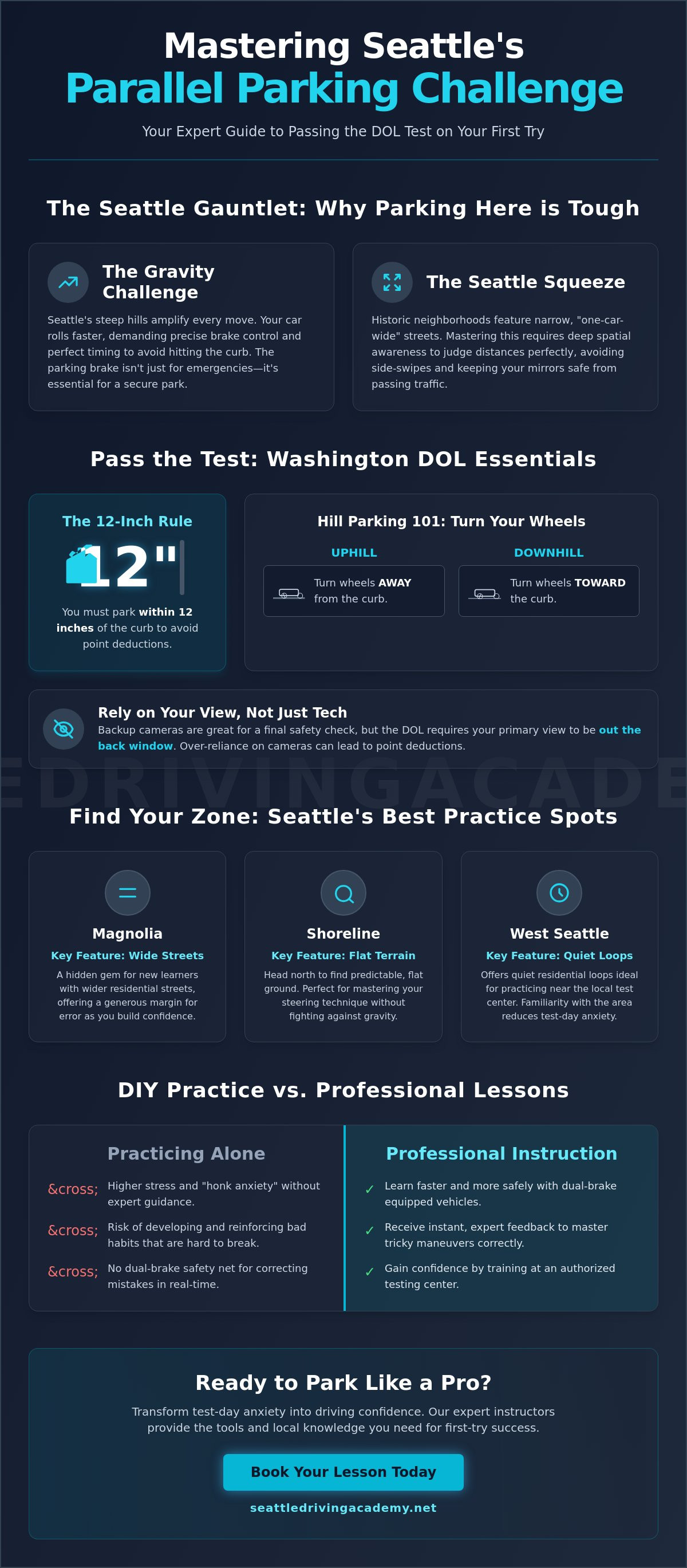
Gravity changes the rules of the game. On a steep Seattle hill, your car will roll much faster than it does on flat ground, which can throw off your steering timing and lead to curb strikes. We teach our students to respect the roll by using the brake with precision. Your parking brake isn't just an "emergency" tool here; it's a vital part of your parking sequence. Remember the golden rule for the test: when parking uphill, turn your wheels away from the curb; when downhill, turn them toward the curb. This simple step ensures your vehicle stays exactly where you left it.
Narrow Streets and Spatial Awareness
In neighborhoods like Wallingford or Fremont, you'll often encounter "one-car-wide" streets where every inch counts. This is where the "Seattle Squeeze" happens. You have to judge the distance between your passenger door and the curb while simultaneously keeping an eye on your driver-side mirror to avoid passing traffic. Practicing in these tight urban environments helps you internalize the dimensions of your vehicle. We help you master the "12-inch rule" so you can tuck into those narrow spots perfectly, keeping your mirrors safe and your car legally parked without the stress of side-swipes.
Top Seattle Neighborhoods for Stress-Free Parallel Parking Practice
Finding the right environment is the first step toward building your confidence. While it might be tempting to head straight to the busiest street to prove your skills, we always recommend starting in a low-stakes setting. Your first parallel parking practice seattle session should be about mastering the mechanics without the distraction of heavy traffic or impatient commuters. Look for streets with wide curbs and plenty of visibility; this gives you the mental space to focus on your 45-degree angle rather than the car behind you.
One of the best "cheat codes" for success is practicing in the neighborhoods surrounding your chosen DOL test center. Every testing location has a few standard routes they prefer to use. By familiarizing yourself with the specific curb heights and street widths in that area, you'll feel a sense of calm recognition when your examiner tells you to pull over. If you find yourself struggling to find the right rhythm, our individual driving lessons can provide that extra boost of local knowledge to get you over the hump.
The Best Low-Traffic Zones
Magnolia is a hidden gem for new learners. The residential streets here are notably wider than those in the city center, offering a generous margin of error. If you're looking for flatter terrain to perfect your backing technique, head north to Shoreline. The residential pockets there provide a predictable environment where you can practice your steering without fighting gravity. West Seattle also offers quiet residential loops that are perfect for those planning to take their test at the local licensing office. These areas allow you to focus on expert lessons in spatial awareness before moving on to more challenging terrain.
Advanced Practice Areas
Once you've mastered the basics, it's time to level up. Queen Anne is the ultimate training ground for managing that brake and gas balance on steep inclines. For those who want to prepare for the high-density reality of city living, the side streets of Capitol Hill will test your ability to judge tight gaps. We also suggest the industrial zones in Ballard during the early evening. These areas often have larger vehicle obstacles, like delivery trucks, which help you learn how to navigate around different car lengths and heights safely.
Timing is everything when you're learning. We suggest heading out between 10:00 AM and 2:00 PM on weekdays to avoid the morning and evening rush. Always be mindful of the local community. Avoid practicing in front of the same house for an hour, and never block a driveway or a fire hydrant. Being a respectful neighbor is just as important as being a skilled driver; it keeps our community supportive of new learners like you. We are all in this together, and a little courtesy goes a long way in making the streets safer for everyone.
Understanding Washington State DOL Parallel Parking Requirements
The Washington Department of Licensing (DOL) doesn't expect you to be a professional stunt driver, but they do demand precision and safety. When you begin your parallel parking practice seattle sessions, your goal should be more than just "getting into the spot." You are training to meet a specific set of criteria that examiners use to ensure you're a safe addition to our city streets. As of 2026, examiners use a standardized digital scoring system to track your performance, requiring a minimum score of 80 out of 100 to pass the overall skills test.
The most famous requirement is the "12-inch rule." In Washington, your vehicle's wheels must be no more than 12 inches from the curb once you've finished the maneuver. While this sounds daunting on a steep incline, the examiner allows for two adjustments during the process. If you find yourself too far out or too close, you can pull forward and back up again to straighten out. We encourage our students to use these adjustments wisely; it's better to use one to get closer to the curb than to finish the test 13 inches away and lose points. If your testing center uses the pole method, the space provided will be exactly 25 feet by 7 feet.
Safety checks are actually more important than your steering wheel technique. Examiners are trained to watch your head movement throughout the entire process. You must perform a 360-degree check before you start backing up, and you should continue to look over your shoulder. Even if you have the latest backup camera, the DOL requires you to use your mirrors and physical head turns as your primary tools. If you simply stare at a screen, you will lose points for failing to observe your surroundings properly.
The Official 5-Step Maneuver
The DOL looks for a controlled, logical sequence of actions. First, signal your intent and align your vehicle parallel to the car or poles ahead, leaving about two feet of space. Second, as you shift into reverse, find the "sweet spot" by cutting your wheel toward the curb at a 45-degree angle. Third, once your front seat is past the rear bumper of the lead vehicle, turn the wheel the opposite way. Fourth, straighten the car as you back into the space. Finally, center the vehicle so you're equidistant from the front and back boundaries.
Automatic Failures to Avoid
While hitting a pole during the test is a four-point deduction, mounting the curb is a different story. Tapping the curb with your tire is a common deduction, but "climbing" or mounting it with the wheel is usually a disqualification. You also want to avoid creating a traffic hazard. If a car approaches while you are mid-maneuver, you must wait for a safe gap or ensure you aren't blocking their path dangerously. Lastly, don't forget your turn signals. Failing to signal when pulling over or when leaving the spot is an easy way to lose points.
DIY Practice vs. Professional Adult Driving Classes in Seattle
You might be tempted to grab a family member and head to a quiet street for a few hours of trial and error. While DIY effort is admirable, it often lacks the precision required for the modern Washington state licensing exam. A professional instructor provides an objective eye that a parent or friend simply can't offer. They know the exact 2026 digital scoring metrics and won't pass on the long-held bad habits that many experienced drivers have developed over the years. When you're preparing for your test, you need feedback based on current laws, not someone's personal driving style.
One of the biggest hurdles in parallel parking practice seattle is the very real fear of a minor collision while navigating tight residential gaps. Our training vehicles are equipped with dual-brake systems, giving you a safety net that removes the stress and allows you to focus entirely on your technique. This professional environment transforms a high-pressure situation into a manageable learning experience. If you're struggling with specific maneuvers, an Adult Drivers Training 3 Hour Package allows us to dedicate a full session to your specific weak points, ensuring you get the most value out of your time behind the wheel.
Think of professional lessons as an investment in your long-term freedom. While there's a cost associated with professional training, it's helpful to weigh that against the emotional and financial burden of a failed test. Re-testing fees and the frustration of scheduling a new appointment can add up quickly. By choosing expert guidance, you're giving yourself the best possible chance to succeed on your first attempt, saving you time and stress in the long run.
Why Adult Learners Benefit from Professional Guidance
Adult learners often carry unique anxieties, perhaps from years of navigating the city as a passenger and witnessing the complexities of urban driving firsthand. We specialize in helping you unlearn passive habits and replacing them with active, confident decision-making. Our instructors use patient, expert instruction to help you overcome long-held fears, focusing on the specific skills needed for urban mastery. We don't just teach you how to pass; we teach you how to drive with confidence in any neighborhood.
The Pre-Test Warm-Up Advantage
The pre-test warm-up is a significant advantage for any student. Having a 30-minute practice run right before your exam ensures your angles and spatial awareness are fresh in your mind. This short session provides last-minute feedback on your parallel parking depth, helping you calibrate your movements for the specific vehicle you'll be using. Check out our Pre-test warm up practice to boost your score and walk into your exam feeling calm and prepared.
Ready to turn your parking anxiety into professional-level confidence? Our team is here to support you every step of the way. Schedule your individual driving lessons today and take the first step toward mastering the streets of Seattle.
Get Test-Ready with Seattle Driving Academy’s Expert Lessons
We believe that learning to drive should be an empowering journey rather than a source of constant stress. At Seattle Driving Academy, we've spent years helping neighbors just like you transform their parking anxiety into genuine city-driving mastery. Our instructors aren't just experts in vehicle mechanics; they are local guides who understand every unique quirk of our city's terrain. When you choose us for your parallel parking practice seattle, you're gaining a partner who is deeply invested in your long-term safety and success. We treat every student with the care and patience we would extend to our own family members.
One of the biggest advantages we offer is our status as an authorized driver license testing center. There's a profound sense of comfort in training on the same streets and in the same environment where you'll eventually take your official exam. This familiarity helps quiet the nerves, allowing your skills to shine through when it matters most. Whether you're a teen getting behind the wheel for the first time or an adult looking to polish your urban navigation, we provide the flexible scheduling you need to fit mastery into your busy life. We're here to ensure that by the time you reach your test date, the maneuvers feel like second nature.
Tailored Training Packages
We offer specific solutions designed for every stage of the learning process. Our Teen Complete Package provides a comprehensive foundation for the next generation of drivers, covering everything from basic rules to advanced city maneuvers. For those who need a concentrated burst of expertise, our Adult Drivers Training 3 Hour Package is the perfect way to build targeted skills quickly. We also offer individual driving lessons if you simply want a bit of extra time to master the curb without any pressure. Each session is customized to your pace, ensuring you never feel overwhelmed or rushed.
Your Journey Starts Here
Starting your journey is simple. You can book your first session at our Seattle or Burien locations through our online portal, choosing the time that works best for your schedule. For your first lesson, remember to bring your valid Washington Instruction Permit and wear comfortable, flat-soled shoes to ensure you have the best feel for the pedals. We'll take care of the rest, providing a supportive environment where you can ask questions and grow at your own pace. Our goal is to see you drive away with more than just a license; we want you to have the confidence to navigate any street in the Pacific Northwest.
Ready to master the road? Schedule your Seattle driving lesson today!
Take Your Place on the Seattle Streets with Confidence
Mastering the tight spots and steep inclines of our city is a major milestone that unlocks a lifetime of freedom. You now have the tools to choose the best neighborhoods for your initial attempts and the knowledge to navigate the strict 12-inch curb rule that examiners prioritize. By focusing your parallel parking practice seattle efforts on the specific requirements of the 2026 digital scoring system, you are already building a solid foundation for success.
We are here to ensure that your path to a license is as smooth and empowering as possible. As an authorized driver license testing center, we offer the unique advantage of training you in a supportive environment where your growth is our priority. Our specialized Adult Drivers Training 3 Hour Package provides the patient, expert guidance you need to unlearn old habits and master urban maneuvers with ease. We believe in your potential to become a safe, skilled driver who can navigate any neighborhood with pride.
Book Your Expert Driving Lesson in Seattle Now and let us help you turn your driving goals into a reality. We can't wait to see you thrive on the road.
Frequently Asked Questions
Where is the best place to practice parallel parking in Seattle?
Quiet residential neighborhoods like Magnolia or the flatter blocks of Ravenna are excellent choices for your initial sessions. These areas offer wider streets and lower traffic volumes, giving you the mental space to focus on your technique. You can also head to the parking lots at North Seattle College during off-hours for a low-pressure environment to start your parallel parking practice seattle journey before moving to real curbs.
Do I have to parallel park for the Washington State driving test?
Yes, parallel parking is a mandatory requirement for the Washington State skills exam. Every driver must demonstrate this maneuver to prove they can safely navigate the dense urban environments found throughout our region. It is one of the key skills used to evaluate your spatial awareness and control of the vehicle in tight spaces.
How many points is parallel parking worth on the WA DOL test?
The skills test is scored out of 100 points, and you must earn at least an 80 to pass. While the maneuver itself isn't a single "point value," specific errors carry deductions. For instance, hitting a pole during the test results in a four-point deduction. Other mistakes, such as failing to signal or finishing more than 12 inches from the curb, will also reduce your final score.
Can I use a backup camera during the parallel parking part of the test?
You may use a backup camera for quick safety glances, but it cannot be your primary source of vision. The DOL requires you to maintain a physical view out the back window and use your mirrors to stay aware of your surroundings. Any automated "park-assist" features that steer the car for you must be turned off during the exam.
How much space do I need for a parallel parking spot in Seattle?
The official dimensions for a testing space marked with poles are 25 feet long by 7 feet wide. In a real-world setting, we recommend looking for a gap that is approximately one and a half times the length of your vehicle. This extra space provides a comfortable margin for error as you learn to judge the depth and angle of your turn.
Is it harder to parallel park on a hill in Seattle?
Parking on an incline is more challenging because gravity affects how quickly your vehicle rolls and reacts to steering inputs. You have to be much more precise with your brake and gas pedal to maintain control. We teach our students to always use the parking brake and remember the specific wheel-turning rules for uphill and downhill slopes to ensure the car remains secure.
What happens if I hit the curb during my driving test?
Tapping the curb with your tire usually results in a point deduction for poor positioning or lack of control. However, mounting the curb or "climbing" it with your wheel is considered a dangerous maneuver. This will typically lead to an automatic failure of the skills test. We focus on helping you master the 12-inch rule to avoid these common pitfalls.
How many lessons does it take to learn parallel parking?
Many students find that a focused 3-hour session or a few individual lessons provide enough time to master the mechanics of the maneuver. While everyone learns at a different pace, professional instruction helps you build muscle memory much faster than practicing alone. Our goal is to transform this high-stress task into a routine skill that you can perform with total confidence.


