

A teen driver’s legal passenger count in Washington changes with experience, and the first six months are stricter than the months that follow. If you’re looking up passenger restrictions for teen drivers wa, start with the date your teen received an intermediate license. These rules apply to intermediate-license holders, generally ages 16 and 17, and can remain in effect until age 18 unless the driver completes a year without violations.
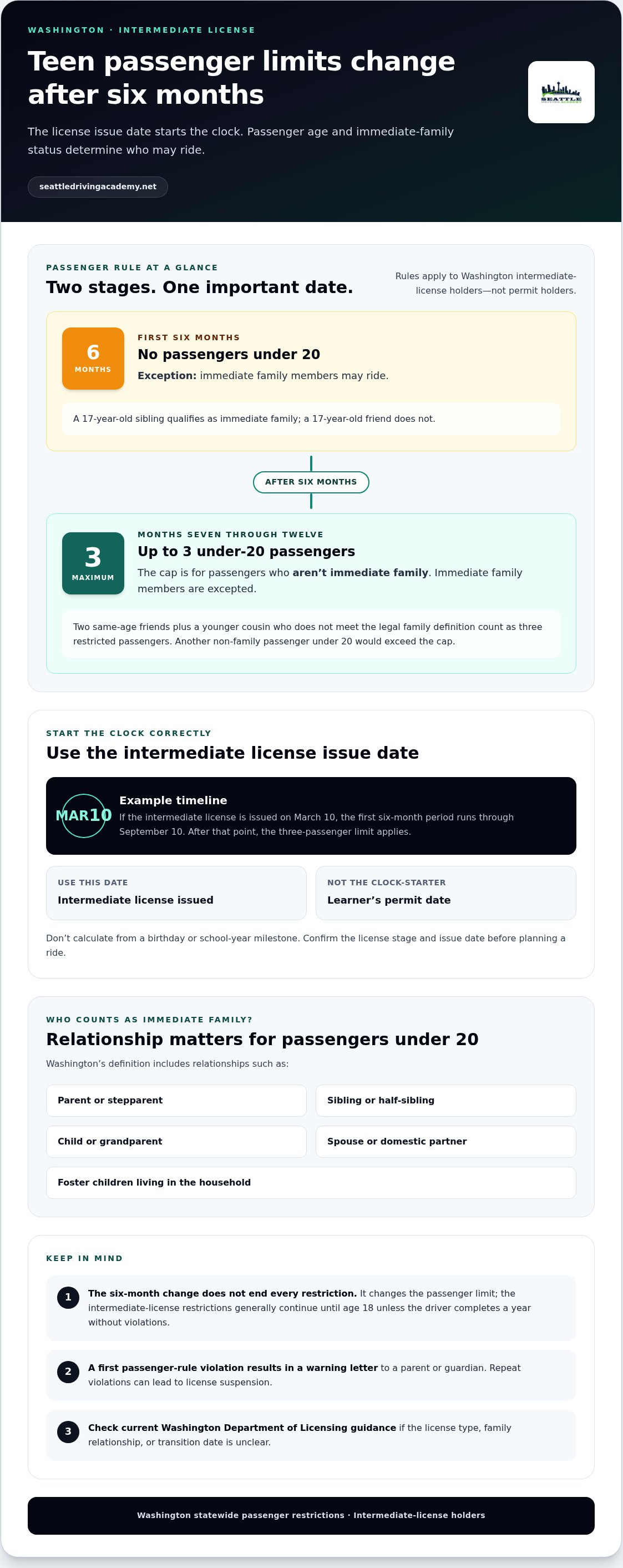
It’s easy to confuse the six-month passenger limit with the separate 12-month nighttime restriction, or to assume every relative qualifies as immediate family. During the first six months, passengers under 20 are generally prohibited unless they’re immediate family. After that, the teen may carry up to three passengers under 20 who aren’t immediate family. A first violation results in a warning letter to a parent or guardian; repeat violations can lead to license suspension.
This guide explains when each rule applies, which siblings and relatives count, and how to plan compliant rides. It also points to Washington Department of Licensing resources for checking current requirements and offers practical ways to help your teen build confidence and sound judgment behind the wheel.
Key Takeaways
- Identify your teen’s license stage and the date their intermediate license was issued. Those details determine which passenger rules apply.
- Check how passenger age and Washington’s immediate-family definition affect who may ride.
- Before planning a carpool or social ride, check each passenger’s age and relationship to the driver.
- Use Washington’s Department of Licensing guidance to verify current passenger restrictions for teen drivers wa.
- Teen driver training and individual lessons can help young drivers develop confidence, judgment, and safer habits.
Who do Washington’s teen passenger restrictions apply to?
Passenger rules depend on a teen’s Washington license stage. The restrictions in this guide apply to intermediate driver license holders, not simply to every young person learning to drive. They’re statewide, so a teen driving in Seattle follows the same passenger rules as a teen driving elsewhere in Washington.
Washington uses a graduated licensing system to introduce driving privileges in stages as young drivers gain experience. These Graduated Driver Licensing (GDL) programs commonly distinguish supervised learning from independent driving. Confirm your teen’s license stage before applying a rule. A permit and an intermediate license have different conditions, so don’t rely on age alone.
Learner’s permit versus intermediate driver license
A learner’s permit is the supervised learning stage. The teen may practice driving only under the permit’s supervision and other conditions. An intermediate driver license is the next stage, allowing a qualifying teen to drive independently while still following restrictions. The passenger limits discussed here apply to intermediate-license holders. Permit holders must follow their own supervision and licensing requirements.
In Washington, the intermediate license is generally issued to new drivers who are 16 or 17. Passenger and nighttime restrictions apply while the driver holds that license and generally continue until age 18, unless the driver has completed a year of driving without violations. The passenger limits change over time, as explained below.
Why a teen’s license stage matters
Before approving a ride with friends, check the license type shown on your teen’s credential. A teen practicing with a permit is in a different stage from one who has earned an intermediate license. This simple check helps prevent a family from applying the wrong passenger rule.
An intermediate driver license is Washington’s restricted independent-driving stage for qualifying teens, and it is the license stage to which the state’s teen passenger limits apply.
Keep a note of the intermediate license issue date. It’s the date you need to calculate how long your teen has held the license and whether the first six-month limit still applies. Don’t use a birthday, permit date, or school-year milestone instead.
Seattle families don’t need to add a separate city passenger limit to the state rule. Start with the teen’s Washington license stage, then check the applicable statewide conditions before planning a ride. If the license type or issue date is unclear, consult Washington Department of Licensing guidance. Confirming the details in advance makes it easier for teens to build independence safely.
What are the passenger limits during the first year of a WA intermediate license?
For an intermediate-license holder, the passenger rule changes after six months, but it doesn’t disappear. The key questions are whether a passenger is under 20 and, if so, whether they meet Washington’s definition of immediate family. Use the intermediate license issue date to track the periods; the learner’s permit date doesn’t start this clock.
As of October 2026, Washington’s passenger limits are no passengers under 20 during an intermediate license’s first six months, except immediate family, followed by a maximum of three passengers under 20 who aren’t immediate family.
| License period | Restricted passengers | Verified exception |
|---|---|---|
| First six months | No passengers under 20 | Immediate family members may ride |
| After six months | No more than three passengers under 20 who aren’t immediate family | Immediate family members are excepted from the restriction |
The first six months: explain the passenger limit
During the first six months, the teen may not carry anyone under 20 unless that person is an immediate family member. Washington’s definition includes relationships such as a parent, stepparent, sibling, half-sibling, child, grandparent, spouse, or domestic partner, as well as foster children living in the household. For example, the driver’s 17-year-old sister qualifies as a sibling; a 17-year-old friend does not.
Months seven through twelve: what changes?
After the first six months, the teen may carry up to three passengers under 20 who aren’t immediate family. Two same-age friends and a younger cousin who doesn’t meet the legal family definition would count as three restricted passengers. Adding another non-family passenger under 20 would exceed the cap. The six-month mark changes the passenger limit; it doesn’t end the first year or every intermediate-license restriction.
For example, if the intermediate license is issued on March 10, the first six-month period runs through September 10. After that point, the three-passenger limit applies. The permit date doesn’t affect this timeline. Calculate from the intermediate license issue date and consult Washington Department of Licensing guidance if you’re unsure about the transition date.
These limits are intended to reduce risks that can come with new drivers carrying teen passengers. The Centers for Disease Control and Prevention (CDC) discusses teen driver safety and the added crash risk associated with teen passengers. Treat the legal limit as a baseline, then agree on a ride plan that keeps distractions manageable. Seattle families can also explore teen driver training to support their teen’s driving skills and understanding of the rules.
Do family members count, and what passenger situations cause confusion?
For Washington’s passenger rule, both age and relationship matter. “They’re related” isn’t enough by itself: the exception uses a specific definition of immediate family. This distinction matters most during the first six months of an intermediate license, when the exception determines which passengers under 20 may ride.
How should families think about the immediate-family exception?
Washington’s definition includes a spouse or domestic partner; a child, stepchild, or grandchild; a parent, stepparent, or grandparent; and a brother, half-brother, sister, or half-sister of the driver or the driver’s spouse or domestic partner. It also includes foster children living in the household. Use these listed relationships rather than a broader, everyday definition of “family.”
A teen’s sister is included in the stated definition. A cousin, aunt, uncle, or family friend isn’t named in that list, so don’t assume the person qualifies just because the family considers them close. For a step-relative or a relative connected through a domestic partner, compare the relationship with current Washington Department of Licensing guidance before the ride. That can prevent a misunderstanding about who is exempt.
Age matters too. The restriction concerns passengers under 20 who aren’t immediate family. A passenger who is 20 or older isn’t part of that under-20 category, but that doesn’t settle every question about safe seating or other rules. Follow vehicle occupancy and seat-belt requirements as well.
Do age, supervision, or nighttime rules change the passenger limit?
Keep the passenger rule separate from the nighttime restriction. Washington’s nighttime limits apply during the first 12 months of an intermediate license and have their own conditions and exceptions. They don’t change who qualifies as immediate family or automatically expand the passenger allowance. Check DOL guidance for current nighttime details, especially before a late ride.
Likewise, don’t assume that an adult in the car creates a passenger-limit exception. A licensed driver age 25 or older is part of a stated exception to the nighttime restriction, but that doesn’t by itself establish an exception to the passenger rule. Apply each condition to the rule it belongs to.
For a quick check, write down each passenger’s age and exact relationship to the teen or the teen’s spouse or domestic partner. Compare those details with the official definition and the teen’s current license period. If the relationship or situation isn’t clearly covered, use Washington DOL’s current intermediate-license guidance rather than relying on an assumption. This is especially useful for blended families and informal caregiving arrangements.
Understanding these details makes passenger restrictions for teen drivers wa easier to apply to real plans. Make the decision before handing over the keys so your teen has a clear answer about who can ride.
How can Seattle families plan rides and follow teen passenger rules?
A reliable ride plan starts before your teen reaches for the keys. Whether the destination is a friend’s house, a school event, or an activity across Seattle, compare the planned passengers with the teen’s current license restrictions. A consistent household routine makes the rules easier to follow, even when plans change.
A quick passenger-rule check before each drive
Before approving a ride, confirm four details together. Keep them in a shared household note so everyone is working from the same information:
- License stage: Is your teen driving under a permit or an intermediate license?
- Issue date: If they have an intermediate license, when was it issued? Use that date to identify the current restriction period.
- Passenger ages: How old is each person who plans to ride?
- Relationships: For passengers under 20, does the relationship fit Washington’s stated immediate-family definition?
Record the issue date from the intermediate license and note when the passenger limits change. Don’t calculate from the learner’s permit date, a birthday, or the start of the school year. If a date or relationship is uncertain, consult Washington Department of Licensing guidance before deciding. Keep the applicable rule with your calendar reminder so the parent and teen can review the same information.
What should a teen do when a ride does not fit?
If the planned passengers don’t fit the rule, your teen doesn’t need to guess at an exception or solve the problem alone. They can tell friends the ride needs to change, then call a parent or guardian to arrange another option. That might mean splitting the group among drivers who can legally carry them, asking an adult to drive, or changing the pickup plan.
Plan for common Seattle scenarios in advance. Before a movie, school event, or team activity, agree on who is riding with whom and what to do if another friend asks to join. A calm, prepared response helps a teen follow the rules without making a rushed decision in a parking lot.
Parents can make the conversation easier by treating the check as a normal part of handing over the keys, not a test of trust. For broader preparation on driving skills and instruction, read this teen driver training guide. Passenger restrictions for teen drivers wa are one part of helping a young driver make thoughtful decisions. Seattle Driving Academy’s teen driver training can support your family as your teen builds safe habits.
How Seattle Driving Academy can support safer teen driving
Knowing the passenger rule is a strong start. Teens also need to make steady decisions when friends want a ride, plans change, or the car gets distracting. Clear expectations at home and continued practice help young drivers apply what they know, not just recall a rule when someone asks to hop in.
Turn passenger rules into safer driving decisions
Before a social outing, talk through the ride plan: who is expected to ride, what the teen will do if someone else wants to join, and how they can ask for help without feeling pressured. Agreeing on a simple response, such as calling a parent before changing the plan, gives teens a practical way to handle peer pressure while keeping attention on driving.
Keep legal details grounded in current Washington Department of Licensing guidance. Restrictions depend on license stage and timing, so revisit the official information when circumstances change or a scenario isn’t clear. The goal isn’t to make every drive complicated. It’s to make safe choices familiar enough that your teen can act with confidence.
Continue learning with local teen driver training
Seattle Driving Academy offers a Teen Complete Package and individual driving lessons. Lessons give teens opportunities to practice driving skills and build confidence with support. Families can pair instruction with conversations at home, connecting rule awareness with thoughtful choices behind the wheel. Training complements, but doesn’t replace, checking current licensing requirements.
As you organize the broader learning process, use the Seattle teen driver checklist to plan teen driver education. Consider how practice and discussion can reinforce good judgment, including how a young driver responds when passengers add noise or distraction.
Washington’s passenger restrictions for teen drivers wa are one part of gaining independence responsibly. Keep current rules accessible, make room for questions, and help your teen practice speaking up when a ride plan needs to change. These habits support safer decisions on everyday trips around Seattle.
Ready to help your teen build driving skills and confidence? Explore teen driver training with Seattle Driving Academy.
Help Your Teen Build Confidence for the Road Ahead
Growing independence behind the wheel is a process, and steady support can help your teen meet each new responsibility with good judgment. Keep conversations open about ride plans, distractions, and speaking up when a situation feels uncertain. These habits can make safe choices feel natural rather than like a last-minute checklist.
Understanding passenger restrictions for teen drivers wa gives your family a solid starting point. Professional instruction and practice can help a young driver turn knowledge into confidence. Seattle Driving Academy offers teen driver training, individual lessons, and Department of Licensing knowledge and skills testing to support the steps toward licensing.
Explore teen driver training at Seattle Driving Academy and take a supportive next step in your teen’s driving journey. With clear guidance and practice, your family can move forward with confidence.
Frequently Asked Questions
How many passengers can a teen driver have in Washington?
It depends on how long the teen has held an intermediate license and who is riding. During the first six months, passengers under 20 are generally allowed only if they’re immediate family. After six months, the teen may carry up to three passengers under 20 who aren’t immediate family. For a planned ride, count passengers in the restricted age group, then check whether the family exception applies.
Can a teen driver in Washington have siblings in the car?
Yes. A brother, half-brother, sister, or half-sister is included in Washington’s immediate-family definition, so siblings qualify for the family exception to the passenger restriction. This can matter during the first six months of an intermediate license. If friends are riding too, check each passenger’s age and relationship separately; the sibling exception doesn’t cover them.
When do passenger restrictions end for teen drivers in WA?
They generally end when the driver turns 18, or after a year of driving without violations, as specified for intermediate-license restrictions. Turning 18 isn’t the only detail to consider if the teen has already completed a violation-free year. Check the teen’s license status and driving history against current Washington DOL guidance before treating restrictions as over.
Do Washington teen passenger restrictions apply when a parent is in the car?
A parent riding along doesn’t automatically waive the passenger limit for other young passengers. A parent who is under 20 is included in the immediate-family exception, but unrelated passengers under 20 still have to fit the applicable limit. Keep nighttime rules separate: their exception refers to a licensed driver age 25 or older, not simply any parent in the vehicle.
What happens if a teen driver violates passenger restrictions in Washington?
A first violation results in a warning letter to the teen’s parent or guardian from the Department of Licensing. A second violation can lead to license suspension for six months or until the teen turns 18, whichever comes first. A third violation can mean suspension until age 18. If your family receives a notice, review it and follow the DOL instructions for next steps.
Do passenger restrictions apply to teens driving in Seattle?
Yes. Seattle teens with an intermediate license follow Washington’s statewide passenger rules; the city doesn’t have a separate passenger limit. The same state restrictions apply whether the destination is a school activity, a friend’s home, or another Seattle neighborhood. Check current DOL guidance if a passenger relationship or license situation is unclear.


