

What if a practice quiz makes you feel ready but leaves you unsure about Washington’s right-of-way rules? Good washington state knowledge test practice does more than help you recognize answers. It helps you understand why a rule applies, especially when signs or driving situations feel confusing.
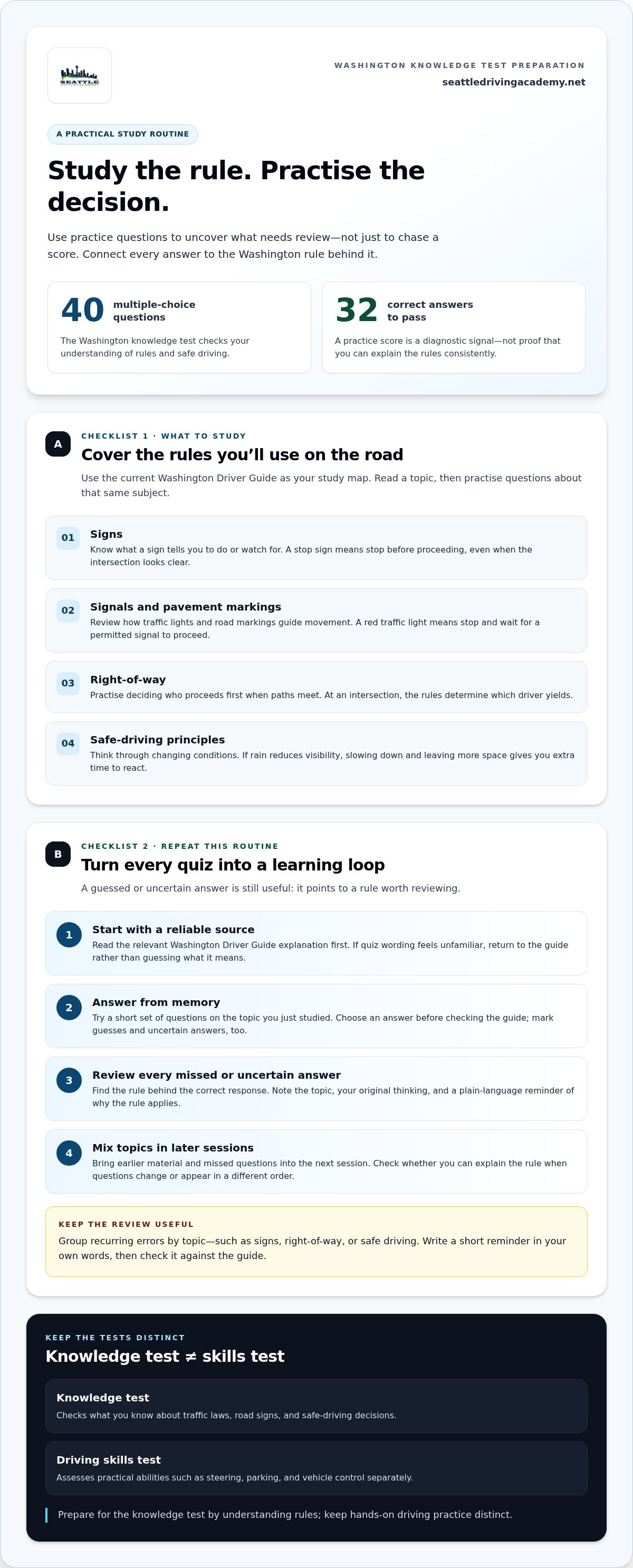
If you’re anxious about unfamiliar questions on test day, you’re not alone. Washington’s knowledge test has 40 multiple-choice questions, and you need 32 correct answers to pass. Online quizzes can help you get comfortable with the format, but the Washington Driver Guide is the official foundation for your study plan.
Use a repeatable routine: study a topic, practise questions, then review every answer you missed or guessed. This helps you spot gaps before test day. You’ll also learn how to choose study tools and plan for local testing. Seattle Driving Academy facilitates official Department of Licensing knowledge tests in Seattle, offering a local next step after your preparation.
Key Takeaways
- Use washington state knowledge test practice to find topics to review, not just to chase a quiz score.
- Follow a simple routine: start with a reliable source, answer questions from memory, note uncertainty, and review mistakes.
- Compare study tools by how clearly they reflect Washington rules and explain answers, not by how many questions they offer.
- Check your readiness by explaining the rules behind your answers and revisiting recurring errors.
- Seattle Driving Academy facilitates official knowledge testing in Seattle, a local next step as you prepare for test day.
Washington State knowledge test practice: what should you study?
Practice is most useful when it helps you understand why a rule applies, not just choose the right answer once. The Washington knowledge test is a written assessment of your understanding of traffic laws, road signs, and safe-driving rules needed to drive in the state. It is separate from the behind-the-wheel skills test, which assesses how you operate a vehicle.
For Washington-focused washington state knowledge test practice, use the current Washington Driver Guide as your study map. It explains traffic controls, rules of the road, and safe-driving practices in context. Read about one topic, then answer questions on that subject. This makes it easier to connect each answer to the rule instead of memorizing a phrase without understanding it.
Which Washington driving topics belong in your study plan?
Build your review around the topics below, using the current guide for exact wording and coverage. When a term feels unfamiliar, turn it into an ordinary driving situation before trying to memorize it.
- Signs: Learn what a sign tells you to do or watch for. A stop sign means you must stop before proceeding, even if the intersection looks clear.
- Signals and pavement markings: Review how traffic lights and road markings guide movement. A red traffic light tells you to stop and wait for a permitted signal to proceed.
- Right-of-way: Practise deciding who should proceed first when paths meet. When two vehicles arrive at an intersection at the same time, the rules help determine which driver yields.
- Safe-driving principles: Study how to respond responsibly to changing conditions and other road users. If rain reduces visibility, slowing down and leaving more space gives you extra time to react.
These examples are starting points, not substitutes for the guide’s full explanations. As you read, note any term you can’t explain in your own words. Find the relevant section and make up a simple example, such as how you would respond to a sign on a familiar Seattle route.
How the knowledge test differs from the skills test
The knowledge test checks what you know about driving rules and safe decisions. It doesn’t measure steering, parking, or vehicle control. Those practical abilities are assessed separately in a driving skills test, so keep hands-on preparation distinct from studying rules.
The Washington State Department of Licensing oversees state licensing information. Use the current Washington Driver Guide for study content, rather than relying on a general agency overview. When you’re ready to plan the local testing step, Seattle DOL knowledge test locations can help you understand where testing is available.
How to practise for the Washington knowledge test, step by step
A useful study routine turns each quiz into a learning opportunity, not a verdict on whether you’re ready. Use a trustworthy Washington source, answer from memory, and spend time understanding what you missed. This makes washington state knowledge test practice more focused and shows you which rules need another look.
- Check your source. Start with the official Washington Driver Guide. Choose a topic, such as signs or right-of-way, and read the relevant explanation before starting a quiz. If a question uses unfamiliar wording, return to the guide instead of guessing what it means.
- Take a short quiz without looking up answers. Try a small set of questions on the topic you just reviewed. Choose your answer before checking the guide. Mark questions where you guessed, felt unsure, or couldn’t explain your choice. Even a correct answer you guessed is a signal to review the topic.
- Review every missed or uncertain answer. Find the rule behind the correct response. Ask what detail in the situation matters and why another choice doesn’t fit. Record the topic, your original thinking, and a plain-language reminder.
- Repeat with a mix of topics. Once you’ve reviewed one area, include it in your next session alongside material you’ve already studied. This helps you check whether a rule sticks when questions change or appear in a different order.
A practice score is a diagnostic signal, not proof of readiness. It can show where your understanding is strong and where it needs attention, but one result doesn’t tell you whether you can explain the rules consistently. Look for patterns in your answers, not just a number.
Turn each missed answer into a useful review
Reviewing mistakes helps you connect the right answer to the rule behind it. Group errors by topic, such as signs, right-of-way, or safe driving, to see whether one misunderstanding is causing several misses. For each recurring error, write a short reminder in your own words. For example: “A sign gives instructions even when the road looks empty.” Then revisit the guide and make sure your note matches its explanation.
Build a manageable practice schedule
Brief, regular sessions are easier to sustain than a last-minute cram. Choose a topic, study it, quiz yourself, and finish by noting what to revisit next time. Bring earlier missed questions into later sessions to check what you remember. If a question’s wording seems unclear, return to the source material instead of memorizing a confusing phrase.
Keep your notes close as you study. When you’re ready to move from independent review to local testing, Seattle Driving Academy facilitates official Department of Licensing knowledge tests in Seattle. Learn more about the Seattle knowledge test as you plan your next step.
Are online Washington knowledge test practice questions reliable?
Online questions can help you practise recognizing and applying rules, but a quiz is only as dependable as its source. Treat each question as a study aid, not an official exam question or a promise that the same wording will appear on test day. For Washington-specific study, compare the resource with current state guidance and use the Washington Driver Guide to resolve questions about the rules.
Use this comparison to decide what each tool can do. A source may be useful for one purpose and still need checking for another.
| Study source | Washington relevance | Source transparency | Explanations | Update date |
|---|---|---|---|---|
| Official Washington Driver Guide | Directly focused on Washington rules. | Published by the state licensing agency. | Explains rules in context; use it to verify answers. | Check the edition or revision information. |
| State-specific practice quiz | Potentially relevant if it clearly covers Washington. | Look for the guide or state sources it relies on. | Prefer explanations that identify the rule, not just a score. | Look for a visible review or update date. |
| User-created flashcards | Varies by creator and the material used. | Check who made the deck and what it cites. | Often supports quick recall; explanations may be brief or absent. | Check when the cards were created or last reviewed. |
How to check whether a practice quiz reflects Washington guidance
Look for an explicit Washington focus and a clear reference to state guidance. Then check whether the answers explain the rule behind each choice. A quiz that marks an answer wrong without explaining why may test recognition, but it won’t show you how to correct a misunderstanding. Be cautious about claims that questions are official, identical to the exam, or guaranteed to appear. Verify claims about official questions or test format against current state information rather than relying on promotional wording.
For a broader licensing context, the Washington State Department of Licensing outlines requirements for obtaining a Washington State driver's license. That page can help clarify how knowledge testing fits into the licensing process. It isn’t a substitute for checking study answers against the Driver Guide.
When flashcards help, and when they fall short
Flashcards work well for quick recall, such as recognizing a sign or defining a driving term. They’re less effective on their own for questions that ask you to apply a rule to a situation. Pair a card with a scenario: after recalling what a sign means, explain what you’d do if you encountered it at an intersection. Don’t treat an unverified, user-created deck as your final source of truth. If a card conflicts with the guide or leaves a rule unclear, return to current Washington guidance before adding it to your review.
How can you tell when you are ready for the Washington knowledge test?
Readiness is more than a strong result on one practice quiz. You’re building a solid foundation when you can explain why a rule applies, recognize where you’re uncertain, and make fewer repeated mistakes as you review. Use this checklist to assess what you understand, not to promise yourself a particular test result.
Use a self-checklist before scheduling
Check whether you can explain rules without copying wording from a quiz. If an answer is correct but you can’t say why, mark that topic for another review. A steady understanding matters more than one isolated score.
- Explain recurring rules in your own words. Could you describe what a sign means or why a driver should yield in a situation without relying on a memorized answer?
- Look for improvement across sessions. Review missed topics more than once. Notice whether you can answer related questions with better reasoning, even when they’re phrased differently.
- Identify unresolved gaps. List rules you still mix up or can’t explain clearly. Return to the current Washington Driver Guide and use its explanations to resolve uncertainty.
- Separate knowledge from logistics. Knowing the rules doesn’t automatically confirm your eligibility or complete your appointment planning. Check current Washington instructions for testing eligibility, scheduling, and required identification.
If you keep repeating the same mistake, treat it as useful information, not a reason to panic. Focus your next review on the rule causing confusion, then test your understanding with a fresh example. Don’t rely on a passing practice result alone as proof that every topic is clear. Washington’s passing-score and retake details can change or depend on current policy, so verify them through official state guidance before making plans.
Reduce test-day uncertainty without cramming
In your final review, revisit your notes and the rules you’ve found hardest to explain. Avoid adding unfamiliar, unverified material at the last minute; it can make a clear topic feel confusing. For appointment procedures and documents, use current official instructions rather than assumptions from an old quiz or another learner’s experience.
Knowledge readiness and test-day preparation are related, but they’re separate tasks. Your study notes help you understand traffic rules, while official instructions explain what to expect at the testing location. The Washington State knowledge test preparation guide offers related context as you consider the local testing process.
Ready to take the next step after your review? Explore official knowledge testing with Seattle Driving Academy, a local option for Department of Licensing knowledge tests in Seattle.
Taking your Washington knowledge test in Seattle: a supported next step
Independent study and the official knowledge test serve different purposes. Your study routine helps you learn Washington’s driving rules, check what you understand, and spot gaps that need attention. The official test assesses your knowledge in a testing setting. Practice questions can prepare you to think through topics, but they aren’t official exam questions and can’t guarantee a result.
After your washington state knowledge test practice, review any rules you still can’t explain clearly. Revisit the relevant material in current Washington State Department of Licensing guidance, then read the test instructions that apply to you. Separating those steps can make preparation more manageable: first build your knowledge, then handle the practical details of testing.
What to do after your practice routine
Before taking the official test, identify your remaining knowledge gaps rather than trying to memorize more quiz answers. If signs, right-of-way, or another topic still feels uncertain, return to the official study material and work through the rule again. Use current state guidance for test requirements and instructions, since details such as eligibility, documents, and procedures should come from an up-to-date source.
A final review doesn’t need to become a cram session. Revisit your notes, focus on the areas that have caused repeated confusion, and avoid relying on a last-minute quiz or unverified study material to settle a disputed rule. For test-day arrangements, follow the current official instructions that apply to your situation instead of assuming every testing location follows the same process.
Find Seattle knowledge-test information and support
Seattle Driving Academy facilitates official Department of Licensing knowledge tests in Seattle, providing a local next step after independent preparation. Use the Seattle DOL knowledge test locations guide to explore location-specific information and plan for testing. The guide complements your study: it can help with local logistics, while the Washington Driver Guide remains the source for learning traffic rules.
Give yourself time to address lingering questions, then move forward when you feel prepared to take the official test. You don’t need to know every answer by heart; aim to understand the rules and approach the next step with a clear plan. If you’re ready to explore local testing support, explore knowledge test services with Seattle Driving Academy.
Carry your knowledge into the next step
The goal of washington state knowledge test practice isn’t simply to get through a test. It’s to build understanding you can draw on when making real decisions on the road. Give yourself credit for progress: each rule you can explain clearly is one less uncertainty to carry forward.
Your next step can be straightforward. Use the official test process to put your preparation into practice, and keep following current instructions as you plan. Seattle Driving Academy supports teen and adult learners in Seattle by facilitating official Department of Licensing knowledge tests, connecting focused study with a local testing option.
You don’t need to feel perfectly confident about every detail before moving forward. A clear plan and a willingness to keep learning can take you a long way. Explore knowledge test services with Seattle Driving Academy and take your next step with support.
Frequently Asked Questions
How many questions are on the Washington State knowledge test?
The Washington State knowledge test has 40 multiple-choice questions. Each question asks you to choose an answer based on traffic rules, signs, or safe-driving knowledge. Knowing the question count helps you understand the test format, but use your study time to strengthen your grasp of the rules rather than predict which questions will appear. Practice materials aren’t a complete preview of the official test.
What score do you need to pass the Washington knowledge test?
You need to answer at least 32 of the 40 questions correctly, which is a passing score of 80%. Treat that threshold as a useful benchmark, not a reason to stop studying as soon as a practice quiz reaches it. Review any topic where you guessed or couldn’t explain your choice. Confirm current test details with Washington State Department of Licensing guidance before your test.
Can you take the Washington knowledge test online?
The test is electronic, but that doesn’t mean you take it remotely from home. Washington knowledge tests are given at DOL-approved driver training schools and testing businesses; DOL offices don’t administer the test. If you’re in Seattle, follow the current instructions for the approved testing location you plan to use, including how to arrange your test and what to bring.
Is the Washington knowledge test available in other languages?
Yes. The knowledge test is available in multiple languages, including English, Spanish, Russian, Simplified and Traditional Chinese, Vietnamese, Korean, and Japanese. Some testing locations may offer additional language options, so availability can depend on where you take the test. Check the current choices as you plan, and make sure you’re studying Washington-specific rules rather than relying on a translated general driving quiz.
How should I study Washington road signs for the knowledge test?
Use the Washington Driver Guide’s sign illustrations to connect each sign’s appearance with the action or warning it communicates. For example, make a quick review card with the sign on one side and its meaning in your own words on the other. Group signs you confuse, then compare their shapes, colors, and messages. This gives your washington state knowledge test practice a focused sign-review routine.
What happens if you fail the Washington knowledge test?
If you don’t pass, review the topics that caused difficulty and follow the current retake instructions before arranging another attempt. Confirm retake procedures and any applicable requirements through the approved testing location or current Washington State Department of Licensing information, rather than assuming they match an old online post. Use the result to identify what needs more study, then return to the relevant source material before trying again.
Is a Washington knowledge test practice quiz the same as the official test?
No. A practice quiz is a study tool, while the official knowledge test is the assessment you take at a DOL-approved testing location. Online quizzes can help you get used to answering questions, but they aren’t official questions and don’t guarantee what you’ll see. If an answer conflicts with a Washington rule or seems unclear, use the current Washington Driver Guide to check it.


