

Did you know that as of June 30, 2026, every testing center in Washington has officially retired the traditional paper exam in favor of a fully digital experience? It's completely natural to feel a bit overwhelmed when you're staring down a 100-page driver's manual while worrying about those frustrating re-testing fees. We know you don't just want to memorize trivia; you want to feel prepared for the actual experience. We're here to strip away the confusion and show you exactly how to master the washington knowledge test format so you can walk into your appointment with total confidence.
You deserve a study plan that respects your time and targets what actually matters for your success. This guide breaks down the 40-question structure and the specific 80 percent scoring threshold you need to reach to pass on your very first attempt. We'll also explore the common question types you'll face and how the modern electronic systems function. By the time you finish reading, you'll have a clear roadmap to earning your license and the peace of mind that comes from being truly ready.
Key Takeaways
- Understand the modern digital-first approach to testing that is now standard across all Washington testing centers.
- Discover the specific breakdown of the washington knowledge test format, including the 40-question structure and the 80% score required to pass.
- Identify the four primary pillars of road safety that form the bulk of your exam so you can focus your study time where it counts most.
- Learn how to use "Active Recall" and simulated environments to build the muscle memory needed for a stress-free testing day.
- Explore why a professional driving academy offers a more supportive atmosphere and valuable pre-test warm-up sessions compared to a standard DOL office.
Understanding the Washington State Knowledge Test Format in 2026
The Knowledge Test is your first major milestone on the path to earning your driver's license. It isn't just a hurdle to clear; it's a vital safety check designed to ensure you understand the responsibilities that come with operating a vehicle. While the process of obtaining Driver's licenses in the United States varies by state, Washington has set a high standard for its residents. By mastering the washington knowledge test format, you're proving that you have the judgment necessary to keep yourself and others safe on our roads. This exam is mandatory whether you are a teenager applying for your first permit or an adult seeking a full license for the first time.
Washington has moved toward a modern, digital-first approach that prioritizes student success and clarity. This means you won't be fumbling with Scantron sheets or worrying about sharpening pencils. Instead, you'll engage with an interactive system that focuses on real-world scenarios where safety-first decision-making is the priority. The questions aren't designed to trick you with obscure trivia. If you're more comfortable testing in a language other than English, you're in luck. The state offers the exam in several languages, including Spanish, Russian, Vietnamese, and Chinese. This ensures that every driver has a fair chance to succeed regardless of their primary language.
Digital vs. Paper: How You Will Take the Test
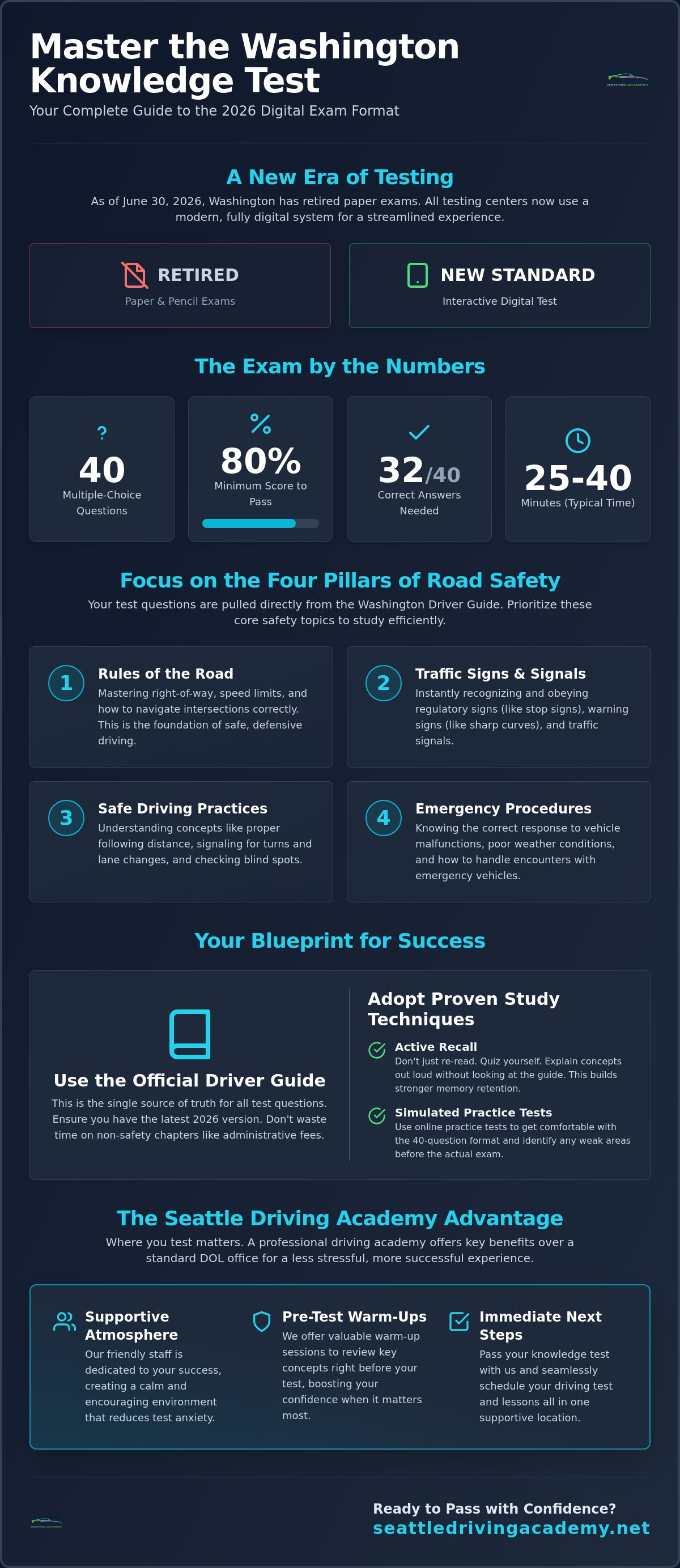
The era of paper-and-pencil exams is officially behind us. As of June 30, 2026, all approved testing centers have transitioned to a fully electronic system. You'll likely use a touch-screen interface that is intuitive and easy to navigate. One of the best perks of this modern washington knowledge test format is the immediate feedback. You won't have to wait days to find out if you passed; the system calculates your score the moment you submit your final answer. This instant gratification helps lower anxiety and allows you to plan your next steps immediately, whether that is scheduling your driving test or hitting the books for a quick review.
The Role of the Washington Driver Guide
Your primary tool for success is the official Washington Driver Guide. Think of it as the only source of truth for your exam. The 2026 version is updated to reflect current traffic laws, so make sure you aren't using an outdated copy from a sibling or friend. While the handbook is over 100 pages, you don't need to memorize every single word. Focus your energy on the "must-read" chapters covering right-of-way, signaling, and emergency procedures. Sections regarding administrative fees or vehicle registration are often less prevalent on the test. This allows you to prioritize the rules that actually keep you safe behind the wheel.
The Numbers Behind the Exam: Scoring, Timing, and Limits
Numbers have a way of making people nervous, but understanding the math behind the exam is the best way to quiet those nerves. The standard washington knowledge test format is built around the 40-Question Rule. This means your entire evaluation consists of 40 multiple-choice questions pulled directly from the official driver guide. To earn your passing mark, you must meet the 80 percent threshold. In practical terms, that means you need to get at least 32 questions right. This gives you a small but manageable eight-question margin for error. If you find yourself overthinking a specific sign or rule, remember that you don't have to be perfect; you just have to be prepared.
While the state doesn't impose a strict stopwatch time limit, most students find that they finish within 25 to 40 minutes. There's no prize for being the fastest person in the room. In fact, taking your time is often the secret to success. One of the most helpful features of the modern digital system is the immediate results. The second you hit that final submit button, your score appears on the screen. There's no agonizing wait for a letter in the mail or an email later that evening. You can find more details on the Washington State Knowledge Test requirements to see how these rules apply to your specific licensing situation.
Passing Scores and Passing Grades
When you're sitting at the terminal, the screen will usually display a live counter of your progress. It's helpful to visualize that 32 out of 40 requirement as you go. Seeing a Correct counter climb can be a huge confidence booster, but don't let a winning streak make you reckless. Read every single answer choice, even if you think the first one is right. If you're feeling a bit shaky about the process, booking your exam at a dedicated driver license testing center can provide a much calmer environment than a busy government office.
What Happens if You Don’t Pass?
If the screen doesn't show the result you hoped for, take a deep breath. It's a setback, not the end of the road. Washington state law requires a specific waiting period before you can attempt the test again. Typically, you can take the test a second time as early as the next day, though subsequent failures might require longer waits. Keep in mind that re-testing fees apply for every attempt, and these costs vary depending on which testing center you choose. Before you schedule your next slot, take some time to review the common mistakes on the WA driving test. Learning from where others tripped up is a brilliant way to ensure your second attempt is your final one.
Core Topics: What Questions Will You Actually Face?
To truly conquer the washington knowledge test format, you need to know exactly what the examiners are looking for. The 40 questions are carefully distributed across four primary pillars of road safety. By understanding these categories, you can stop guessing and start studying with a purpose. Most of your exam will focus on the "Rules of the Road," which covers everything from right-of-way at four-way stops to the specifics of making safe turns. Washington places a heavy emphasis on state-specific legislation, such as the "Move Over" law. This requires you to change lanes or slow down when approaching emergency vehicles on the shoulder. You can find the full details of these laws in the Official Washington Driver Guides, which serve as the foundation for every question you'll encounter.
One thing that surprises many students within the washington knowledge test format is how road signs are tested. You won't just be asked to identify a shape or color. Instead, the test presents situational scenarios. For example, you might see a picture of a specific sign and be asked how you should adjust your speed or lane position based on the traffic around you. This approach ensures you aren't just memorizing symbols, but actually understanding how to apply them to keep everyone safe.
Alcohol, Drugs, and Distracted Driving
We often call these the "high-stakes" questions because they are designed to test your judgment on the most dangerous road behaviors. The examiners want to see that you respect the gravity of DUI and marijuana-related offenses. Washington has strict penalties for these violations, and the test will ask about specific consequences like license suspension or fines. For drivers under the age of 21, the legal blood alcohol content limit is 0.02 percent. Don't let these questions trip you up; they are your chance to prove you're a responsible member of our driving community.
Signs, Signals, and Pavement Markings
Mastering the visual language of the road is essential for your success. You'll need to distinguish between regulatory signs, which tell you what you must do, and warning or guide signs that provide helpful context. When you're driving on hilly Seattle roads or navigating multi-lane roundabouts, the pavement markings become your best friends. You must know the difference between solid and dashed lines, especially when it comes to passing or changing lanes. We've seen many students feel overwhelmed by complex intersections, but if you take it one signal at a time, you'll find that the logic is actually quite simple.
Practice Strategies to Master the Knowledge Test Format
Studying for the washington knowledge test format requires more than just a quick skim of the driver guide. You need a strategy that actively engages your brain and builds the confidence required to pass on your first attempt. We recommend the "Active Recall" method. Instead of passively reading, try to quiz yourself after every chapter. Close the book and ask yourself what the key safety rules were for that section. This forces your brain to retrieve information, which creates much stronger memory pathways than simply highlighting text. To make the most of your time, we suggest a "Three-Read" system for the official handbook. Read it once for general context, a second time to focus on specific laws, and a third time to quiz yourself on the details. This methodical approach ensures you're never surprised by what appears on the screen.
Simulating the actual exam environment at home is another powerful way to prepare. Find a quiet space, set a timer for 40 minutes, and use our Washington State Knowledge Test Practice resources to test your skills. By replicating the digital-first experience of the modern washington knowledge test format, you'll reduce the "newness" factor on your actual testing day. If you want to ensure you're fully prepared in a supportive environment, book your Knowledge Test at a dedicated center where your success is the top priority.
Taking a DOL Practice Test Effectively
When you're taking practice exams, don't stop as soon as you hit the 80 percent mark. Aim for a consistent score of 95 percent or higher. This higher threshold accounts for the added pressure you'll feel during the real appointment. If you encounter a question that feels like a "trick," look for the most conservative safety choice. Washington's exam always prioritizes the option that reduces risk. Be careful to avoid using practice tests from other states. Traffic laws in places like Oregon or California often differ in subtle ways that could lead to an incorrect answer on our state's specific exam.
The Night Before the Test: Final Review
Your final review should focus heavily on the numbers. Review the following distances, the required parking distance from a curb, and standard speed limits for different zones. These are the details that often slip our minds when we're nervous. Make sure you also understand the rules for taking the WA DOL knowledge test so you know exactly which identification documents to bring and how to handle your electronics. While it's tempting to stay up late for one last cram session, your brain functions best when it's well-rested. Prioritize a full night of sleep over midnight study sessions to ensure your mind is sharp and ready for success.
Why Testing at Seattle Driving Academy Beats the DOL Office
Choosing where to take your exam is just as vital as how you study. Most people assume they must visit a government office, but those spaces are often frantic and impersonal. At Seattle Driving Academy, we've created a space that feels like a supportive classroom instead of a loud lobby. This change in atmosphere makes a huge difference in how you handle the washington knowledge test format. Instead of dealing with noise and long lines, you'll find a quiet setting that lets you focus entirely on your success. You aren't just another number in a queue; you're a student we're proud to support.
The environment where you take your exam can actually change your final score. if you're sitting in a crowded room with people rushing around, your anxiety levels naturally spike. This makes it harder to recall the facts you worked so hard to learn. By choosing a private academy, you're opting for a controlled and peaceful environment. This allows your brain to stay in a focused state, which is essential for navigating the washington knowledge test format successfully. Our instructors are proactive problem solvers. If you're stuck on a specific concept like right-of-way in a roundabout, they'll offer a clear explanation that sticks.
Our pre-test warm-up sessions are a game changer for many of our students. It acts like a final dress rehearsal for the big moment. We walk through the most common areas where people get tripped up, giving you a fresh boost of confidence right before you sit at the terminal. This personalized touch is something you simply won't find at a standard licensing office. We also believe in scheduling flexibility. You shouldn't have to wait weeks for an appointment that fits a government schedule. We offer the ability to test on your own timeline so you can get on the road faster.
A Student-Centric Testing Experience
We treat every student like family. We understand that nerves are often the biggest hurdle to passing, so we work hard to reduce that stress from the moment you walk in. Our Seattle location is easy to reach for local families and adult learners. This isn't just about checking a box on a government form; it's about welcoming you into the community of safe drivers. Our goal isn't just a passing score. We want to see you become a safe, confident driver who feels ready for anything the road throws your way, from rainy highway merges to tight city parking.
Next Steps After Passing Your Knowledge Test
Once you finish the computer portion, you're ready to start your journey behind the wheel. You can move right into our teen or adult training packages to build your hands-on skills with our expert instructors. After you've mastered the basics of vehicle control and safety, you can return to our driver license testing center for your final skills exam. Don't let the stress of a government office hold you back from your goals. Book your Knowledge Test at Seattle Driving Academy today!
Take Your Next Step Toward the Driver’s Seat
You now have the roadmap to navigate the washington knowledge test format with ease. By focusing on the four pillars of safety and using active study methods, you're already ahead of the curve. Remember that passing isn't just about memorizing facts; it's about proving you're ready to protect yourself and others on our Washington roads. You've put in the work to understand the digital interface and the specific scoring rules, so now it's time to put that knowledge into action.
We know that the right environment makes all the difference. As an Authorized Washington DOL Testing Center, we offer a stress-free alternative to the busy state offices. Our patient, expert instructors are here to support students of all ages, ensuring you feel like a valued member of our community rather than just a number. With our convenient Seattle location and flexible scheduling, we make it easy to fit your test into your busy life. We're dedicated to helping you master the skills you need for a lifetime of safe driving.
Ready to turn your preparation into a license? Schedule Your Washington Knowledge Test with Seattle Driving Academy today. We're excited to help you unlock your freedom and start this new journey with total confidence. You've got this.
Common Questions About the Washington Knowledge Test
How many questions are on the Washington State knowledge test?
The exam consists of 40 multiple-choice questions that are designed to test your understanding of traffic laws and safety procedures. These questions are randomly selected from the official driver guide, ensuring that you have a well-rounded grasp of the rules before you get behind the wheel. We suggest focusing on the safety-critical sections of the handbook to feel most prepared for this specific washington knowledge test format.
What is the passing score for the WA DOL written exam?
You must achieve a score of at least 80 percent to pass the exam. This means you need to correctly answer 32 out of the 40 questions provided. While this gives you a small margin for error, our goal is to help you aim for a perfect score so you can feel completely confident in your ability to make safe decisions on the road.
Can I take the Washington knowledge test online from home?
No, you cannot take the official exam from your home. You must visit a DOL-approved testing location or a licensed driving school to complete your test in person. As of June 30, 2026, all approved centers have transitioned to electronic testing terminals. This digital-first approach ensures a secure environment while providing you with the immediate scoring feedback you need to move forward.
What happens if I fail the knowledge test in Washington?
If you don't pass on your first try, you are allowed to retake the exam after a required waiting period. You'll need to pay a re-testing fee for each new attempt, so we encourage you to take some extra time to review the handbook before scheduling your next slot. Our instructors are always here to help clarify any confusing rules so your next attempt is a success.
How long is the Washington state knowledge test valid for?
A passing score on your knowledge exam is valid for exactly two years. This period gives you ample time to complete your required driving hours and master your skills before you take the final road test. If you don't obtain your license within those two years, you'll need to sit for the written exam again to ensure your knowledge of the washington knowledge test format and current laws is up to date.
What should I bring to the testing center for my knowledge exam?
You must bring a valid form of photo identification and your Washington Driver License Number, which is also known as a WDL number. You can obtain this number by pre-applying on the Department of Licensing website before you arrive for your appointment. Having these documents ready ensures a smooth check-in process so you can focus entirely on your exam.
Is the Washington knowledge test available in other languages?
Yes, the state offers the exam in several languages to support our diverse community of drivers. You can choose to take the test in English, Spanish, Russian, Vietnamese, Chinese, Korean, or Japanese. Some testing centers may offer additional options, so it's always a good idea to check with your local school if you prefer a specific language for your testing experience.
How much does it cost to take the knowledge test at Seattle Driving Academy?
Testing fees are set by the individual driving schools and testing centers rather than the Department of Licensing. Because rates can vary based on the type of testing package you choose, we recommend visiting our scheduling page or contacting us directly for the most current information. We strive to provide excellent value and a supportive environment that helps you succeed on your very first try.


