

What can your teen legally do with a Washington intermediate license, and when do the rules change? The washington state intermediate driver's license restrictions set different timelines for passengers and nighttime driving, so it’s easy for families to mix up what’s allowed. One important detail: the immediate-family exception doesn’t mean every passenger is permitted.
Clear rules can make it easier to plan your teen’s trips and support their growing independence. Knowing which limits apply now, which change after six months, and what a violation can mean helps your family avoid last-minute uncertainty.
This 2026 guide explains passenger and nighttime limits, exceptions, wireless-device rules, and when restrictions end. You’ll also find a practical way to track dates and plan trips. Seattle Driving Academy offers structured teen driver training to help new drivers build skills and make safer decisions behind the wheel.
Key Takeaways
- Track passenger and nighttime rules separately. Their timelines don’t change at the same time.
- Know which immediate-family passengers qualify for an exception, and don’t assume it applies to every restriction.
- Understand the wireless-device limits and what may happen if a teen violates a restriction.
- Use a family routine to plan passengers, nighttime trips, phone storage, and adult supervision.
- This guide to washington state intermediate driver's license restrictions summarizes the rules in Washington DOL guidance and RCW 46.20.075.
What Is a Washington Intermediate Driver’s License, and Who Needs One?
A Washington intermediate driver’s license is part of the state’s graduated driver licensing system. It lets a qualified driver under 18 drive independently, subject to additional restrictions as they gain experience. It is a license for eligible drivers under 18 with limits on certain driving situations.
The rules depend on both the driver’s age and how long they’ve held the license. The washington state intermediate driver's license restrictions are separate from driver education. Completing a course is one part of qualifying, but it doesn’t replace the rules that apply after the license is issued.
How Washington’s graduated driver licensing system works
The process generally moves from an instruction permit, with supervised practice, to driver training and then an intermediate license. To qualify, a teen must be at least 16, have held an instruction permit for at least six months, complete a state-approved driver training course, and log at least 50 hours of supervised driving, including 10 at night. The supervising driver must have been licensed for at least five years. Applicants also need to meet the state’s driving-record requirements.
The Washington State Department of Licensing administers driver licensing in Washington. This guide focuses on the conditions that begin with an intermediate license, not the supervision rules for an instruction permit. Seattle Driving Academy provides structured teen driver training to help students build skills at each stage. Current state rules determine eligibility and legal requirements.
When do intermediate-license restrictions apply?
Restrictions generally apply while the driver is under 18, and some also depend on how long they’ve held the intermediate license. Passenger and nighttime rules follow different timelines, so record the license issue date and track each milestone rather than relying on age alone.
Some restrictions can end before the driver turns 18 if they meet the clean-driving requirement. Washington DOL removes the restrictions after 12 months without a traffic citation or an accident caused by the driver. Otherwise, they’re removed when the driver turns 18. Keeping the issue date and driving record in one place makes the timeline easier to follow.
Think of the intermediate stage as a structured transition from practice to independent driving. The limits are designed to help teens gain experience while reducing exposure to higher-risk situations. For the rules that apply to a particular trip, use current Washington DOL guidance and RCW 46.20.075.
Washington Intermediate License Restrictions: Passenger and Nighttime Rules by Timeline
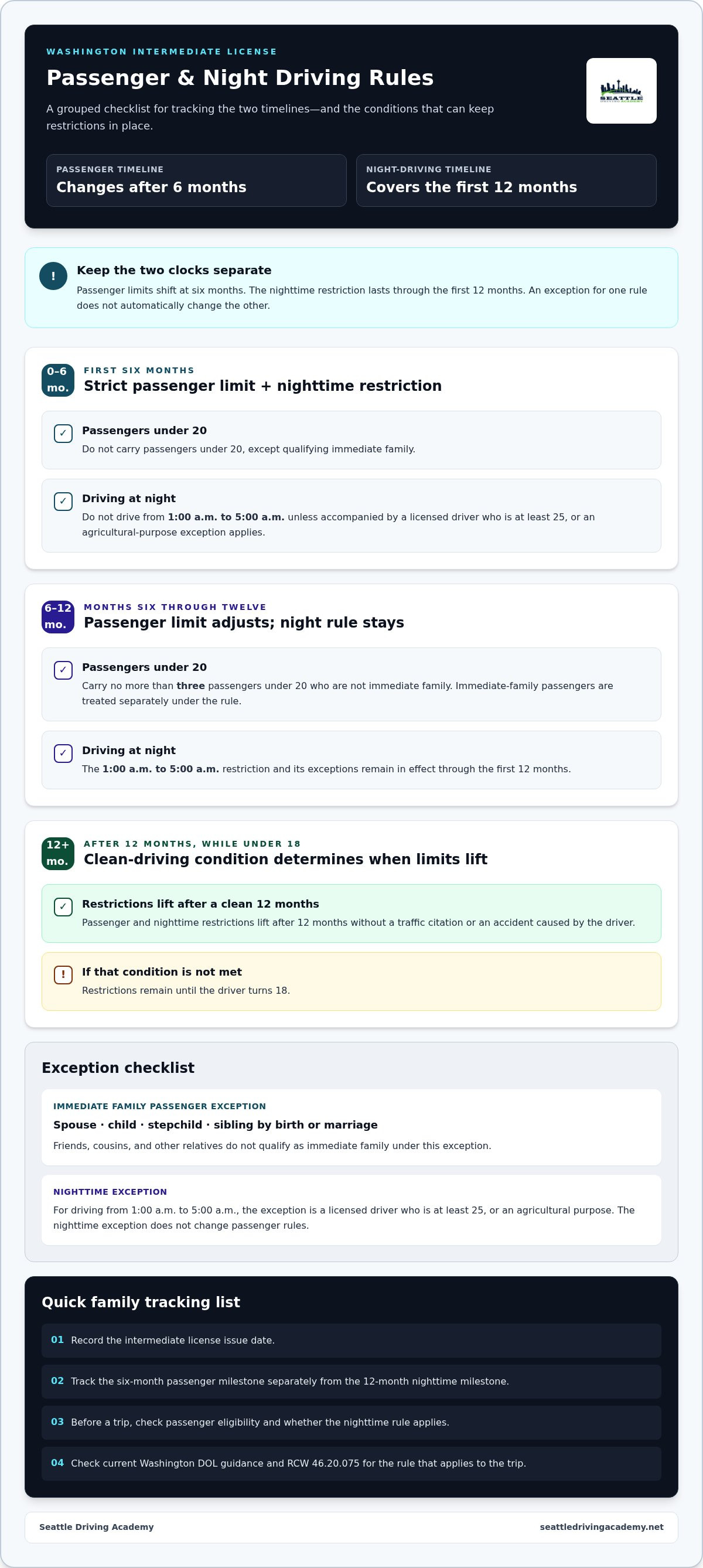
Track each rule separately. Passenger limits change at the six-month mark, while the nighttime restriction covers the first 12 months. This timeline summarizes the washington state intermediate driver's license restrictions. The controlling statute is RCW 46.20.075.
| Time with intermediate license | Passengers under 20 | Night driving |
|---|---|---|
| First six months | No passengers under 20, except immediate family. | No driving from 1:00 a.m. to 5:00 a.m., unless accompanied by a licensed driver age 25 or older. An agricultural-purpose exception also applies. |
| Months six through twelve | No more than three passengers under 20 who are not immediate family. | The same 1:00 a.m. to 5:00 a.m. restriction and exceptions remain in effect. |
| After 12 months until age 18 | Restrictions lift after 12 months without a traffic citation or an accident caused by the driver. Otherwise, they remain until age 18. | The nighttime restriction also lifts after 12 months without a traffic citation or an accident caused by the driver; otherwise, it remains until age 18. |
Who can ride with a teen during each restriction period?
During the first six months, the immediate-family exception is limited to a spouse, child, stepchild, or sibling by birth or marriage. It doesn’t include friends, cousins, or other relatives. From month six through month twelve, a teen may carry up to three passengers under 20 who aren’t immediate family. Immediate-family passengers are treated separately under the rule. If a planned trip depends on who qualifies, check the statute’s current wording.
When can a teen drive at night?
For the first 12 months, driving between 1:00 a.m. and 5:00 a.m. is prohibited unless the teen is accompanied by a licensed driver who is at least 25. This exception doesn’t specify a family relationship. An agricultural-purpose exception also applies. Passenger exceptions don’t change the nighttime rule.
In brief: passenger limits shift after six months, but nighttime limits last for the first 12 months. Both can remain until age 18 if the clean-driving condition isn’t met. Seattle families can pair this timeline with structured teen driver training.
Exceptions, Phone Rules, and What Happens If a Teen Breaks a Restriction
Each exception applies to a specific rule. A passenger exception doesn’t automatically allow late-night driving, and the nighttime supervision exception doesn’t change who may ride in the car. Before treating a trip as permitted under the washington state intermediate driver's license restrictions, identify the exact rule and exception that apply. See RCW 46.20.075.
Which exceptions may apply to intermediate drivers?
For passenger limits, immediate family means a spouse, child, stepchild, or sibling by birth or marriage. A friend or cousin doesn’t qualify simply because they’re close to the family. During the first six months, the exception allows those immediate-family passengers. After that, the later passenger limit applies to passengers under 20 who are not immediate family.
The nighttime exception is separate. During restricted hours, a teen may drive if accompanied by a licensed driver who is at least 25. An agricultural-purpose exception also applies. The passenger rule’s immediate-family exception doesn’t authorize nighttime driving, and the adult-supervision exception doesn’t expand passenger allowances. For an unusual trip, review current Washington DOL guidance and the statute.
Can a teen use a phone or face license consequences?
Drivers under 18 with an intermediate license may not use wireless devices while driving, including hands-free devices. The exception is using a device to report an emergency. Make phone use easier to manage by setting navigation and music before leaving, then storing the phone out of reach.
Consequences depend on the violation and the driver’s record. For a first violation of the intermediate-license passenger or nighttime restrictions, the parent or guardian receives a DOL warning letter, and those restrictions remain until the driver turns 18. A second violation can lead to a six-month suspension or suspension until age 18, whichever comes first. A third can result in suspension until age 18. After a suspension, a reissue fee is required in addition to other licensing fees.
A traffic citation or an accident caused by the teen can also affect when passenger and nighttime restrictions end. The clean-driving period is no longer met, so restrictions may remain until age 18. Not every collision or citation has the same licensing outcome. If your teen receives a citation, is involved in a crash, or faces a possible suspension, use current DOL information to understand their specific status.
A Practical Parent-Teen Checklist for Following Washington’s License Restrictions
A shared plan can turn the washington state intermediate driver's license restrictions into a few clear habits. Keep the rules accessible, talk through trips before they happen, and revisit the plan as your teen gains experience.
How to track restriction dates without confusion
Start with the license issue date. Passenger limits change after six months, while passenger and nighttime restrictions may continue until the teen turns 18 unless the clean-driving condition is met. Set calendar reminders for the six-month and 12-month marks, then confirm the teen’s current licensing status with Washington DOL before treating any restriction as ended.
Save or bookmark the relevant official guidance alongside your family driving plan. That makes it easier to review the current wording together when a planned trip raises a question.
- Record the license date. Write down the issue date and keep it where both parent and teen can find it.
- Mark the milestones. Add reminders for six months and 12 months, plus a reminder to verify when restrictions end.
- Review each trip. Before departure, consider who will ride, the planned return time, and whether any restriction or exception applies.
- Agree on the routine. Decide how to handle passengers, nighttime plans, phone storage, and adult supervision before the car leaves.
- Recheck after a change. If the teen receives a citation, is involved in a collision, or has a change in license status, review current DOL guidance rather than assuming the existing plan still applies.
How parents can support safe, legal independence
Make the family agreement specific. For example, have your teen share the passenger list and expected return time before a drive. Decide in advance who can accompany them when supervision is needed, and establish a phone-away routine before the vehicle moves. Clear expectations help teens make confident choices without guessing in the moment.
As your family builds its routine, the Seattle teen driving checklist offers additional planning ideas. For skill-building alongside your household plan, explore teen driver training in Seattle. Professional instruction can support safe decision-making, while Washington’s current rules remain the guide to what’s legally permitted.
Next Steps: Verify Rules and Build Teen Driver Confidence
Families can make the washington state intermediate driver's license restrictions easier to follow by keeping the timeline visible, separating passenger exceptions from nighttime exceptions, and checking current rules when a trip raises a question. A saved summary is useful, but it shouldn’t replace the latest official guidance.
Where should families confirm current Washington rules?
Use Washington State Department of Licensing guidance and RCW 46.20.075 as primary references. Check for updated wording and effective dates before relying on notes or calendar reminders, especially after a citation, collision, or change in license status.
This article provides general educational information, not legal advice or an individual licensing determination. For a question about a specific teen’s status, use current DOL information.
How can professional teen driver training help?
Training gives teens structured opportunities to practice observation, sound judgment, and safe driving habits. Those skills support confident decision-making, but instruction doesn’t change the legal restrictions attached to an intermediate license. The rules still determine which trips are allowed.
For more family guidance, read the Seattle teen driver training guide. It can help you consider how instruction fits into your teen’s learning journey.
Keep the plan simple: track the relevant dates, review who may ride and when your teen may drive, and check official guidance before relying on an exception. These habits help parents support growing independence while keeping expectations clear.
For added practice and support, explore teen driver training with Seattle Driving Academy. Structured instruction can help your teen build skills and confidence while your family follows Washington’s current licensing rules.
Help Your Teen Move Forward With Confidence
The washington state intermediate driver's license restrictions become easier to manage when your family tracks the timeline, separates passenger exceptions from nighttime rules, and checks current Washington DOL guidance when circumstances change. A clear plan can help your teen make responsible choices while gaining experience behind the wheel.
Driver education and license restrictions serve different purposes. Training helps build driving skills and judgment, while the state’s current rules determine what your teen may legally do. Use official guidance for questions about a specific license or situation.
Seattle Driving Academy offers structured teen driver training and DOL knowledge and driving skills testing. Supportive instruction helps new drivers keep developing the habits that make independence safer and more confident. Explore teen driver training in Seattle and help your teen take the next step.
Frequently Asked Questions
How long do Washington intermediate driver’s license restrictions last?
The washington state intermediate driver's license restrictions follow different timelines. Passenger limits change after the first six months, while the nighttime restriction applies for the first 12 months. Passenger and nighttime restrictions lift after 12 months without a traffic citation or an accident caused by the teen; otherwise, they remain until age 18. Washington DOL removes them at 17 if the teen has a clean driving record for 12 months, or at 18.
Can a teen with an intermediate license drive friends in Washington?
It depends on how long the teen has held the license and the friends’ ages. During the first six months, the teen generally can’t carry passengers under 20 unless they’re immediate family. During months six through twelve, the teen may carry up to three passengers under 20 who aren’t immediate family. After passenger restrictions lift, these limits no longer apply. Check current Washington DOL rules before a trip.
Can a Washington teen drive after midnight with a parent?
Only if the parent meets the nighttime exception: they must be a licensed driver who is at least 25 years old. For the first 12 months, an intermediate-license holder may not drive between 1:00 a.m. and 5:00 a.m. without qualifying supervision. A parent who is under 25 or unlicensed doesn’t meet that exception. A separate agricultural-purpose exception applies, but it isn’t general permission for late-night trips.
What happens if a teen violates an intermediate license restriction in Washington?
A first violation of passenger or nighttime restrictions brings a warning letter to the teen’s parent or guardian, and those restrictions remain until the driver turns 18. A second violation can result in suspension for six months or until age 18, whichever comes first. A third can result in suspension until age 18. Outcomes depend on the violation and circumstances, so use Washington DOL information to understand an individual licensing status.
Can teens use hands-free phones while driving in Washington?
No. An intermediate-license holder under 18 may not use wireless devices while driving, including hands-free devices. The exception is using a device to report an emergency. Set navigation before leaving, silence notifications, and put the phone out of reach before the vehicle moves. If you’re unsure how the rule applies, review current Washington DOL guidance.
Do Washington intermediate license restrictions end when the driver turns 18?
Yes. Restrictions are removed when the driver turns 18 if they haven’t already ended. They may lift at 17 after 12 months without a traffic citation or an accident caused by the teen. Because the timeline and the teen’s record matter, don’t rely on a calendar estimate alone. Check Washington DOL guidance to verify the driver’s current status before assuming a restriction has ended.
What are the passenger rules during the first six months of an intermediate license?
During the first six months, a teen generally may not carry passengers under 20, except immediate family. The exception covers a spouse, child, stepchild, or sibling by birth or marriage; it doesn’t include friends or unrelated passengers. These passenger rules are separate from the nighttime supervision exception. Seattle families can record the license issue date and review current DOL guidance together before planning a ride. For structured instruction and practice in Seattle, explore teen driver training with Seattle Driving Academy.


